Two Sahuarita Retail Pads Sell to Circle K & Taco Bell
La Jolla Verde Circle K site
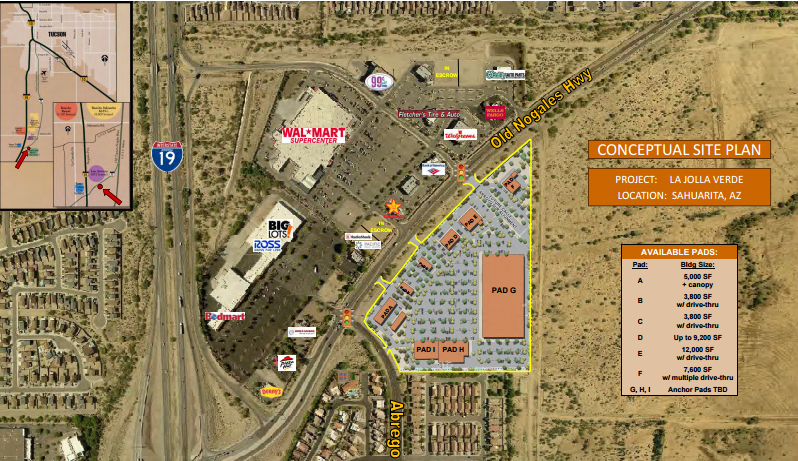
Circle K Stores of Tempe, AZ purchased a 57,935-square-foot retail pad at La Jolla Verde Commercial Center in Sahuarita for $1 million ($17.30 PSF). This will be the first pad construction at this new retail center located southeast of I-19 on Old Nogales Hwy near the full diamond interchange.
This core retail intersection for Sahuarita with a Super Walmart-anchored center directly across from it. This Walmart center also has Ross Dress for Less, Big Lots, Wells Fargo, Walgreens, Bank of America, 99 Cent Only, and other national retailers.
Brenna Lacey with the Volk Company in Tucson represented the seller, La Jolla Verde Land Holdings, LLC of Los Gatos, CA.
Kurt Maes with Scarbrough & Associates in Phoenix represented Circle K in the acquisition.
To learn more Lacey should be reached at 520.326.3200 and Maes can be contacted at 602.774.4243,
* * * * *
Rancho Sahuarita, Taco Bell Site
In a second unrelated transaction, a 42,047-square-foot retail pad (lot 3 block 45) in Rancho Sahuarita, Sahuarita, AZ sold to Gen2Properties, LLC dba Taco Bell for $895,000 ($21.29 PSF).
Located at the southeast corner of I-19 and Sahuarita Road, Taco Bell with join McDonalds, Shell, United States Post Office, and Pima County Public Library.
A growing bedroom community, Sahuarita is only 15 minutes to Tucson Airport and 45 minutes to Nogales and Mexico.
Rob Tomlinson, Retail Specialist with Cushman & Wakefield | Picor of Tucson represented the seller, RSMC VI, LLC and Aaron LaPrise, Retail Specialist with Cushman & Wakefield | Picor represented the buyer.
To learn more Tomlinson should be contacted at 520.546.2757 and LaPrise can be reached at 520.546.2770.
For additional information see RED Comp #2849 and #2850.
Land Sale, Buyers Move forward on New Industrial Building in Tolleson
Mattress Firm Rendering (phot courtesy of Colliers)
Daum Signs Mattress Firm as First Tenant
PHOENIX, AZ – Colliers International in Greater Phoenix recently completed the sale of 21.2 acres of land in Tolleson, where a 386,100-square-foot cross dock distribution building is to be completed by December of this year.
First Industrial Realty Trust Inc., a Chicago-based publically-traded REIT, purchased the land and teamed up with Merit Partners Inc. of Phoenix to develop the site, located at the northeast corner of 94th Avenue and Buckeye. First Industrial will be the 100% owner of the building and expects to invest a total of $21.1 million in the facility.
The transaction was negotiated by Payson MacWilliam and Don MacWilliam, executive vice presidents, and Jimmy Leaf, associate, with Colliers International.
The development team is headed by Kevin Czerwinski, president of Merit Partners and a 30-year veteran of commercial real estate in the Valley. Prior to founding Merit Partners, Czerwinski led the Phoenix region for First Industrial and was responsible for the acquisition, development and sales of more than $1.2 billion of industrial and flex properties.
Sun State Builders of Tempe will construct the Class A building. It will offer 36-feet clear height, cross dock configuration and state-of-the-art features.
Mattress Firm has signed a long-term lease for 170,000-square-feet represented by Daum Commercial Real Estate Services of Phoenix’ Steve Bodeman, executive vice president of Daum in association with Damian Rivera, president of national account services for E Smith Realty Partners of Dallas. Mattress Firm will take occupancy of its lease upon the building’s completion.
Colliers represented the owner, First Industrial Realty Trust, in the lease transaction. The remaining 216,000-square-feet is available to lease.
“The timing of the new building was perfect for Mattress Firm’s expansion from their current location right next door,” said Bodeman. Payson MacWilliam added, “The development team was creative to allow this lease to occur.”
Merit Partners specializes in acquisitions, development, asset repositioning, leasing, operations and sales of industrial, flex and office properties. First Industrial Realty Trust owns and has under development more than 64 million square feet of distribution centers and other industrial facilities in the nation’s top markets.
Tolleson Land Sale (photo courtesy of Colliers)
New Puerto Peñasco cruise port expected to boost economy
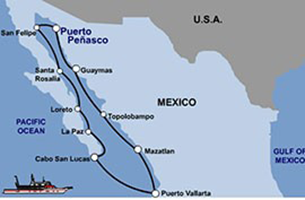
Proposed destinations shown along cruise ship’s route (photo courtesy of Sandy Beach Resorts) CLICK TO ENLARGE
By Carina Dominguez WALTER CRONKITE SCHOOL OF JOURNALISM AND MASS COMMUNICATION AT ARIZONA STATE UNIVERSITY
The sound of heavy machinery scraping against rocks and an overwhelming smell of diesel fuel invade an otherwise serene desert beach where Mexico will spend roughly $100 million building its first cruise ship home port.
The Mexican government chose to build the port in this sleepy beach town ¬¬– better known as Puerto Penasco or Rocky Point ¬ – because of its proximity to the United States and potential to become an international tourism destination.
“It is the most important project the city has ever had,” said Miguel Guevara, director of promotion and international affairs for the city.
Construction workers spend their days dumping rocks, making concrete blocks and placing them along the breakwater to prepare the port for a January 2017 opening.
Officials said they hope the roughly mile-long port will tap into the growing cruise ship industry by offering passengers an opportunity to explore the Sea of Cortez.
Supporters said the port could attract 3,000 new weekly visitors and transform the city’s economy.
However, critics said the port could have a harmful impact on local residents, wildlife and biodiversity.
Why Rocky Point?
Rocky Point is about 200 miles southwest of Phoenix and Tucson in Sonora, Mexico, along the Gulf of California. Some have nicknamed the town “Arizona’s beach” because it’s a three and half hour drive from both cities.
Tourism in the town, historically driven by fishing, is increasing with a majority of the town’s visitors coming from Arizona.
Rosie Glover, a co-founder of the Rocky Point Tourism and Visitor Assistance Office, said the increase in tourism has been “surprisingly dramatic and not gradual at all.”
Guevara said tourism dropped after the 2009 recession and although the city has not fully recovered, some have seen impressive gains.
“For the last six months or more, we’ve been busy every single week,” Glover said.
Residents said there’s been talk around the town about the home port for decades, but many people didn’t take it seriously until recently, after construction began in December 2013.
The government has already spent roughly $40 million on the port, which is about 50 percent completed, Guevara said.
Mexican authorities support the project because it will benefit the entire country’s economy, said Jose Luís Castro, director of port operations for the Sonoran government’s tourism department.
Castro said money would flow into cities situated on the cruise ships’ routes, like San Felipe, Cabo San Lucas and Mazatlan.
Joe Houchin, who has followed the cruise industry for decades, said the cities have opportunities for repeat visitors because 80 percent of cruise goers choose land vacations based on the destinations they visit on a cruise trip.
Castro said millions of the country’s residents want to take a cruise, but don’t have visas – leaving that market largely untapped.
In addition, officials hope to attract millions of international visitors annually.
“Our main market is and will always be Arizona, but the home port will bring people from other states to come and start their trip on the Sea of Cortez,” Guevara said.
The proximity to the U.S. made the town an ideal location for the home port, said Gustavo Brown, owner of Sandy Beach Resorts.
“With half a tank full of gas, you’ve got a whole family at the destination,” Brown said of Arizonans.
Brown donated 12 acres of land for the construction of the home port and terminal on Sandy Beach, just west of the tourist strip.
“Our dream is to create a mega tourist resort in which we could have people from all around the world to come see us,” Brown said.
Port will open up new cruise route
Hotels and condominiums line a strip of oceanfront property, distinguishing the town as a tourist destination except Rocky Point is on a much smaller scale compared to cities like Cancun and Acapulco.
Although other resort towns serve as popular ports of call for cruise ships, Rocky Point’s home port will serve as a departure and arrival point for passengers.
It will start small and eventually host 3,000-passenger ships. Officials said they brought in the best contractors in the world for the project, which will include a state-of-the-art terminal and convention center.
Guevara said he hopes the port will provide a catalyst for new projects in the town.
“We’re like 20 years behind (Puerto) Vallarta and 30 behind Cancun, but yeah, why not?” Guevara said. “We are closer to the U.S. than anywhere else, so why not? That’s a good dream.”
He said this is the first test to see what Mexico can do with the cruise industry.
“There’s a need for new routes for cruises,” Guevara said.
Passengers would get a unique view of the uncharted waters of the Sea of Cortez, Castro said.
“The cruise liners also suggested (the home port) because it’s an area where they haven’t exploited,” Project Administrator Wendy Winzer said.
Houchin said some cruise goers have seen the same routes dozens of times and the growing industry needs to offer new destinations.
In 2009, about 17.8 million people took cruises. In 2013, that number grew to 21.3 million passengers, according to Cruise Lines International Association, an industry association.
Last year, major cruise lines added 22 new ships, which made room for 20,000 more beds, according to the association’s website.
Houchin, who lives in Puerto Peñasco, said cruise liners are building bigger ships to accommodate the increasing passenger volume.
“They will send the smaller ones to more exotic destinations, such as Puerto Peñasco, we hope,” Houchin said.
Houchin writes a monthly economic impact blog about the home port for the Sandy Beach Resort. He said people should expect major airlines to begin applying for landing rights at the Puerto Peñasco International Airport.
Major cruise liners did not respond to requests for comment but Castro said authorities are in contract negotiations with several liners – including Carnival, Princess, Royal Caribbean and Holland America.
However, some cruise liner officials expressed concerns over the small town’s ability to accommodate an influx of visitors.
If tourism swells to the level officials hope, the city will need to improve hotels, roads and airport accesses, Castro said.
“I think the city is not ready yet,” Guevara said.
However, Guevara said the infrastructure and supplies would be ready by the time the port opens.
“We can bring all the components together really fast,” he said.
Home port brings jobs, potential development
Those involved with the project said the port will have an economic impact on both sides of the border and bring in much-needed jobs to the area.
“Puerto Peñasco is the closest beach to El Paso, Texas,” Brown said.
He said the home port presents economic opportunity for Arizona because tourists would drive through the state to get to the port.
“We are in the same region. What’s good for Arizona is good for Sonora, what’s good for Sonora is good for Arizona,” Guevara said.
Once the home port opens, it will generate about 2,500 direct jobs and 5,000 indirect jobs in the first two years of operation, Guevara said.
And the project has brought construction jobs as well.
Winzer said there are nearly 100 people working on the port.
“It’s been a good thing because a lot of people really needed the work,” Winzer said.
She said many are working around the clock, in two shifts, making the concrete cubes that are the foundation of the structure. There’s a possibility of more 24 hours shifts if they need to increase production, she said.
Mary Snyder, director of sales and marketing for Puerto Privada Luxury Waterfront Condominiums, said when it opens, the port would send property values soaring in the town of 60,000 people.
She said this would be a good thing for the thousands of Arizonans who own properties in the area.
Guevara and Snyder said the hikes would not affect local residents because increases would apply to beachfront properties, which many locals already can’t afford.
“There’s a lot of wildlife that’s actually coming in that wasn’t in that area,” Hill said. “But will that stay there when the ships actually come in, and there’s traffic in that area?”
Workers have spotted many whales, dolphins, seals and locals watching construction on the port.
Everyone is curious to see what happens on Sandy Beach.