SimonCRE hits 200 projects in its 10th anniversary year
Joshua Simon, Founder & CEO, SimonCRE
SCOTTSDALE, ARIZ. – SimonCRE, a national commercial real estate development and acquisition firm, recently hit a notable milestone – completing its 200th project during its 10th anniversary year.
The Scottsdale-based company, founded in 2010 by CEO and Founder Joshua Simon, has completed 200 projects across 22 states totaling more than $400 million.
The timing of this closing is significant because it occurred during an exceptionally rough climate for the retail sector in 2020. Against all odds, SimonCRE has completed more than 40 projects totaling over $200 million in this year alone.
The 200th deal was a 7,200-square-foot Big O Tires at Laveen Village, 4808 W. Baseline Road, in Phoenix (Laveen).
“With all the challenges surrounding the retail sector – especially now – we’re proud to have hit our 200th deal after a decade and are grateful to still have about 50 projects planned for 2021,” Simon said.
A decade ago, SimonCRE started at “ground zero” without partners or investors and built its way up through its projects and reputation with a main core value in mind: Be First. Be Fast. Persist. The company began with just one employee and has increased the staff by more than 50 percent since 2019. Today, SimonCRE totals 42 employees and continues to grow.
Mainly recognized for its single-tenant, build-to-suit properties, SimonCRE has recently adapted its business model to accommodate expansion and current demands of the market. Other property types SimonCRE has been successful in completing include multi-tenant retail centers, medical office buildings and RV storage facilities. Its client roster comprises more than 100 local and national tenants.
Recent projects:
The Steelyard, a 4.03-acre, 26,300-square-foot ground up multi-tenant building in Chandler, Ariz. Tenants include Pita Jungle, Jersey Mike’s, Someburros, High Tide Seafood Bar, F45 Training, Athletico, Heartland Dental, Tan Max, and Nail Logic.
Simon Medical Plaza, a 2.51-acre, 32,000-square-foot ground up medical office building in Phoenix (Laveen). Tenants include Empower Physical Therapy, Laveen Total Eyecare, Mark T. Evans Dentistry, MVP Kids Care, Stewart Chiropractic, and SMI Imaging.
The Shops at Prasada Village, a 2.14-acre, 10,850-square-foot ground up retail center in Surprise, Ariz. Tenants include Sleep Number, Pacific Dental Services, BackFit Health & Spine.
RV & Boat Storage, an 11.03-acre at 6455 S Wilmot Road for an Ameripark Covered Storage in Tucson, Arizona.
Jackrabbit Ranch Marketplace, a 13.5-acre ground up retail center in Buckeye, Arizona.
“As we celebrate our 10th anniversary and 200th deal, we reflect on how our strategy has become even more laser-focused on growth, acquisition and expanding our team with the right core values,” Simon said. “I believe that is a big part of what led to our success today and will continue to push us forward.”
Fourth Quarter 2020 Forecast Update
By George W. Hammond, Ph.D., Director and Research Professor, EBRC
If you missed the virtual 2020Eller Economic Outlook last Friday, no worries! The video of the entire event on Arizona’s Economy is posted here.
The Arizona recovery continued in the third quarter, although at a much slower pace than during the April-June period. The state has received a significant boost from the CARES Act, with just over $40 billion in federal funds flowing to the state in the second quarter. That supported taxable sales and boosted the recovery in retail trade, warehousing, and transportation jobs. While construction employment rose modestly from June to October, housing permits surged, rising almost one-third over the year in the third quarter.
The outlook for Arizona remains unusually uncertain and continues to be dominated by the pandemic. The baseline forecast assumes that the outbreak recedes from summer highs, but remains elevated. It also assumes significant federal stimulus in the fourth quarter of 2020. Under these assumptions, the state is forecast to return to pre-pandemic employment levels by mid-2021. The pessimistic scenario projects a slower recovery, with the state returning to its prior peak at the end of 2021.
Arizona Recent Developments
Arizona added 55,600 jobs (seasonally adjusted) from June to October. Trade, transportation, and utilities added the most jobs during the period, followed by professional and business services; government; education and health services; leisure and hospitality; construction; other services; financial activities; and information. Manufacturing jobs were stable, while natural resources and mining jobs fell slightly.
Overall, the state has now replaced 193,900 of the 294,600 jobs lost from February to April, for a 65.8% replacement rate. The nation has replaced 54.5% of the jobs lost from February to April.
Note that the state needs to add 100,700 jobs to return to pre-pandemic employment. If the state can continue to add nearly 13,900 jobs per month on average, as it has since June, then employment will be back to pre-pandemic levels next June. However, that may be a difficult pace to maintain, since over-the-month job gains averaged 6,200 during 2015-2019.
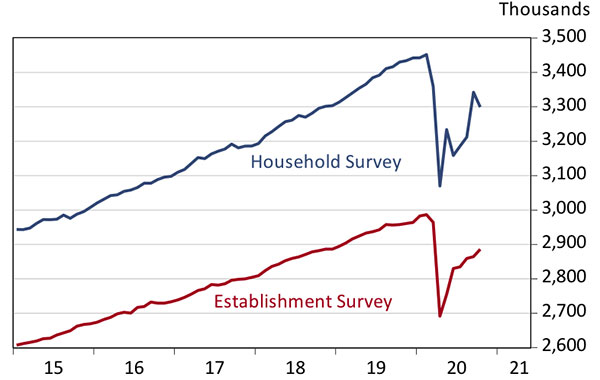
Exhibit 1 shows seasonally-adjusted employment from both the establishment and household surveys. As the exhibit suggests, we have a long way to go to replace the jobs lost during the spring.
Seasonally-adjusted employment measured by the household survey experienced a huge jump in September that was not reflected in the establishment survey. These data are always volatile during the current year and seem to be even more volatile than usual this year. This may be related to reduced survey response rates during the pandemic.
Exhibit 1: The Jobs Recovery in Arizona Has A Long Road Ahead Employment Measured by the Establishment and Household Surveys, Seasonally Adjusted
The household survey also generates estimates of the state unemployment rate. These estimates have also been very volatile, with the seasonally adjusted state rate falling from 10.7% in July to 5.9% in August then back up to 6.5% in September and 8.0% in October.
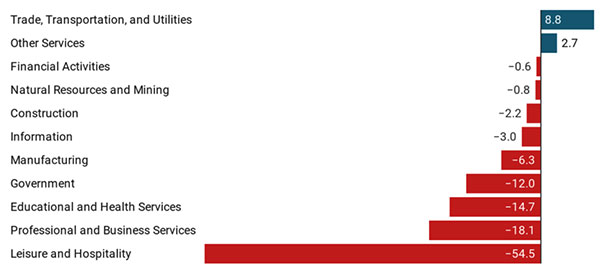
The travel and tourism sector continues to struggle with the impact of the pandemic. As Exhibit 2 shows, leisure and hospitality jobs in October were 54,500 below February. Through October, jobs at eating and drinking places have recovered much faster than jobs in accommodation or arts, entertainment, and recreation. Employment at eating and drinking places was down 9.7% in October, compared to -29.4% and -34.3% for accommodations and arts, entertainment, and recreation.
Exhibit 2: Arizona’s Leisure and Hospitality Sector Remained Hardest Hit from February 2020 to October 2020 Thousands, Seasonally Adjusted
From February to October, jobs in professional and business services were down 18,100, reflecting losses in employment services (temporary help). These jobs are very sensitive to the business cycle.
Employment in education and health services declined by 14,700 from February to October, reflecting large declines in health care and social assistance (although education jobs were down as well). Job losses in health care and social assistance were fairly evenly distributed across social assistance, ambulatory health care, nursing and residential care facilities, and hospitals.
Two sectors posted more jobs in October than February: other services and trade, transportation, and utilities. Job gains in trade, transportation, and utilities were driven by transportation, warehousing, and utilities. Retail and wholesale trade jobs were up slightly.
Arizona’s personal income skyrocketed in the second quarter of 2020, thanks to the CARES Act. State personal income rose 11.6% over the year, driven by a 62.2% increase in transfer receipts. Net earnings by place of residence fell by 0.8% and income from dividends, interest, and rent fell by 1.3%.
According to estimates from the U.S. Bureau of Economic Analysis, the CARES Act pumped $40.2 billion into Arizona in the second quarter. The largest contribution came from the Economic Impact Payments (Recovery Rebates), which added $23.4 billion to state income. Absent CARES Act funds, Arizona’s personal income would have declined by 3.8% (or -14.4% annualized) from the first to the second quarter.
While construction jobs have weakened during the pandemic, housing permit activity has surged. Preliminary seasonally adjusted housing permit data suggest that statewide total permits were up 25.2% year to date through October compared to last year. Even so, house prices continue to rise at a rapid pace.
Arizona Outlook
The forecast for Arizona depends on global and national economic performance. The current state and local forecasts rely on the October 2020 U.S. forecast generated by IHS Markit, which was based on the following assumptions:
COVID-19 infections and deaths recede from July levels, but remain elevated. This creates stop-and-go openings by states. A vaccine is assumed to become widely available in mid-2021.
The forecast includes current federal fiscal policy actions and assumes legislation enacting a $300/week unemployment insurance supplement from October through December. Further, the forecast assumes $270 billion in stimulus checks are disbursed in the fourth quarter of 2020. As of this writing, it does not appear that this assumption will be met, which suggests that the baseline projections may be too optimistic.
The Federal Reserve maintains its policy rate near 0% until late 2026. Real foreign GDP contracts by 6.7% in 2020. Growth rebounds to 4.4% in 2021.
The current baseline forecast calls for a sharp rebound in real GDP growth in the third quarter, but the level remains well below the pre-pandemic peak. Thereafter, growth decelerates significantly as the current durable goods spending overshoot unwinds, fiscal stimulus fades out in 2021, and the pandemic accelerates this winter.
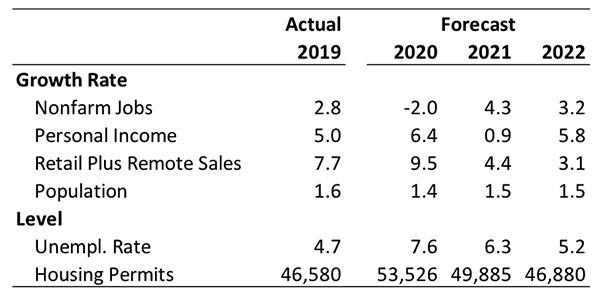
The national forecast sets the stage for Arizona’s recovery, summarized in Exhibit 3. In the baseline, state jobs are expected to decline by 2.0% in 2020, on an annual average basis. Jobs rebound in 2021, rising 4.3%, followed by 3.2% growth in 2022.
Exhibit 3: Arizona Outlook Summary
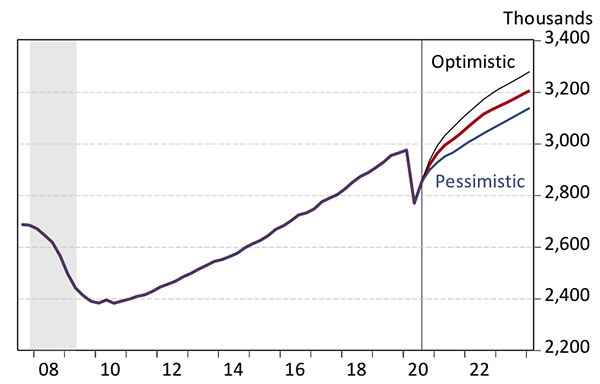
On a quarterly basis, the baseline forecast calls for Arizona jobs to return to their pre-pandemic peak in the second quarter of 2021. Keep in mind that this assumes a major federal fiscal stimulus package in the fourth quarter of 2020. The pessimistic scenario envisions a slower recovery, with state jobs reaching pre-pandemic levels at the end of 2021.
Overall, Arizona population growth is forecast to hit 1.5% in 2021 (fiscal year basis) and then gradually decelerate as the aging of the baby boom generation raises deaths while births stabilize and recover weakly.
The combination of remote sales with traditional retail beginning at the end of 2019 artificially boosts growth in the combined category in 2020. The forecast calls for growth in the retail plus remote sales sector to rise by 9.5% in 2020, then decelerate to 4.4% in 2021 and 3.1% in 2022.
The baseline forecast calls for nonfarm payroll jobs in Phoenix to decline by 2.0% in 2020, then rebound with growth of 4.0% in 2021 and 3.3% in 2022. Maricopa County generates the bulk of the job gains for the metropolitan area during the next decade. However, job gains in Pinal County are expected to be robust, in part driven by expanding auto/truck manufacturing in the county.
The Tucson metropolitan area also generates a solid recovery from the pandemic. Tucson nonfarm payroll jobs are forecast to decline by 3.2% in 2020. Growth returns in 2021 with a 3.4% increase, followed by 2.1% growth in 2022.
Risks to the Outlook
The risks to the outlook primarily revolve around the progress of the outbreak. Exhibit 4 shows three scenarios for Arizona nonfarm jobs.
The pessimistic scenario assumes that the progress of the outbreak is less controlled than under the baseline, with large negative impacts on consumer spending, particularly services. The result is a slower recovery. Under this assumption, Arizona jobs return to their pre-pandemic peak in the fourth quarter of 2021.
The optimistic scenario assumes a less threatening progression of the outbreak, with correspondingly faster gains in consumer spending. The result in this case is faster growth in the near term. Under this assumption, Arizona jobs return to their pre-pandemic peak in the first quarter of 2021.
Exhibit 4: Arizona Jobs Take Longer to Recover Under the Pessimistic Scenario Three Scenarios for Arizona Nonfarm Jobs
Need more information about the outlook for Arizona, Phoenix, and Tucson? Email George Hammond .
Cushman & Wakefield Advises Sale of Carefree Covered RV Storage Property in Chandler, AZ
Property to become largest covered RV Site in state following $4M improvements
PHOENIX, Ariz.– Cushman & Wakefield announced today the firm has represented Carefree Covered RV Storage, a division of Business Property Trust, in its acquisition of a 23-acre facility in Chandler, Arizona, that will become the largest covered RV site in the state.
Paul Boyle, Executive Director with Cushman & Wakefield’s Self Storage Advisory Group in Phoenix represented the buyer in the transaction. M&T Bank provided the acquisition financing.
RV SuperStorage, as it is currently known, offers 594 covered, enclosed and open-air parking spots, in addition to 53 storage units. It is regarded as a top-quality RV storage facility with wide name recognition in the Phoenix metro area. The high-profile location along Interstate 10 has a volume of over 200,000 cars a day.
Upon acquisition, the property will undergo more than $4 million in improvements, including the addition of 450 new covered parking stalls, security upgrades and a complete renovation of the office/welcome center.
“We are ecstatic about our newest Carefree Covered acquisition,” said Barry Raber, BPT’s president and chief executive officer. “When done, this will be the largest covered RV storage property in Arizona. We hope to become a destination location for RV storage and are pleased to be building our brand with this opportunity.”
The Chandler site joins its sister property, in Apache Junction, as the second in the Carefree Covered RV Storage portfolio. The new property is located within Lone Butte Development Park, established by the Gila River Indian Community to economically develop the area.
Carefree Covered RV Storage is seeking additional all-RV storage properties to expand its brand in the Phoenix and Dallas, Texas, metropolitan areas. For more visit www.carefreecoveredrvstorage.com.
The Cushman & Wakefield Self Storage Advisory Group is a full service real estate platform dedicated to the self storage asset class. The group offers investment advisory, valuation, consulting, feasibility and data services in all major markets in the U.S.

 Property to become largest covered RV Site in state following $4M improvements