PHOENIX, ARIZONA – Wednesday, Medistar Corporation, GMH Communities (“GMH”), and CBRE Investment Management (“CBRE IM”) were joined by Phoenix Mayor Kate Gallego, Vice Mayor Laura Pastor, Councilwoman Yassamin Ansari, and an audience of business and community representatives,to celebrate the ceremonial groundbreaking of Central Station, a dynamic one-million-square-foot mixed-use development that will sit adjacent to Civic Space Park and Arizona State University’s Downtown Phoenix Campus.
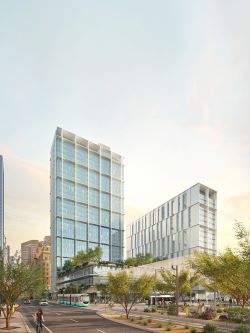 Designed to merge seamlessly with the existing transit station to create a bustling urban hub, Central Station will establish two residential towers, 30,000-square-feet of retail space focusing on food-oriented concepts; 70,000-square-feet of state-of-the-art flexible creative office space; and two levels of below-grade parking with 430 spaces.
“Downtown Phoenix is a rising hot spot, and Central Station sets a new standard for transit-oriented development elevating the vibrancy of our city,” said Mayor Gallego. “The care and thoughtful design set a tone for the City’s future. It’s projects like this that are among the reasons more people choose Phoenix as their new home than any other U.S. city.”
One tower, a 22-story student housing building will be fully furnished and comprised of 655 beds. Fostering a collaborative living environment, the development will be equipped with smart technology, amenities, and services designed to meet the unique needs of urban residents. This component of the Central Station development will also feature a diverse array of residential options ranging from micro studios to four-bedroom units, catering to undergraduate and graduate students, as well as young professionals.
The second,a 33-story residential tower,includes 362 units and features smart-tech throughout. All residents will have access to an outdoor amenity deck that includes barbeque grills, fire pits,and a resort-style pool.
“At GMH, we have been actively pursuing opportunities to expand our footprint and develop Class-A, smart-tech apartment communities across the country,” said Steve Behrle, Chief Development Officer of GMH. “With Central Station, our plan is to transform Downtown Phoenix, providing students the local workforce with the living accommodations necessary to support their unique live-work-play-learn-thrive lifestyles.”
“Downtown Phoenix is an entirely different place today than it was just five or six years ago. It is a vibrant urban hub,” said Phoenix Vice Mayor Pastor. “Every week, new restaurants are opening. New tenants are filling apartments downtown four times faster than anywhere else in the Valley. Central Station is a community that brings even more vibrancy to downtown with diverse housing choices and a variety of uses to meet the needs of those living and working in Downtown Phoenix.”
“With Downtown Phoenix booming, Central Station is the centerpiece we need and deserve,” Councilwoman Ansari said. “Mixed-use, pedestrian-oriented, and aesthetically pleasing projects with a range of units that include workforce-priced housing are exactly what a city of our stature should be building and encouraging. I cannot wait to see this project completed and bring even more vibrancy to the center of our city.”
Central Station, which is slated to open in 2024, will reimagine the city’s primary downtown bus and light rail transit center that serves two million passengers annually. It will also link to the city’s Civic Space Park in a unified public space for the vibrant heart of Phoenix. Poised to capitalize on the development’s strategic location, Central Station keys off robust transit ridership and proximity to the urban core of the fifth-largest city in the United States.
Central Station is a public-private partnership with the city of Phoenix retaining ownership of the land and the development partners entering into a long-term lease for the project. The project was designed by Gould Evans, and Layton Construction will serve as general contractor.
“Central Station is ideally positioned to benefit from the expanding knowledge cluster formed by the Phoenix Bioscience Core and ASU’s downtown campus,” said Ben Green, Managing Director, Residential Transactions, CBRE Investment Management. “It fits well within our fund’s ‘Eds and Meds’ investment theme as a premier rental option catering to the substantial, growing demand generated by higher education and life science employment.”
“Central Station will be a vibrant, pedestrian-friendly addition to downtown Phoenix with its densely landscaped pathways,” said Monzer Hourani, CEO of Medistar. “Its connection to Civic Space Park will provide another amenity bringing people together to experience events, dining, music and green space.”
PHOTOS: Courtesy of Gould Evans, the project’s architect.
 PHOENIX, ARIZONA – NAI Horizon facilitated the sale of an IT firm’s industrial asset, then helped find the client a smaller warehouse and office space in a highly desirable uptown business plaza.
 TUCSON, Ariz.– The University of Arizona Center for Innovation (UACI) held a grand opening yesterday to celebrate its new startup incubator at Biosphere 2, which supports renewable energy and sustainable tech startups.
 The transit-oriented development will introduce apartments, student housing, office, and retail space offering a vibrant urban hub adjacent to Arizona State University’s Downtown Phoenix Campus