Arizona’s Permit Freedom Act Shaved Time Off Homebuilding Process — But Housing Crisis Persists

(July 10, 2025) — The 2023 Permit Freedom Act (PFA) was designed to speed up Arizona’s notoriously slow housing development pipeline. And while it has reduced permitting delays, a new report from the nonpartisan Common Sense Institute (CSI) confirms that the state’s housing market remains deeply constrained by supply shortages, affordability challenges, and lagging construction activity.
CSI found that since the PFA’s passage, permitting and development timelines have improved between 7.1% and 17.7% across seven major Arizona cities. Residential building permits, in particular, saw a notable drop in approval times, from 200 days in 2022 to 126 days in 2024. But despite these improvements, it still takes more than 300 days on average to go from permit to final inspection, and housing production has not kept pace with demand.
“Cities are making an effort to speed up the pipeline, but the PFA played a key role in tightening review timelines and limiting excessive oversight,” said Glenn Farley, CSI’s Director of Policy & Research. “That said, we’re still not building fast enough to meet demand.”
New housing permits issued in Q1 2025 are down 21.5% compared to the same quarter in 2024, with CSI forecasting fewer than 48,000 permits statewide this year—the slowest pace since 2019. At this rate, Arizona will fall further behind on its growing housing shortfall.
A Statewide Housing Deficit
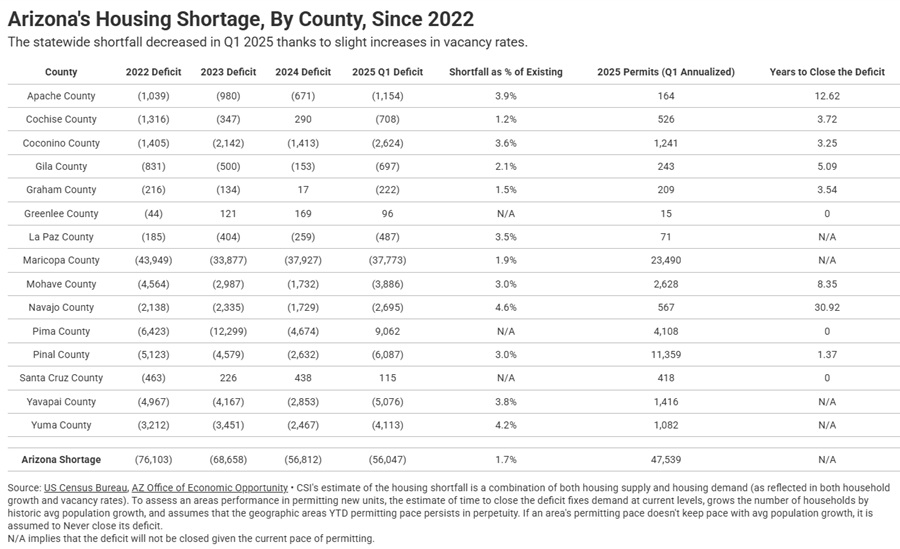
Arizona currently faces an estimated “instantaneous” housing shortage of 56,047 units, only slightly improved from 2024’s 56,812-unit deficit. On a cumulative basis—tracking long-term construction versus population growth—the shortfall is even greater, at over 121,000 units.
The effects are clear in both prices and accessibility. As of April 2025, the average home in Arizona costs $434,797—nearly 54% higher than in 2019. Mortgage rates hovering near 6.8% have more than doubled monthly mortgage costs compared to late 2019. According to CSI, it now takes a household income of $96,490 to afford a median-priced home.
CSI’s Homebuyers Misery Index—tracking the combined burden of high home prices and interest rates—remains elevated at 105.3. Conditions are worse now than during the pre-2008 housing bubble, Farley said, because prices have not corrected even as rates have surged.
Pima County: A Mixed Picture
While much of Arizona struggles to close the housing gap, Pima County may be a rare bright spot, at least temporarily. According to the latest CSI Housing Report Card, the Tucson metro area has moved from a 4,674-unit deficit to a 9,062-unit surplus, driven largely by a spike in vacancy rates.
This shift boosted Pima County’s permitting-to-shortfall grade from a “D” to an “A.” However, CSI warns that the change may be statistical noise, not structural improvement. The county issued just 9,504 permits in 2024, and analysts believe the dramatic swing could reflect lower demand rather than meaningful supply growth.
Even so, if permitting holds steady and demand remains soft, Tucson could avoid the severe affordability pressures seen in Maricopa County, where the deficit now exceeds 37,000 units and permitting activity has sharply declined.
Homebuilders: Still Facing Regulatory Burdens
Despite the progress from the Permit Freedom Act, homebuilders continue to face challenges. CSI estimates that regulatory compliance can add up to one-third of the cost of a $300,000 home. Builders must often secure 40 to 50 permits per subdivision, a process that remains “cumbersome” and “very difficult,” according to Spencer Kamps, VP of Legislative Affairs for the Home Builders Association of Central Arizona.
Kamps said delays can cause builders to re-market entire subdivisions to new buyers, adding further cost and uncertainty. He credited the PFA with helping at the local level but emphasized that deeper reforms are still needed.
Outlook: Slowing Supply, Soaring Costs
While sellers have recently begun to outnumber buyers—pushing some prices down slightly—CSI warns that the core problem remains: there isn’t enough housing. With new home construction declining and many existing homeowners “locked in” by lower mortgage rates, inventory remains tight.
To keep pace with growth, Arizona needs to build nearly 50,000 homes annually. At current permitting levels, the state is forecast to deliver just over 43,000. CSI estimates that reducing permitting and development timelines by 25% through 2035 could result in 100,000 additional homes, nearly 50,000 new jobs, and an 11% decrease in home prices.
For now, however, Arizona’s housing crisis remains unresolved—even as permitting speeds up. The state earned a “D” on CSI’s Q1 2025 Housing Report Card, down from a “C-” the year before. Without faster permitting and more aggressive homebuilding, supply will continue to lag, and affordability will remain out of reach for thousands of Arizonans.
For more information, see Despite Short-Term Buyer Relief, Declining Permitting Activity Threatens to Exacerbate Arizona’s Housing Shortage