Arizona cities on verge of losing authority to bar short-term rentals
PHOENIX – The Capital Times is reporting cities and counties are on the verge of losing their authority to keep property owners from renting out their homes for short-term and vacation rentals.
Without debate the Senate Friday gave final approval to SB 1350 which is designed to preclude local governments from barring such rentals because a property is not classified as a hotel. The measure now goes to the governor.
Ducey is expected to sign the restriction as it is in line with his vision to have Arizona be the leader of “the sharing economy.” He sees online services like Airbnb, which links up property owners and renters to be similar to Uber and Lyft, which connect motorists with people needing a ride.
The measure drew some concern from local governments. But proponents said the legislation still allows cities and towns to adopt regulations designed to protect public health and safety.
Local communities also would be able to adopt ordinances related to noise and property maintenance. And a city or town could specifically outlaw short-term rentals for housing sex offenders, making pornographic videos, running an adult-oriented business or maintaining a structured sober-living home.
That still left some foes.
During earlier debate, Sen. John Kavanagh, R-Fountain Hills, said he fears what this could do to neighborhoods.
“I didn’t move into a neighborhood to have the house next door to me turned into a weekly rental property,” he said.
“We had a problem in Fountain Hills where people were renting houses and they were allowing individuals through services like this to rent them for the weekend when there are big golf or other events in town,” Kavanagh said. “And a whole bunch of people come and they party at the house, they arrive on Friday and they leave on Sunday.”
Real Estate Daily News May 12, 2016
Real Estate Daily News Buzz May 12, 2016
Real Estate Daily News Buzz is designed to give news snippets to readers that our (yet to be award winning) editors thought you could use to start your day. They come from various business perspectives, real estate, government, the Fed, local news, and the stock markets to save you time. Here you will find the headlines and what the news buzz of the day will be.
Wednesday, the Dow Jones industrial average fell 217.23 points, or 1.2 per cent, to 17,711.12. The Standard & Poor’s 500 index dropped 19.93 points, or 1 per cent, to 2,064.46. The NASDAQ composite index lost 49.19 points, or 1 per cent, to 4,760.69.
U.S. crude rose $1.57, or 3.5 per cent, to $46.23 a barrel in New York. Brent crude, the international benchmark, jumped $2.08, or 4.6 per cent, to $47.60 a barrel in London. Wholesale gasoline rose 10 cents, or 6.4 per cent, to $1.58 a gallon. Heating oil increased 6 cents, or 4.4 per cent, to $1.40 a gallon. Natural gas rose 2 cents to $2.17 per 1,000 cubic feet.
Macy’s struggles go on, outlook slashed — Macy’s slashed its full-year profit and sales expectations as the department store chain struggles to lure shoppers seemingly in an extended funk. First-quarter income tumbled 40 per cent and revenue fell 7.4 per cent, sending shares down 10 per cent in early trading Wednesday. The report from Macy’s, following dismal sales numbers from the Gap earlier in the week, dragged down the entire retail sector in premarket trading.
US had $106B budget surplus in April, thanks to tax receipts — The United States posted a budget surplus in April, but the deficit so far for the 2016 year remains wider than it was in 2015. The April surplus came in at $106.5 billion, down from an April surplus a year earlier of $156.7 billion, the Treasury Department said Wednesday. Aprils are normally a good month for the budget: Thanks to annual tax receipts, April has registered a surplus in 48 of the past 62 years. But seven months into the fiscal year, the deficit was $354.6 billion, up from $282.8 billion over the same period a year earlier. The Congressional Budget Office foresees cumulative deficits totalling $9.3 trillion from 2017 through 2026. Spending on Social Security and Medicare has been rising as the vast baby boom generation retires.
Marriott’s Bid for Starwood Challenged in Suit by Hotel Owners “Marriott International Inc.’s acquisition of Starwood Hotels & Resorts Inc. was challenged by the owners of hotels in Chicago and New York who say the merger would violate exclusivity agreements. Cityfront Hotel Associates Limited Partners, the owner of the Sheraton Grand Chicago, and Dream Team Hotel Associates LLC, which owns the Westin Times Square in New York, sued Marriott and Starwood in New York state court Tuesday, arguing the merger would unfairly eat into their business. Sheraton and Westin are units of Starwood. The lawsuit seeks to block Marriott and Starwood from taking steps to finalize the purchase. Marriott is preparing to complete its deal to buy Starwood following a tumultuous bidding war. The purchase, valued at $12.9 billion based on Monday’s closing prices, would create the world’s largest hotel operator by room count.” (Bloomberg)
Staples-Office Depot merger killed by antitrust claims, again“Nearly two decades after an unsuccessful attempt to combine, Staples Inc. and Office Depot Inc. produced a carbon copy of that result. Staples’ $6.3 billion acquisition of its largest rival ended unsuccessfully Tuesday, after a judge agreed to the Federal Trade Commission’s request for a preliminary injunction on antitrust grounds. The same result occurred when Office Depot and Staples sought to combine in 1997. ‘We are extremely disappointed that the FTC’s request for preliminary injunction was granted despite the fact that it failed to define the relevant market correctly, and fell woefully short of proving its case,’ Staples Chief Executive Ron Sargent said in his company’s announcement. Staples said it planned a series of changes in the wake of the failed merger, which was first announced in February. The company, which will pay a $250 million breakup fee, said it is initiating a $300 million cost-reduction plan, cancelling a deal to sell $550 million in corporate contracts to Essendant Inc. and exploring strategic alternatives for its European operations.” (MarketWatch)
How CMBS Lenders Are Divvying Up A Smaller Pot Of Loans“With the pace of commercial mortgage-backed securities deals slowing since last year, making for less stew in the CMBS pot, CrediFi analysts have evaluated which CMBS lenders are scooping up the stew with as much zest as ever – and which are downsizing their portions. Projections for the 2016 CMBS market have been scaled back due to market volatility and ahead of the year-end implementation of risk-retention rules that require CMBS issuers to hold on to 5% of every new deal or designate a B-piece buyer to assume that risk. CMBS issuance for 2016 is now widely expected to come in below last year’s numbers, despite earlier estimates that issuance this year would be at least as high as last. In this year’s first quarter, conduit/fusion CMBS issuance totaled about $11 billion, compared with about $62 billion for all of last year.” (Forbes)
Economy Watch: Apartment Fundamentals, Sales Still Solid in Q1 “U.S. apartment sales surged 33 percent last year to $151.8 billion, and that momentum has carried over into first quarter of this year with another $38.6 billion in sales, according a recent report by apartment listing and data specialist Abodo, citing Real Capital Analytics data. In fact, apartments appear to be bucking the slowdown in commercial real estate sales during the first quarter. Real estate sales across all major property types dropped 20 percent to $111 billion during Q1, while apartments were the only sector that reported a year-over-year increase, with sales volume rising 12 percent.” (Commercial Property Executive)
Simon Property Group Reaches Deal To Sell $569M In Notes “A subsidiary of Simon Property Group Inc. is selling €500 million ($569 million) in notes, according to a Monday announcement from the Indianapolis, Indiana-based retail-focused real estate investment trust. Simon International Finance SCA is selling €500 million of unsecured notes at 1.25 percent that are due in 2025. The firm is using Regulation S of the Securities Act of 1933 and is selling the notes per the laws of the Grand Duchy of Luxembourg. Simon Property Group LP will guarantee the notes.” (Law360)
Retail Imports Plummeted in March Amid High Inventory Levels“Ocean-borne imports into the U.S. fell short of expectations in March, according to a new report from retailers, signaling dimming confidence in a rebound in consumer spending. Ports covered by the Global Port Tracker report, released monthly by the National Retail Federation and research firm Hackett Associates, handled 1.32 million inbound twenty-foot equivalent units, or TEUs, in March. That was down 14.2% from February, missing an earlier forecast for 1.35 million TEUs. It was also down 23.7% from a year earlier, but the comparison is misleading because of a burst in import volume in March 2015 as West Coast ports cleared cargo that had been backlogged due to a labor dispute. Container volume numbers will continue to be difficult to compare year-over-year for the next two months.” (The Wall Street Journal)
Howard Hughes to self-fund Seaport development“The Howard Hughes Corporation will not take out a construction loan for its planned commercial development at the South Street Seaport. Instead, it is taking the unusual route of funding the entire project from its own balance sheet, the company’s CEO David Weinreb said Tuesday. ‘We didn’t want to have the burden of a lender who was going to have various requirements about, you know, when you were going to be leased, the timing, etc.’ Weinreb said, speaking on a panel at Weiser Mazars’ Commercial Real Estate Summit at the New York Athletic Club. ‘Because when you’re resuscitating an asset, often the best decisions are not signing a lease, not doing something, just being patient.’” (The Real Deal)
HCP to Focus on High-Growth Sectors after Spinning-Off HCRManorCare “Five years after acquiring HCR ManorCare Inc. and its portfolio of post-acute, skilled nursing and assisted-living facilities for $6.1 billion, HCP Inc. has decided the challenges facing that part of the industry were holding back growth of its core “high-growth healthcare sectors” like senior housing, life science and medical office properties and is spinning HCR ManorCare off into its own publicly traded REIT. ‘Skilled nursing operators have been out of favor with investors in recent months as Medicare-centric payment changes have impacted industry length-of-stay and reduced payment rates. The ManorCare spin-off allows HCP to separate itself from the struggling entity, while providing investors with the choice of ManorCare ownership via the newly created company,’ Green Street Advisors analyst Kevin Tyler said in a written statement provided to Commercial Property Executive.” (Commercial Property Executive)
How Fairway will refocus after a quick bankruptcy “After filing for Chapter 11 on May 2, the grocer pledged to continue paying in full all employees, suppliers and landlords. The only parties who figure to suffer big losses are Fairway’s lenders, most of whom have already have agreed to swap their debt for shares in the reorganized company. ‘There’s not going to be a lot to fight over,’ said Peter Schaeffer, a retailing expert and principal at financial advisory firm GlassRatner. Going forward, Fairway has to decide which of its 15 locations should be closed and how to lure customers back into the others. The company said last week that it does not plan to close any stores, but the grocer has not made a profit since its initial public offering three years ago.” (Crain’s New York)
Madison Realty Capital debt fund raises $695M “Madison Realty Capital closed off its latest debt fund after raising $695 million – ‘substantially exceeding’ an initial goal of $600 million, the real estate investment and lending firm said Tuesday. The fund, Madison Realty Capital Debt Fund III LP, is the firm’s third institutional debt vehicle and raised money from ‘a diverse group of investors’ including public and corporate pension funds, foundations and endowments, and asset managers.” (The Real Deal)
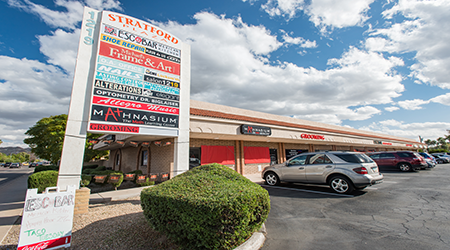
Stratford Plaza, Phoenix Sells for $2.27 Million
Stratford Plaza, 1219 E Glendale Ave., Phoenix, AZ
Phoenix, AZ – CBRE has completed the sale Stratford Plaza located at 1219 E. Glendale Avenue in Phoenix. The ±20,400-sq.-ft. retail strip center was 84 percent occupied at time of sale and commanded a sale price of more than $2.27 million ($111 PSF).
Steve Julius and Jesse Goldsmith with CBRE’s Phoenix office negotiated the transaction. The seller was La Crescenta Properties of California. The buyer was Phoenix-based Jacor Partners.
“This is a good purchase for Jacor. Infill properties continue to be sought after, and it’s rare to find quality product in such a dense part of Phoenix,” said CBRE’s Goldsmith. “The neighborhood is evolving, and with new local ownership Stratford Plaza should see much success.”
Stratford Plaza is well located and benefits from exceptionally busy traffic on Glendale Avenue, which averages ±38,130 vehicles per day. The property also thrives due to its proximity to the 51 freeway, and its proximity to the Biltmore district. Additionally, the very popular Luci’s Healthy Marketplace is opening its highly anticipated The Orchard concept just north of the subject property on 12th Street, which will further drive traffic to the area.
 PHOENIX – The Capital Times is reporting cities and counties are on the verge of losing their authority to keep property owners from renting out their homes for short-term and vacation rentals.