City of Tucson Sells 173 Acres in Houghton Road Corridor
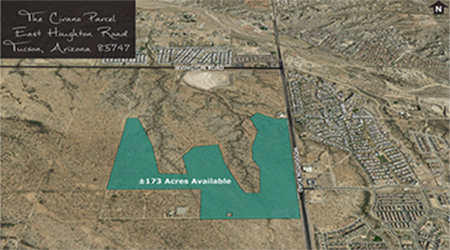
Civano Parcel 450x250Tucson, AZ – The City of Tucson has sold 173 acres of land in the Houghton Road Corridor. One of the City’s largest land offerings in recent memory, it is part of the greater 320-acre Civano land parcel which fronts the west side of South Houghton Road, between East Irvington Road to the north and East Valencia Road to the South. The parcel commanded a sale price of $8.26 million ($47,746 per acre).

Ian Stuart, Ben Becker and Adam Becker of CBRE’s Tucson office negotiated the sale on behalf of the City. Thrac Paulette of Cantera Real Estate, LLC, represented the buyer, Mattamy Homes.

Mattamy’s plans for the 173-acre parcel are not yet final, but will involve a master planned residential community, being called Saguaro Trails. Across Houghton Road, directly east of the property, is the Civano residential neighborhood, which is approaching full build out. Mattamy’s future project will be well positioned to capitalize on remaining, significant demand for homes in the Houghton Road Corridor. Over the past several years, the Houghton Road Corridor has developed as a regionally significant corridor and is recognized as such by the Pima Association of Governments.

“The Houghton Road Corridor has been established as a desirable place where people enjoy a comfortable environment in which to work, raise children, be close to nature, and pursue an outdoor-centered lifestyle,” said CBRE’s Stuart.

Mattamy Homes is one of the largest privately owned builders in North America, and the company has built more than 70,000 homes in hundreds of communities across the United States and Canada. Mattamy’s first expansion into the Tucson area occurred in August 2014. The premier homebuilder currently has two active communities in the market. Mattamy intends to develop the property as a residential master planned community centered around active and healthy lifestyles that complement the surrounding amenities.

Mattamy’s Tucson Division President Josh Robinson said, “We are excited to be a part of this opportunity and look forward to working with the City of Tucson and other stakeholders on this important and exciting project.”

In addition to the 173-acre parcel sold to Mattamy, the area is also known for the popular system of mountain bike trails collectively known as Fantasy Island Trails Park, which extend onto the greater 320-acre Civano Parcel. The City has taken steps to put aside approximately 106 acres to the north of the sale site to be preserved as open space for the purpose of protecting the trails system on the greater Civano Parcel as a public resource.

In addition to preserving the 106 acres for the Fantasy Island Trails Park, approximately 40 acres in the southwest corner of the Civano Parcel will be used by Tucson Water for a groundwater recharge facility and a small well site.  Again, areas within the Tucson Water property will also be set aside for public recreation.

“The City has worked closely with the mountain bike and development communities since 2005 to bring responsible development to this parcel, while protecting the Fantasy Island trails so many people love and enjoy,” said James MacAdam, a project manager in the City Manager’s Office who worked with the stakeholders to prepare for the sale. “We see this as a win for bikers, the City, and our growing east side communities.”

The 173-acre parcel in the Houghton Road Corridor is the largest parcel to date to be declared surplus by the City of Tucson and put up for sale. The City retained CBRE in March of 2012 to identify and categorize its inventory of surplus properties, and to market high value properties from the portfolio.



Renovation, Parking Attract Buyer to JLL’s $14M Fiesta District Listing

827 W Grove Ave., Mesa, AZ

1994-built project completely renovated to serve modern user

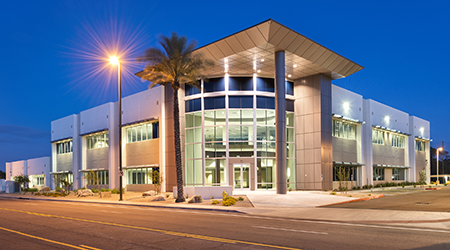
PHOENIX, AZ – Modern amenities and ample parking aided in the $14 million sale of 827 W. Grove Avenue, a Class A office building in Mesa, Arizona. Leased by the Phoenix office of JLL, the deal involves a Class B-to-A renovation that removed 26,000 square feet of office space to achieve an approximate 6.63/1,000 parking ratio.

JLL Senior Vice President Brian Ackerman represented the property seller, Pathfinder TRF Twelve LLC and G2 Capital, in the transaction. The property buyer was Canadian-based Mesa Investment Corp. JLL Managing Directors Karsten Peterson, Mark Gustin and Dave Seeger served as the project’s leasing specialists.

“This was originally a Class B building, but the seller recognized the location and potential,” said Ackerman. “An ensuing renovation shaved off 26,000 square feet off of the building and fully improved what remained, making this basically a brand new asset – with the added bonus of a very high parking ratio in the heart of the Fiesta District.”

A 2015 reno took out the 26,000-square-feet of building space to create almost 7/1,000 parking.

LGE Design Build handled the renovation with design services by Cawley Architects creating a successful strategy and nice sidebar to the District’s $500 million redevelopment.

Totaling 69,561-square-feet, the 1994-built 827 W. Grove Avenue is now a two-story, Class A office building that is 100 percent leased to National General Management Corp., who operates in the building as National General Lender Services, a leading provider of mortgage and auto lender-placed protection solutions, insurance products and risk management services.

The building is mission critical to National General, featuring premier interiors, redundant GIG E Fiber, UPS back up and a 1,000kw generator. In addition, nearly half of the parking is covered.

The project is located on 5.09 acres between the US60 freeway, Alma School Road, Southern Avenue and South Extension Road, less than three miles from the Loop 101 freeway and within the Fiesta District – an area of Mesa undergoing a $500 million redevelopment boom. It is also in walking distance to approximately 55 restaurants and four hotels. Other nearby amenities include Mesa Community College, Banner Desert Medical Center, Dobson Ranch Golf Course, Fiesta Mall and The Shoppes at Gilbert Commons.


Q1 2016 Arizona Economy Heads into Uncertain Global Terrain

Eller College ForecastBy George W. Hammond, Ph.D.
Director and Research Professor, EBRC

The University of Arizona’s Economic & Business Research Center (EBRC) is reporting in its economic scorecard for 2015 shows the state of the economy added jobs, residents, and income. Labor market performance improved, with 61,600 net new jobs and an unemployment rate of 6.1% according to the preliminary data. Arizona also added just over 91,000 new residents last year, with positive net migration. Personal income is expected to rise by 4.9%, slightly faster than in 2014. The Phoenix metropolitan statistical area (MSA) continued to drive state growth, but the Tucson MSA managed to grind out slow gains. Overall, 2015 was a solid but not great year.

Look for modest improvements in job, population, and income growth in 2016, but keep an eye on national/global growth risks as well. Recent stock market declines, if sustained, may weigh a bit on consumer spending, particularly for luxury goods. Low oil and gasoline prices are a net positive for Arizona, but they are having an adverse impact on oil producing states, for instance Texas and Mexico.  The major increases in the value of the U.S. dollar during the past year and a half will impact U.S. exporters of goods and services, including exporters in Arizona.  Further, possible monetary policy mistakes remain a concern as we look to the future, as does growth of our major trading partners.

Arizona also faces risks related to U.S. residential mobility, which has been slow to recover from the Great Recession. If mobility does not increase as expected, it will dampen state population gains and the housing recovery.

Arizona Recent Developments

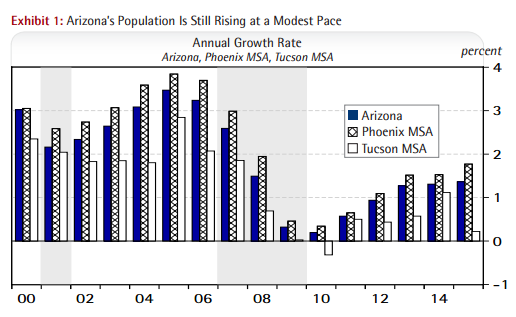
In December, the Arizona Department of Administration released population estimates for the state, counties, and cities for 2015. The data put the state’s population at 6,758,251 on July 1, which was up by 91,010, or 1.4%, from 2014. That was a slight improvement over growth in 2014 (at 1.3%) but it was also less than one half of our average growth rate during the 30 years before the Great Recession (3.2% per year)

As Exhibit 1 shows, both the Phoenix and Tucson metropolitan statistical areas (MSAs) added residents last year. The Phoenix MSA (Maricopa and Pinal counties) added 78,018 residents last year, which translated into a rate of 1.8% and accounted for 85.7% of statewide population gains. The data put population in Phoenix at 4,482,906. The Tucson MSA (Pima County) also added residents last year, but at a far slower pace than the state or Phoenix. The latest estimates put Tucson’s population at 1,009,371 in 2015, up 2,209 or 0.2%.

Exhibit 1

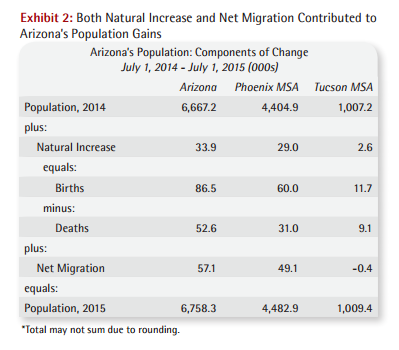
Arizona’s population gains last year were driven both by natural increase and net migration. Natural increase is the difference between births and deaths. Net migration is the difference between in-migration and out-migration during the year. As Exhibit 2 shows, positive net migration contributed more to Arizona’s population increase than did natural increase. Of the roughly 91,000 increase during the year, 33,900 were due to the difference between births and deaths. Net migration contributed more, with an estimated 57,100 more people moving in than moving out.

exhibit 2Arizona continues to generate solid job gains. In 2015, the state added 61,600 jobs, up from 49,100 in 2014. Job gains in 2015 translated into a growth rate of 2.4%, up from 1.9% in 2014. While job growth in the state beat the national average last year (of 2.1%) our pace fell below the average established during the 1977-2007 period, which was 4.1% per year. The Phoenix MSA added  54,500 jobs last year, which translated into a rate of 2.9%. That was faster than the pace set in 2014, of 2.4%. Job gains in Tucson continued at a slow pace last year, with an increase of 1,500 (0.4%). Keep in mind that all of the employment data referenced here is based on EBRC’s internal benchmark of the raw data from the U.S. Bureau of Labor Statistics.

Arizona Outlook

The U.S. economy continues to grow at a modest pace, with real GDP rising by 2.4% in 2015. That was the same pace posted in 2014. The IHS Economics’ forecast calls for gains to accelerate modestly during the next two years, with real GDP growth rising to 2.7% next year and 2.9% in 2017. This is driven by less drag from the inventory cycle, federal spending, and energy-sector capital spending.  In addition, the housing sector is expected to continue to gain momentum.

Consumer spending is expected to remain a solid contributor to growth during the forecast, supported by income and job gains. Auto and light truck sales remain a bright spot.

Net exports are expected to be a small drag on the U.S. economy during the next three years, as a stronger dollar reduces export competitiveness and increases imports. With world interest rates and growth becoming more synchronized during the next three years, the dollar is forecast to gradually retreat.

The outlook for interest rates calls for the Federal Reserve to gradually push rates up during the next four years. Overall, the interest rate outlook calls for the 10-year Treasury note yield to rise from 2.14% on average in 2015 to 3.82% by 2019.

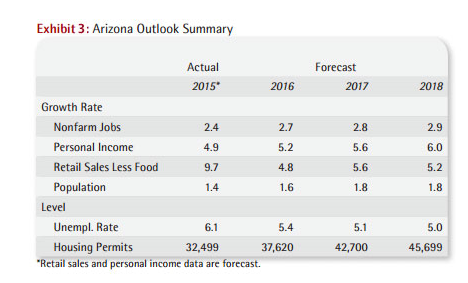
Exhibit 3 summarizes the outlook for Arizona in the near term. Overall, the forecast calls for the state gain momentum during the next three years. Job growth is forecast to accelerate from 2.4% in 2015 to 2.9% by 2018. Population and income gains show a similar pattern. Overall, if the national economy continues to expand, the state is well positioned for stronger growth. However, that growth is expected to remain well below long-run historical averages.

Exhibit 3The Phoenix MSA is forecast to continue to drive state gains, with job growth rising from 2.9% in 2015 to 3.2% by 2018. That far outpaces growth in the Tucson MSA, where job gains accelerate from 0.4% in 2015 to 1.5% by 2018.

For full article click here.

Breakfast with the Economists will be held June 1, 2016 with EBRC Director and Research Professor George W. Hammond, Ph.D., will be joined by Ross DeVol, Chief Research Officer at the Milken Institute.   Details and registration coming soon.