Residential Construction: Time From Permit to Completion

By George W. Hammond, Ph.D., Director and Research Professor, EBRC 

The building of a residential structure take time. The U.S. Census Bureau Building Permits Survey and the Survey of Construction provide information on the length of time from when a permit is issued to the start of construction and then from the start of construction through completion for new private residential buildings.

The data are monthly and available for the U.S. and the four Census regions. If construction begins in the same month the permit is issued then the length of time is zero. Further, some places allow construction to begin before the final permit is issued. This would result in a negative amount of time from permit issuance to the initiation of construction.

Nationally, residential construction tends to begin soon after the permit is issued. For single-unit structures in 2019, the average time was 1.1 months between permit issuance and the start of construction. As Exhibit 1 shows, the time from permit to start of construction has risen from 0.6 months in 1976 to 1.1 months in 2019. The wait for built-for-sale structures in 2019 was 1.0 months. For contractor-built structures the wait was 1.2 months and the wait for owner-built structures was 1.4 months.

Exhibit 1 also shows that the time from authorization to start of construction is generally a little longer for multi-unit structures. The wait for all multi-unit structures was 1.9 months in 2019. Wait times varied across the size of the structure. For structures with 2-4 units the wait was 1.7 months. For structures with 5-9 units the wait was 2.0 months. For structures with 10-19 units the wait was 2.3 months. Finally, the wait for structures with 20 or more units was 1.8 months.

Exhibit 1: U.S. Average Time from Permit to Start of Construction, In Months, U.S. Recessions Shaded
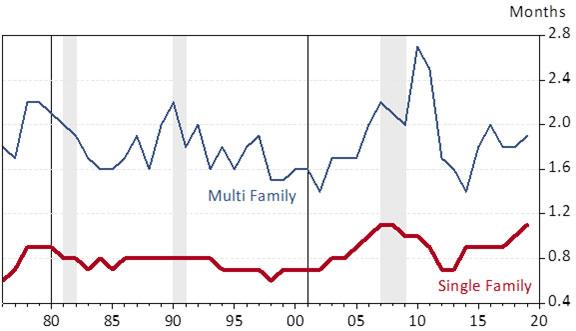
Exhibit 1: U.S. Average Time from Permit to Start of Construction, In Months, U.S. Recessions Shaded

Exhibit 2 shows the average length of time from the start of construction to completion for the U.S. In 2019, the average time was 7.0 months for a building with one unit. Time ranged from 6.1 months for built-for-sale structures to 8.9 months for contractor-built structures to 12.3 months for owner-built structures.

Multi-family structures take longer to complete. The average time for all multi-unit structures in 2019 was 15.4 months, which ranged from 12.6 months for 2-4 unit structures to 17.2 months for structures with 20-or-more units.

Exhibit 2: U.S. Average Time from Start to Completion, In Months, U.S. Recessions Shaded
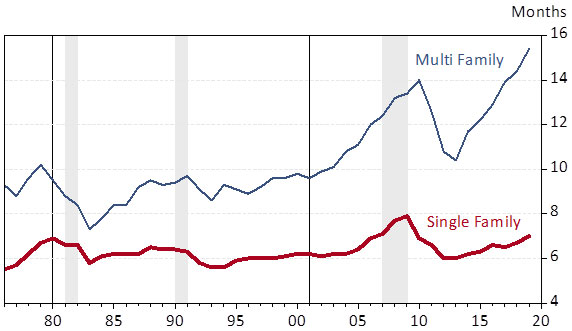
Exhibit 2: U.S. Average Time from Start to Completion, In Months, U.S. Recessions Shaded

Variation in the time from permit to completion of construction is driven by a wide variety of influences reflecting both supply-side and demand-side factors. For instance, as demand rises, it may create temporary bottlenecks in labor markets and supply chains that increase the time between a permit and the completion of construction.

Tucson Rents up by 7.1% year-over-year

With the first full month of 2021 data in the books, our rent estimates are showing that COVID’s impact on the market is continuing to stabilize, according to Apartment List. Our national index ticked up by 0.1% from December to January, the first monthly increase that we’ve seen since last August.

Although the data continue to show significant regional variation, the markets that have been most heavily impacted by the pandemic are beginning to enter calmer waters. In the pricey coastal metros where rents have been plummeting, this month’s data implies that we may have reached the bottom. At the other end of the spectrum, many of the mid-sized markets that have seen rents grow rapidly through the pandemic have seen just modest increases this month.

Tucson rents increased over the past month. In this report, we’ll evaluate trends in the Tucson rental market, including comparisons to cities throughout the state and nation.


Tucson rents increase sharply over the past month

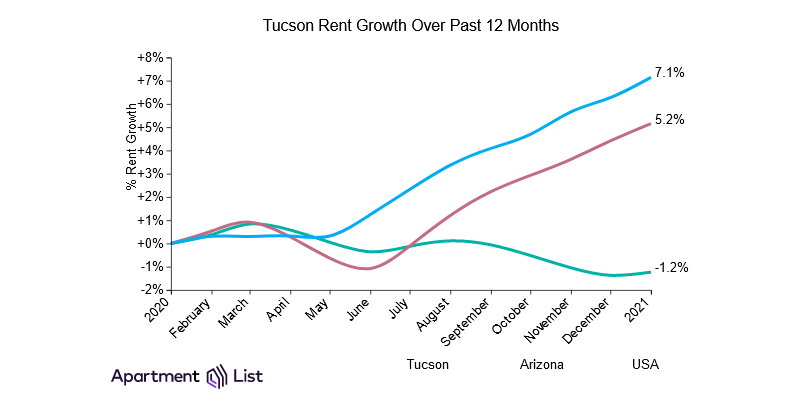
Tucson rents have increased 0.8% over the past month, and have increased sharply by 7.1% in comparison to the same time last year. Currently, median rents in Tucson stand at $825 for a one-bedroom apartment and $1,103 for a two-bedroom. This is the eighth straight month that the city has seen rent increases after a decline in May of last year. Tucson’s year-over-year rent growth leads the state average of 5.2%, as well as the national average of -1.2%.

Rents rising across cities in Arizona

Throughout the past year, rent increases have been occurring not just in the city of Tucson, but across the entire state. Of the largest 10 cities that we have data for in Arizona, all of them have seen prices rise. The state as a whole logged rent growth of 5.2% over the past year. Here’s a look at how rents compare across some of the largest cities in the state.

  • Looking throughout the state, Scottsdale is the most expensive of all Arizona’s major cities, with a median two-bedroom rent of $1,561; of the 10 largest Arizona cities that we have data for, all have seen rents rise year-over-year, with Surprise experiencing the fastest growth (+8.4%).
  • Gilbert, Glendale, and Tucson have all experienced year-over-year growth above the state average (8.4%, 7.5%, and 7.1%, respectively).

Tucson rents more affordable than many other large cities nationwide

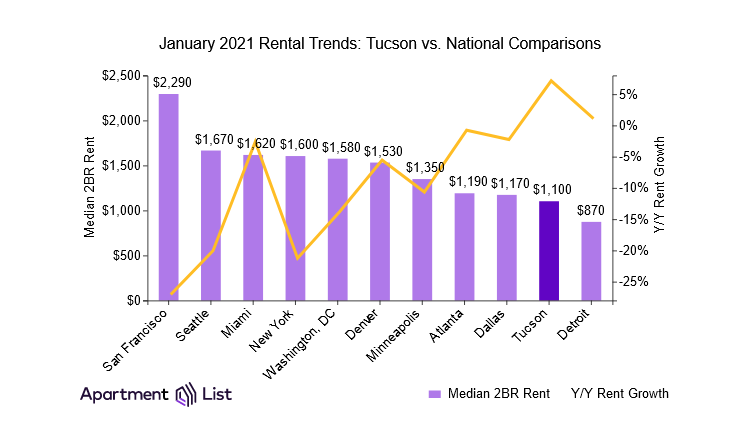
As rents have increased sharply in Tucson, other large cities nationwide have seen rents grow more modestly, or in some cases, even decline. Tucson is still more affordable than most comparable cities across the country.

  • Tucson’s median two-bedroom rent of $1,103 is slightly above the national average of $1,092. Nationwide, rents have fallen by 1.2% over the past year compared to the 7.1% increase in Tucson.
  • While Tucson’s rents rose sharply over the past year, the city of Detroit also saw an increase of 1.1%.
  • Renters will find more reasonable prices in Tucson than most similar cities. For example, San Francisco has a median 2BR rent of $2,294, which is more than twice the price in Tucson.

For more information check out our national report. You can also access our full data for cities and counties across the U.S.


Avilla Marana Luxury Rental Community Expands onto 23 Acres for $9.5 Million

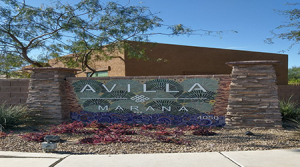
Avilla Marana, 4050 W Aerie Drive, Marana, AZ

MARANA, Arizona — The luxury rental community of Avilla Marana at 4050 W Aerie Drive, Marana will be expanding with up to 400 new homes across the street.

The owner of Avilla Marana purchased 23-net acres for up to 400 homes at 4025-4105 West Aerie Drive in Marana for $9.5 million ($413,000 per net acre). The gross land area includes a wash that adds an additional 4-acres to the site for approximately 27 total acres. It sold rough graded and platted for up to 400 homes.

Art and Clint Wadlund of Berkadia Rea; Estate Advisors Tucson represented the seller, Alta Vista Communities RP, LLC of Tucson (Roger Karber, manager).

The buyer is a Santa Barbara, California company, M3 Multifamily, LLC. Formed in 2008 by John Mosby and Jon Martin for the purpose of acquiring, renovating and managing existing apartment communities in the United States in order to create cash flow and profits for their investors. Since then, M3 has grown steadily, and currently owns/manages communities in Austin, San Antonio, Nashville, Reno, and Tucson.

The investment group purchased the existing Avilla Marana in December 2017 with 284 rental homes, exactly three years prior to purchasing the new expansion site that closed December 2020.

This transaction represents the fifth acquisition for M3 Multifamily in Tucson from the same seller. It also owns Aerie at Tanque Verde, an 85-unit detached luxury rental community, located at 2495 N Desert Links Drive in Northeast Tucson purchased in 2013; Avilla River luxury rental community, a 76-unit community at 1000 W River Road, Tucson sold in 2014; and Avilla Preserve Orange Grove, a 184-unit luxury rental community, located at 2501 W Orange Grove Road, Tucson was acquired in 2015.

Avilla Marana is professionally managed by MEB Management Services. The one-, two- or three-bedroom homes feature a private back yard, 10-foot ceilings, granite countertops, stainless steel appliances and clerestory windows. Only a few minutes from great restaurants, shopping and entertainment as well as the beauty that Tucson has to offer at its Catalina State Park and Saguaro National Park all nearby.

For additional information, Art and Clint Wadlund can be reached at 520.299.7200.

To learn more, see RED Comp #8338.