CBRE Completes $12.3 Million Sale of Goodwill Portfolio in Glendale and Tolleson, AZ
Glendale, Arizona– CBRE has completed the sale of two single-tenant, net-leased Goodwill retailers located at 6161 West Bell Road in Glendale and 2933 South 99th Avenue in Tolleson, Arizona. The portfolio sale commanded a price of $12.3 million and included an additional parcel of land (totaling 27,473-square-feet) located adjacent to the Tolleson Goodwill.
Joseph R. Compagno, Barry Gabel and Chris Marchildon with CBRE’s Phoenix office represented the sellers; Phoenix, Ariz. based M-CountryCorners 1, LLC, M-CountryCorners 2, LLC, M-GlendaleX No. 1, LLC and the buyer; Yorktown Corporation, an Arizona corporation.
“We sold Yorktown’s 105,000-square-foot single tenant JCPenney on Ray Road a few months ago. We identified this Goodwill portfolio as an excellent 1031 exchange opportunity. The buyer placed a great new life insurance loan on the portfolio through Geoff Harris in CBRE’s Debt & Structured Finance group in Phoenix,” said Compagno. “The escrow closed in 50 days with new financing. It was a very smooth and efficient transaction for both parties.”
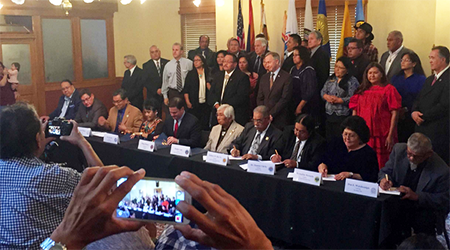
PHOENIX, ARIZONA – Governor Doug Ducey joined 9 tribal leaders Monday afternoon to affirm amendments to the Indian gaming compact, building a connection among the tribes of Arizona and solidifying a promise made 15 years ago in the original Compact.
“It’s time for us to modernize this compact to meet the changing needs of the state and to increase the opportunities for tribal gaming,” Governor Ducey said. “It’s a view that’s been expressed by tribal leaders over the years, and I agree. The time has come to allow each tribe more freedom in their gaming operations and give every Nation the opportunity to have a seat at the table.”
The amendments allow the respective tribes a higher gaming class on their reservations, in return for not building future gaming facilities within the Phoenix Metro Area. It also begins future discussions to improve the Compact in the State, making it work for every tribe.
Governor Ducey was joined by leaders of the Ft. McDowell Yavapai Nation, the Tonto Apache Tribe, Salt River Pima-Maricopa Indian Community, the White Mountain Apache Tribe, the Hualapai Tribe, the Havasupai Tribe, the Gila River Indian Community and Navajo Nation.
Fort McDowell Yavapai Nation – President Bernadine Burnette
“On behalf of the Fort McDowell Yavapai Nation, I want to thank Governor Ducey and his staff for hosting today’s historic signing ceremony,” said President Bernadine Burnette. “It signifies the State’s respect to engage in meaningful government-to-government negotiations with Fort McDowell and other Arizona tribes to plan for and to ensure the future of tribal gaming in our State.”
Tonto Apache Tribe – Chairwoman Jeri DeCola
“As the smallest tribe in rural Arizona, tribal gaming revenue has had a significant impact on the services we provide to our community members. Going forward, our community will look to ensure that the future of tribal gaming continues to support the needs of the rural markets while continuing to benefit all Arizonans. We trust that more tribes will sign on to this important amendment to the compact, and we stand ready to work with Governor Ducey and tribal leaders on the next round of compact discussions.”
Salt River Pima-Maricopa Indian Community – President Delbert W. Ray, Sr.
“Today we reaffirm the promise we made 15 years ago that Indian gaming would be limited, well-regulated and there would be no additional casinos in the Phoenix metropolitan area,” said Delbert W. Ray, Sr., President of the Salt River Pima-Maricopa Indian Community. “I commend Governor Ducey for building on both the legacy of previous Arizona leaders and the incredible success of the 2002 tribal gaming compact. It has created upwards of 15,000 jobs, driven significant economic development, and contributed to making Arizona’s education and health care systems stronger. It is my hope that, with Governor Ducey’s continued leadership, all tribes will be willing to consider signing this agreement to fulfill the promises that were made to other tribes, Arizona’s elected leadership, and the people of Arizona so many years ago.”
White Mountain Apache – Chairman Ronnie Lupe
“The White Mountain Apache Tribe is confident that the Compact Amendment and future Compact Negotiations to Modernize Gaming in Arizona will have a Positive Impact upon Indian Gaming in Arizona; to ensure the continued financial and socio-economic prosperity of both Rural and Metropolitan Tribes as well as the State of Arizona.”
Hualapai – Chairman Dr. Damon Clarke
“The tribal gaming compact adopted in 2002 has benefited all Arizonans, including non-gaming tribes like Hualapai,” said Hualapai Tribal Chairman Dr. Damon Clarke. “The ability to generate revenue from leasing machine rights to other tribes has provided a lifeline to maintain critical programs in our community. In signing this important amendment, we hope to continue our cooperative relationships with other tribes and the people of Arizona. The Hualapai Tribe remains committed to working with Governor Ducey, as well as other tribal leaders, to ensure the voices of non-gaming tribes are fairly represented.”
Havasupai – Chairman Don E. Watahomigie
“The Havasupai look forward to working with the State to extend and update the gaming compact that has provided so much benefit for the people of Supai,” said Chairman Don E. Watahomigie. “We are prohibited by federal law and by our remote location from having gaming on our reservation but the existing compact permits us to transfer our gaming device rights and the revenue from these transfers to the Salt River Pima-Maricopa Indian Community, the Ft. McDowell Yavapai Tribe and the Pascua Yaqui Tribe provide the revenue for the governmental and social services we provide for our members.”
Gila River Indian Community – Governor Stephen Roe Lewis
“I am hopeful that all tribes will join the tribes here today and sign this amendment to reaffirm the principles of limited gaming in Arizona. The Community looks forward to working with Governor Ducey to explore what is possible with a revised compact that benefits the State and all Arizona tribes. The Community encourages all Arizona tribes to sign this amendment and we look forward to working with those that do.”
Navajo Nation – President Russell Begaye and Council Speaker LoRenzo Bates
President Russell Begaye states, “I am pleased that Governor Ducey has taken the lead to negotiate amendments that will modernize our gaming compact, so we can better compete for patrons, cut excessive regulation and extend our compact’s duration. These benefits to Navajo gaming will create more jobs for our tribal members.”
Council Speaker LoRenzo Bates states, “I extend my appreciation to Gov. Ducey and his administration, the Arizona gaming tribes, and the Navajo Nation Council’s Arizona Gaming Subcommittee, including chairman Alton Joe Shepherd, for bringing us to this point, and I look forward to continuing our negotiations in good faith for the benefit of gaming tribes and the entire state of Arizona.”
Real Estate Daily News Buzz Nov. 22, 2016
Real Estate Daily News Buzz November 22, 2016
Real Estate Daily News Buzz is designed to give news snippets to readers that our (yet to be award winning) editors thought you could use to start your day. They come from various business perspectives, real estate, government, the Fed, local news, and the stock markets to save you time. Here you will find the headlines and what the news buzz of the day will be.
Monday, the Dow Jones industrial average gained 88.76 points, or 0.5 per cent, to 18,956.69. The Standard & Poor’s 500 index rose 16.28 points, or 0.7 per cent, to 2,198.18. The Nasdaq composite added 47.35 points, or 0.9 per cent, to 5,368.86.
Benchmark U.S. crude oil gained $1.80, or 3.9 per cent, to $47.49 a barrel. Brent crude, the international standard, rose $2.04, or 4.4 per cent, to $48.90 a barrel in London. In other energy trading, wholesale gasoline gained 6 cents, or 4.3 per cent, to $1.40 a gallon. Heating oil rose 7 cents, or 4.6 per cent, to $1.52 per gallon. Natural gas rose 11 cents, or 4 per cent, to $2.95 per 1,000 cubic feet.
Walmart kicks off Cyber Monday on Friday — Cyber Monday is starting earlier and earlier. Wal-Mart Stores Inc. said Monday that it’s kicking off its so-called Cyber Monday deals at 12:01 a.m. EST Friday for the first time ever as it aims to grab customers ahead of its competitors. Last year, the world’s largest retailer pulled up the Cyber Monday deals to the Sunday evening after Thanksgiving for the first time. Cyber Monday, which falls on the Monday after Thanksgiving, is typically the busiest day of the year for online shopping.
US stock indexes bust records as oil prices jump — Major U.S. stock indexes rose to record highs on Monday, led by big gains in energy companies as the price of crude oil moved sharply higher, which is positive news for the long-struggling energy sector. Investors also applauded several corporate deals, and technology companies, which have been lagging the market in recent weeks, posted solid gains. Makers of basic materials and utility companies also climbed. The price of oil jumped 4 per cent ahead of a meeting of OPEC countries, who collectively produce more than a third of the world’s oil.
As Trump the politician rises, Trump the real estate brand falls“President-elect Donald Trump may be moving into the First Residence in January, but when it comes to his luxury condos, buyers in New York aren’t as enthused to move into homes with the Trump name on them as they used to be. According to the latest figures from CityRealty, a New York real-estate research firm, which among other topics, tracks Trump’s real estate holdings, the president-elect’s flagship properties in Manhattan now sell for about $1,915 a square foot, compared with $1,883 a square foot for other luxury properties in the city — just a 2% premium. During the summer, with the presidential campaign in full swing, per-square-foot prices for Trump-branded condos in Manhattan still eked out a premium, averaging $1,974 a square foot, compared with $1,873 a square foot for all other units, a 5% premium advantage, CityRealty said. Trump enjoyed a similar 5% edge in Manhattan in 2015, said Gabby Warshawer, CityRealty’s director of research.” (MarketWatch)
What does Donald Trump’s infrastructure plan mean for real estate? “Of all the tremendous promises of Donald J. Trump’s presidential campaign, arguably the biggest was his infrastructure proposal. And in this circumstance, ‘biggest’ doesn’t just refer to ambition — the plan will cost $1 trillion and involves building out transportation, water, telecommunications and energy infrastructure across the country. The plan aims to ‘transform America’s crumbling infrastructure into a golden opportunity for accelerated economic growth and more rapid productivity gains with a deficit-neutral plan targeting substantial new infrastructure investments.’ What are the potential implications for the real estate industry? Here are a few.” (Inman.com)
Unit owners sue, claim Tampa condo building is sinking“The owners’ association at a condominium in Tampa sued the contractors who built the 20-story building, alleging that construction defects are causing the condo to sink and tilt. The owners’ association at the 144-unit Plaza Harbour Island condominium claims in a suit filed in Hillsborough County Circuit Court that the nine-year-old building has exterior cracks due to ‘significant subsidence concerns and structural design deficiencies.’ The association’s suit cited geological investigations that found ‘very loose and very soft bottom soils beneath the condominium’s ground floor. These soils are completely unsuitable to support the foundation, and … the soils have settled with resulting movement and significant cracking of the walls, stucco and structure.’ The association at Plaza Harbour Island, located across a channel from downtown Tampa on an island with the same name, claims in the suit that unit owners face multiple costs due to construction defects, including reduced market values for their units. The owners of each unit must ‘disclose the existence of these conditions to any potential purchaser, thereby limiting the marketability of his/her unit and reducing the market value of the unit,’ the suit claims. The impact on unit prices at Plaza Harbour Island is unclear. This year, owners have sold seven units, and the highest price was $885,000 for a two-bedroom unit, which was $74,000 below the asking price.” (The Real Deal Miami)”
Three Hotels Worth $350M to Be Developed at ATL “Atlanta Mayor Kasim Reed, alongside Hartsfield-Jackson Atlanta International Airport (ATL), Majestic Realty Co. and Carter officials, has announced the approval of a ground lease to build a master-planned development at ATL, as part of the ATLNext initiative, a $6 billion expansion and upgrade plan. The development will consist of two phases, with the design stage expected to begin in 2017 and construction slated to commence by 2018. The total cost of the project is estimated at more than $350 million. ‘With this partnership, Hartsfield-Jackson will soon have a world-class hotel worthy of the world’s leading airport. We are making investments today to secure the future of the airport and create long-term economic and business growth,’ Mayor Reed said in a prepared statement. Phase I of the development will consist of a 11-story, 440-key, four-star hotel with 800,000 square feet of conference/meeting space and an additional 60,000 square feet of Class A office space. The property will be built immediately west of the airport’s domestic terminal. The new hotel will also feature 750 parking stalls, MARTA and direct access to the SkyTrain that travels from ATL to Rental car Center and Georgia International Convention Center. In addition, a restaurant is planned for the main lobby and a skybar will be built on the tenth floor.” (Commercial Property Executive)
Abercrombie weighing store closures as turnaround stalls “About half of Abercrombie & Fitch’s 745 U.S. store leases are up for renewal over the next 18 months, presenting an opportunity to shutter stores without leaving too much money on the table, the struggling teen apparel retailer’s CFO Joanne Crevoiserat told analysts Friday. Abercrombie expects to close approximately 50 U.S. stores through natural lease expirations, Crevoiserat said, and in other cases the company may renegotiate rents as an alternative to outright closure. But she also noted that terms of individual leases vary, the “facts and circumstances” of each store vary as well, and in the aggregate Abercrombie’s flagship stores remain profitable, so the company is being judicious about its store-closing plans. Abercrombie also operates 185 stores across Canada, Europe, Asia and the Middle East, and while its European leases are structured differently, several there are also flexible, Crevoiserat added.” (Retail Dive)
Google getting more serious about brick-and-mortar retail“Google is expanding its brick-and-mortar presence. Following the opening of its New York City pop-up store last month, Google has partnered with Best Buy to amp up its retail presence. Starting on Nov. 18, 10 Google shops will begin opening in Best Buy locations across Canada, to be followed by four larger and more interactive shops in Vancouver, Edmonton, Calgary and Mississauga later this year. The in-store Google shops are designed to allow shoppers to fully experience and test drive the company’s growing family of tech devices, including Pixel, Daydream View and Chromecast Ultra. The shops are part of Best Buy’s redesigned “Experience Store” format that boast state-of-the-art renovations and enhancements.” (Chain Store Age)
Clarion Partners Lands $200M Refi for Mixed-Use Portfolio “Clarion Partners of New York has completed $200 million in financing for a nine-property portfolio consisting of multifamily, industrial and retail properties across six states, it was announced late last week by HFF, which had arranged the financing. HFF worked on behalf of the borrower, a commingled fund managed by Clarion Partners, to secure the fixed-rate loan through one of HFF’s correspondent lenders. The loan is secured by three multifamily properties totaling 761 units in Plano and Dallas, Texas and Minneapolis; four industrial properties totaling 1,718,768 square feet in Hanover, Md.; Denver; Pompano Beach, Fla.; and Redlands, Calif.; and two retail properties totaling 275,859 square feet in Delray Beach and Celebration, Fla. The HFF debt placement team representing the borrower was led by Senior Managing Director Riaz Cassum, Director Lauren O’Neil and Senior Real Estate Analyst Robyn King.” (Commercial Property Executive)
Cuomo approves $300M for NYC affordable housing projects “Gov. Andrew Cuomo signed off on granting the city another $300 million in bonding authority on Friday, providing a considerable bump in funds needed to construct affordable housing. With this latest allowance, the state has granted the city $771 million in tax exempt bond capacity this year — an amount Cuomo’s office touted as the highest provided in a decade. ‘Homelessness is exploding and affordable housing is all but disappearing,’ Cuomo said in a statement. ‘New York City needs this help from the state which will provide thousands of units of safe, clean, affordable housing and will help alleviate this crisis.’ Under federal law, the state controls bond capacity, a fact that has been yet another source of tension between Cuomo and Mayor Bill de Blasio. In November 2015, the de Blasio administration claimed it received a far smaller share of the bonds than it was promised and, as a result, had t0 delay construction of certain affordable units. In January, Cuomo also proposed changes that would have added two new layers to the bond allocation approval process, a prospect New York Housing Commissioner Vicki Been called ‘a poison pill.’ The revisions were ultimately not implemented.” (The Real Deal)
In New Jersey and Long Island, Developers Eye Office-to-Warehouse Conversions“Peter Sudler didn’t make the decision to demolish one of his top-end suburban office buildings lightly. But he knew better than to fight the market. ‘Rather than sit there with an empty office building I am repositioning it to warehouse distribution,’ the developer said. Sudler Cos. is tearing down a 25-year-old, 500,000-square-foot office building in Cranbury, N.J., to clear the way for 800,000 square feet of industrial space. Not so long ago, replacing an office building with a warehouse wouldn’t have crossed the minds of many developers. Office space, after all, costs more to build and usually generates higher rents. A red-hot warehouse market driven by the rise of e-commerce has changed that. Though the numbers are small, several suburban office properties in or near New Jersey and Long Island industrial neighborhoods have been redeveloped as warehouses. ‘It was always the reverse, and we used to convert from industrial to office,’ said Thomas DiMicelli, an executive vice president with brokerage firm JLL who works in the Long Island market. ‘Industrial values have gone up enough, it can make converting office buildings worthwhile.’ Many of the converted properties weren’t top-notch office space but met a number of requirements for a warehouse, including close proximity to New York City, ports and highways but ample distance from residential communities. Adequate land for trailer-trucks to park and move goods is also critical, said Jules Nissim, an executive vice president real estate services firm Cushman & Wakefield.” (The Wall Street Journal)
Orlando: The ‘Happiest Place on Earth’ for Industrial Real Estate “Over the past five years, the Central Florida industrial market has been transformed from its prior position as a spoke in the wheel of distribution to the hub. To service consumers located in the country’s third most populous state, companies are locating large distribution centers in Central Florida (hub) with smaller distribution centers in Tampa, South Florida and Jacksonville (spokes). From a distribution standpoint, Central Florida has become the statewide distribution center for Florida. The world of e-commerce began with the birth of the internet in the early 90s, made a big milestone with the first secure online transaction in 1994, and today Amazon is no longer first thought of as a rainforest in South America. In fact, Amazon is so prolific that recent reports from Consumer Intelligence Research Partners estimate that Amazon Prime now reaches nearly half of U.S. households. That translates to 54 million people, just in the United States, who have paid $99 for an annual membership that enables each consumer access to free two-day shipping. Amazon Prime and other retailers are in competition for consumer purchasing, offering free and expedited shipping to gain a competitive edge. The uptick in e-commerce has accelerated demand for statewide distribution in Florida.” (REBusiness)
 Glendale, Arizona– CBRE has completed the sale of two single-tenant, net-leased Goodwill retailers located at 6161 West Bell Road in Glendale and 2933 South 99th Avenue in Tolleson, Arizona. The portfolio sale commanded a price of $12.3 million and included an additional parcel of land (totaling 27,473-square-feet) located adjacent to the Tolleson Goodwill.