Cry ‘Havoc’ and Let Slip the Dogs of NIRP!

By: Thomas M. Brophy, Director of Research, ABI Multifamily

Do Negative Interest Rates Abroad Impact Domestic Commercial Real Estate? In Arizona?

In NIRP We Trust
As I sit down to type this post much in the world of economics and markets has occurred; first, the Nation’s August jobs data was released. As referenced on the chart/table below, most of the job/wage growth came from the lower-tier (Bottom 20%) of the job spectrum.

abi-chart-1According to Elliott D. Pollack & Company, Arizona, during the first 7 months of 2016, continued to see robust employment growth up 3% to date. In fact, both the Phoenix and Tucson Metro’s outpaced most of the country with robust employment growth 3.4% (or 58,000 jobs since July 2015) and 3.3% (or 14,900 jobs since July 2015) respectively over the same time period. The largest job category gains were seen in the information, financial activities, educational and health services and manufacturing sectors.

Second, Fed Chairwoman, Janet Yellen, gave her highly anticipated, albeit underwhelming, Jackson Hole speech. As Janus Capital’s, Bill Gross, points out, “With Yellen, there is no right or left hand — no “on the one hand but then on the other” – there are only decades of old orthodoxy that follows the tarnished golden rule of lowering interest rates to elevate asset prices, which in turn could (should) trickle down to the real economy.”

Third, the ECB (European Central Bank) confirmed its continued commitment to negative interest rates of (0.4%) on deposits and left its benchmark main refinancing rate at 0%. Additionally, the ECB will continue its massive QE schedule of €80 billion in monthly asset purchases through March 2017 and beyond. Mike Shedlock, SitkaPacific Capital Management, in his blog, MishTalk, summed up the ECB’s failed monetary policy in one chart (shown below):

abi-chart-2Last but not least, both the stock and bond markets have experienced tremendous volatility resulting in investor whiplash.  Although the DOW, NASDAQ and S&P are still up for 2016 (as of 9/13/16) at 3.68%, 2.95% and 4.06% respectively, they’ve seen an average reduction of 1.33% in the last few days of trading alone. The sum total of the Jackson Hole meet, stated ECB monetary policies, continued Abenomics in Japan, lackluster US growth and continued market volatility all points to very little chance of a US interest rate increase for the rest of this year, despite some Fed official’s hawkish comments otherwise. In light of the Fed’s focus on NIRP at Jackson Hole, particularly Marvin Goodfriend (Carnegie Mellon University) and Marianne Nessen’s (Swedish Central Bank) in defense of NIRP (and more negative rates) speeches, I’d say we’re all but guaranteed no interest rate increases for, at least, the next few quarters.

Got Yield? The Capital That Moves Markets
As I stated in my 2016 Market Forecast back in January, Congress passed a provision in its December 2015 $1.1 trillion spending bill modifying the 1980 Foreign Investment in Real Property Tax (FIRPTA). To recap:

“FIRPTA has historically made direct investment in U.S. property a non-starter for trillions of dollars-worth of foreign pensions,” said James Corl, a managing director at private equity firm Siguler Guff & Co. “This tax-law modification is a game changer” that could result in hundreds of billions of new capital flows into U.S. real estate….The new law also allows foreign pensions to buy as much as 10 percent of a U.S. publicly traded real estate investment trust without triggering FIRPTA liability, up from 5 percent previously….Cross-border investment in U.S. real estate has totaled about $78.4 billion this year, or 16 percent of the total $483 billion investment in U.S. property, according to Real Capital Analytics Inc. Pension funds accounted for about $7.5 billion, or almost 10 percent, of the foreign total, according to the New York-based property research firm.

Professional researchers, such as myself, and economists are (or should be) obsessed with the impact of marginal, or outlier, moves in a given market. The reason marginal/outlier moves impact markets is that they can, but not always, exacerbate and distort normal market pricing conditions, which one could postulate is already distorted due to our decade old Fed-induced Zero Interest Rate Policy (ZIRP).

For example, I’ve been particularly interested in following the capital that has come from Europe, specifically Germany where NIRP policies have pushed banks to charge fees for nominal deposits (€111,000 or more), to US (Arizona) commercial real estate. Specifically, is there a price per unit premium paid by foreign investors fleeing the draconian impacts of NIRP policies? Although our more detailed analysis is for clients only, suffice-it-to-say that in late 2015 the Phoenix Metro began seeing a noticeable increase in German investment capital targeting multifamily properties in the Tempe and Chandler submarkets.  As GlobeSt recently reported, North Carolina-based Bell Partners and Hamburg, Germany-based Hanseatische Investment-GmbH have partnered in the creation of a multifamily investment fund.  The new investment fund has a $1 billion, $500 million of equity, cap and is targeting core multifamily properties in metro areas with strong fundamentals. As NIRP policies continue to distort investor sentiment (especially acute in European markets), I would not be surprised to see ever increasing amounts of foreign money pushing the sales price per unit margins higher in the coming months and into next year.

Despite Significant Price Increases, Phoenix is still below Peak Pricing
Whereas many markets across the US have exceeded peak sales price per unit amounts, Phoenix Metro, despite our frenetic sales pace, is still an average of 7% below our 2007 peak (see chart below):
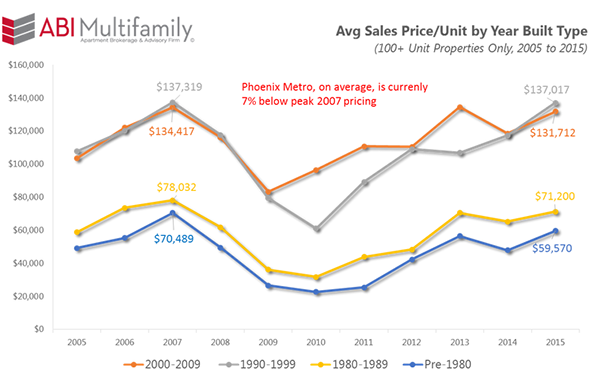
abi-chart-3

As shown in our Phoenix Metro per City Analysis: Rents, Occupancy, Population & Affordability post, despite sustained average per year rental rate increases of approximately 4%+, elevated construction amounts (although nowhere near peak building), the Phoenix Metro is at historical highs both in terms of occupancy, trending towards 97%, and renter retention, which at nearly 55% is some 3% higher than the national average.

Conclusion
Whether or not one agrees with current Central Banker NIRP (or ZIRP) policy, truly matters not, as it is the market in which we must play. Considering Fed governor posturing, and although there are those who disagree, I anticipate stasis of domestic interest rates and further dives into deeper negative rates for most of Europe which has the potential to set off massive capital flights to preservation as opposed to yield. In Phoenix, we’re already experiencing some of that premium pricing setting in, however is not as extreme as those markets on the East/West coasts. As such, I would expect both the Phoenix and Tucson markets to continue their upward trends through the end of the year and well into next.

For full article Click Here.



SVN Managing Director, Perry Laufenberg featured in People & Projects to Know

perry-laufenberg-pic-450x250
Perry Laufenberg, SVN Managing Director

Phoenix, Arizona – There are always “People and Projects to Know” in the valley and this year the PTK publication has been released. Managing Director, Perry Laufenberg is one of only five brokers to be featured in the 2017 publication.

At the end of last year, SVNIC went through major rebranding of the 29-year old commercial real estate firm. Every franchise had to undergo the same rebranding transition.  Earlier this year, Laufenberg stated, “The SVN brand is already one of the industry’s most recognized names based on the annual Lipsey Top Brand Survey, serving over 500 markets.”  The managing director believes that as a locally owned and operated office with a global brand and marketing platform that Desert Commercial Advisors in Phoenix is in a good position in the marketplace with so much consolidation happening around them.

Over the last 6 months, Laufenberg has expanded the Phoenix office to over 23 brokers and counting.  With the help of a new sales manager, he has developed a new training program for both new seasoned advisors and for those just entering the commercial real estate industry.  “Our office has a family atmosphere that makes coming to work enjoyable,” Laufenberg said. Every individual advisor and/or teams are acknowledged throughout the office when goals are reached.  It is the kind of workplace that people look forward to coming to everyday.

With the 3rd quarter coming to end soon, Laufenberg plans to continue to actively recruit new advisors, continue to build momentum in the office, and continue to use the most advanced marketing resources to effectively represent the SVN clients nationwide.


Real Estate Daily News Buzz Sept. 16, 2016

Reserve-White-house-dome
Real Estate Daily News Buzz September 16, 2016

Real Estate Daily News Buzz is designed to give news snippets to readers that our (yet to be award winning) editors thought you could use to start your day. They come from various business perspectives, real estate, government, the Fed, local news, and the stock markets to save you time. Here you will find the headlines and what the news buzz of the day will be.

Thursday, the Dow Jones industrial average rose 177.71 points, or 1 per cent, to 18,212.48. The Standard & Poor’s 500 index jumped 21.49 points, or 1 per cent, to 2,147.26. The NASDAQ composite gained 75.92 points, or 1.5 per cent, to 5,249.69.

Benchmark U.S. crude rose 33 cents to $43.91 per barrel in New York. Brent crude, used to price international oils, added 74 cents, or 1.6 per cent, to $46.59 a barrel in London. Wholesale gasoline jumped 7 cents, or 5 per cent, to $1.43 a gallon. Heating oil rose 3 cents, or 2.5 per cent, to $1.42 a gallon. Natural gas added 4 cents to $2.93 per 1,000 cubic feet.

US stocks jump as Apple pulls tech companies up again — U.S. stocks changed course again Thursday and climbed as Apple led a big gain for technology companies and energy companies recovered some of their recent losses. Investors looked over a series of mixed economic reports as they sought clues about the Federal Reserve’s intentions and the health of the economy. Technology companies made the largest gains as Apple rose for the fourth consecutive day. It’s up 12 per cent this week on growing optimism about early sales of its newest iPhones. Energy companies bounced back after two rough days, though the price of oil rose only a small amount. Health care and phone company stocks also climbed. Bond yields wobbled and finished little changed, a sign investors aren’t sure what will happen with interest rates.

Arizona Unemployment Rate Decreased to 5.8% -Arizona’s seasonally adjusted unemployment rate decreased two-tenths of a percentage point from 6.0% in July to 5.8% in August. The U.S. seasonally adjusted unemployment rate remained unchanged at 4.9% in July and 4.9% in August. A year ago, the Arizona seasonally adjusted rate was 6.0% and the U.S. rate was 5.1%. Over the Month: Arizona gained 29,600 Nonfarm jobs (1.1%) in August. This was less than the post-recessionary (’10-’15) average gain of 50,600 jobs. The Private Sector lost 1,500 jobs (-0.1%). Historically, (’10-’15) the Private Sector averages employment gains of 16,100 jobs in August. Four of the eleven sectors posted gains and seven sectors posted losses. The gains were recorded in Government (31,100 jobs); Education and Health Services (5,500 jobs); Leisure and Hospitality (3,700 jobs); Trade, Transportation, and Utilities (500 jobs); and Natural Resources and Mining (200 jobs). The losses were recorded in Other Services (-400 jobs); Information (-500 jobs); Manufacturing (-1,100 jobs); Financial Activities (-1,400 jobs); Professional and Business Services (-3,600 jobs); and Construction (-4,400 jobs). Over the Year: Arizona Nonfarm employment grew by 2.1% (54,200 jobs) over the year in August. The Private Sector accounted for all of the August gains, adding 59,100 jobs (2.7%). Government employment declined by 4,900 jobs in August. Seven of the eleven sectors reported job gains, and four sectors reported losses. The sectors with the largest gains included Education and Health Services (16,200 jobs); Leisure and Hospitality (9,600 jobs); Professional and Business Services (9,300 jobs); and Trade, Transportation, and Utilities (8,900 jobs).  Additional employment gains were reported in Financial Activities (8,500 jobs); Construction (6,100 jobs); and Information (2,300 jobs). Job losses were reported in Manufacturing (-400 jobs); Other Services (-500 jobs); Natural Resources and Mining (-900 jobs); and Government (-4,900 jobs).

US average 30-year mortgage rate jumps to 3.50 per cent — Long-term U.S. mortgage rates rose this week, with the benchmark 30-year loan reaching its highest level since June. Rates remain at historically low levels, however. Mortgage giant Freddie Mac said Thursday the average for the 30-year fixed-rate mortgage jumped to 3.50 per cent from 3.44 per cent last week. It was the highest level since June, when it averaged over 3.60 per cent. Still, the average 30-year rate is down from 3.91 per cent a year ago, and is close to its all-time low of 3.31 per cent in November 2012. The 15-year fixed mortgage rate edged up to 2.77 per cent from 2.76 per cent. (AP)

As Silicon Valley’s Prices Explode, More Entrepreneurs Head to the Silicon Desert — Much of the tech work force still considers San Francisco the place to be to work with billion-dollar companies. But that may be beginning to change. A recent piece for The New York Times indicates that while Phoenix may not surpass San Francisco in terms of the number of venture capitalists or unicorn companies, it is snagging some tech jobs from the Bay Area, because of the fact that it has become a popular place for tech companies like Uber and Yelp to set up “outpost” offices. Using data from Moody’s, the Times found that the number of tech jobs in Phoenix–known by some as the Silicon Desert–grew by 8 percent from 2014 to 2015, while the number of tech jobs in the Bay Area grew by 7 percent in the same time period. However, Phoenix still has only about one-fifth as many tech jobs as the Bay Area does. Owners of some of the Phoenix-based businesses on the Inc. 5000–an annual list of the fastest-growing private companies–say that they have noticed the number of tech jobs in the area increasing over the past three to four years. And they say that for the most part, it’s been positive growth that has helped raise the profile of the Phoenix business community. (Inc)

Court Ruling on Guns & MMJ Could Lead to Millions in Lost Dispensary Sales — Keep your medical marijuana card or surrender it to purchase a firearm. This is the decision patients in western states may face after a recent court ruling upheld a federal ban on gun sales to registered MMJ users, which could result in millions of dollars in lost sales for dispensaries. The 9th U.S. Circuit Court of Appeals recently ruled that a Nevada woman’s Second Amendment rights were not violated by a federal law prohibiting gun sales to an “unlawful user of and/or an addict to marijuana.” This includes registered medical marijuana patients in states that have legalized MMJ. The ruling covers nine western states, all but one of which has legalized medical marijuana. In terms of overall dollars, Arizona has the potential to lose more MMJ sales than any other state affected by the ruling. If 10% of patients declined to renew their MMJ cards it would cost dispensaries an estimated $7.7 million – 3.4% of the $225 million in projected 2016 MMJ sales. (MJBiz)

Sprawling Suburbs, Not Tall Towers, Lead to Affordable Housing, Study Finds “Building sprawling suburbs is better at making cities affordable than building tall towers, according to research released Wednesday. Environmentalists, urban planners and economists are pushing cities such as New York and San Francisco to build more housing to help combat rapidly rising rents and home prices that are crowding out the middle class. But trying to build upward in order to keep cities accessible to average families may be a losing battle, according to findings to be released Wednesday by BuildZoom, a website for contractors.” (MarketWatch)

California Today: A Leaning Tower in San Francisco “For years, San Francisco was a famously low-rise city. Then came the tech boom and the race was on to build the glass and steel edifices that populate the world’s great cities. But in earthquake-prone San Francisco there’s a catch: many of the city’s new skyscrapers are concentrated in a neighborhood of squishy land reclaimed from the bay. One of the new buildings, the 58-story Millennium Tower, has now sunk by 16 inches. Worse, the condominium building is sinking unevenly.” (The New York Times)

A flurry of tepid economic data could lead Fed to delay hike — U.S. factory output fell, consumers cut back at retailers and wholesale prices went nowhere in August, the latest evidence of a less-than-robust economy. The weak numbers could give the Federal Reserve further reason to hold off on raising interest rates when it meets next week. The Fed reported Thursday that factory production fell 0.4 per cent last month. Overall industrial production — which combines manufacturing, mines and utilities — dropped by an identical amount. A second report Thursday suggested that the factory weakness may be extending into September. The Federal Reserve Bank of New York said that manufacturing in New York shrank in September for a second straight month. New orders and shipments fell sharply.

Reasons for Further Growth of U.S. Real Estate Prices “During the last several years, US housing prices have been gradually rising and that is reflected in the S&P CoreLogic Case-Shiller U.S. National Home Price NSA Index. There are many reasons for price appreciation, including low mortgage rates and a significant decrease in housing prices after The Great Recession. However, current circumstances point out to another driver of price growth. This driver is simply a lack of homes for sale. Based on a comparison of Monthly Supply of Houses and New One-Family Houses Sold, one can easily see that demand for houses is rising but inventories are decreasing that is causing price growth.” (Seeking Alpha)

Asking $200 Million for Prime Santa Barbara Coastline. No Development, Please “Wanted: One billionaire conservationist for four miles of untouched Santa Barbara coastline. Needs $200 million and willingness to part with the most valuable element of the properties—their development rights. That’s the dream buyer of three adjacent ranches, totaling 2,214 acres just west of Santa Barbara, that have hit the market simultaneously. The listing agent is on the hunt for someone with the desire—and deep pockets—to preserve the historic coastline.” (Bloomberg)

Not Your Grandma’s Retirement Home: Check Out This Luxe Living “Active adult communities have seen high demand in recent years, and builder confidence in the sector has been rising steadily, according to the National Association of Home Builders. Both demographics and the trend toward more active living are driving buyers to these developments. The homes in Toll’s latest community in Aurora feature gourmet kitchens, luxury bathrooms with pedestal tubs, grandchildren suites and exercise rooms where walls lift automatically, opening onto outdoor kitchens with mountain views. Hundreds of upgrades are available, depending on what the buyers want to pay.” (CNBC)

Westwood Spins Two Thirds of its Holdings into New Streamlined Entity “Shopping center owner Westwood Financial Corp. recently completed an extensive restructuring of its holdings. The company is shaking up the ownership of 77 of its 120 retail assets into a $1.2 billion retail real estate company. The properties have been bundled with Westwood’s management company to form a separate entity. Set to operate as Westwood Financial, the new entity is poised to have easier access to capital, and will benefit from significantly streamlined operations.” (Commercial Property Executive)

A Look at the New Wall Street Scheme to Make Money with Your Home “Do you want Wall Street to get a piece of your house? On Tuesday, famed venture capitalist Marc Andreesen announced that he’d invested in a startup called Point. Point casts itself as a solution to an intrinsic problem with homeownership: most Americans have most of their wealth tied up in their home. There are mechanisms for ‘taking out’ some of the equity built up as a mortgage is paid down, such as home equity lines of credit or home equity loans. But they require paying interest — not to mention having good credit.” (MarketWatch)

GLP Grows U.S. Presence with $1.1B Buy “GLP, a Singapore-based provider of logistics facilities, is making its third industrial acquisition in the U.S. with plans to purchase a $1.1 billion portfolio from Hillwood Development Co. in several phases starting later this year. The first part of the deal is expected to close in December with the purchase of a $700 million portfolio. The remaining $400 million development portfolio will be acquired in phases upon completion and lease-up.” (Commercial Property Executive)

Red Hook Waterfront Might Be Getting a Major Facelift “It’s like Battery Park City — only in Brooklyn. A sweeping redevelopment is being proposed for the Red Hook waterfront that would bring apartment buildings with up to 45,000 new homes — and some amazing views — to rundown piers on the Erie Basin. Global engineering firm AECOM unveiled the plan on Tuesday, which also includes an ambitious proposal to extend the 1 train from lower Manhattan via a new tunnel to the mass transit-starved neighborhood.” (New York Post)