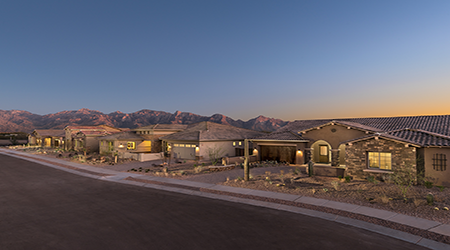
Rancho Vistoso Neighborhood reaches ‘100 Homes Sold’ Milestone in 200 Days
Center Pointe Vistoso, Oro Valley, AZ
Maracy Homes’ Oro Valley Community offers snapshot of industry’s record breaking growth
ORO VALLEY, AZ – Since opening just seven months ago, Scottsdale-based Maracay Homes’ Center Pointe Vistoso community in Oro Valley has sold an average of one home every 48 hours (100 homes in 200 days), reflecting the submarket’s pent up demand for an option with this level of product diversity and amenities. The success of the community, located in the Tucson, Arizona, suburb of Oro Valley, offers a vivid snapshot of the national housing industry’s record-breaking growth, which saw 2016 new-home sales climb 9.3 percent in the second quarter compared to the first quarter, according to the Commerce Department.
In fact, the success of the community is driving the market recovery on a local level, where the 343-homesite neighborhood accounts for 60 percent of Oro Valley’s residential building permit volume this year. Additionally, one in every 11 homes started in Tucson (excluding age-restricted housing) has been at this community.
“Center Pointe Vistoso is the only option in this submarket with this level of product diversity and amenities, which is a big reason one in every 11 homes started in Tucson this year (excluding age-restricted housing) has been at this community,” Maracay Homes Tucson Vice President James Attwood said. “As the national housing market improves, Center Pointe Vistoso is driving the market recovery on a local level.”
Located on one of the final and best parcels within Oro Valley’s Rancho Vistoso master-planned community, Center Pointe Vistoso is the largest new-home project to open in Tucson since 2008 and is reinvigorating an area that has long been adored for its captivating views of the Catalina and Tortolita mountain ranges. With interest in new-home purchase opportunities far out-pacing Rancho Vistoso supply, the region has been building pent-up demand for several years.
“Rancho Vistoso has been one of the most desired master-planned communities in Tucson for nearly 30 years,” said Maracay Homes President Andy Warren. “As new home lots became scarce in the master plan, Maracay recognized the value of this community and invested in the details to create a unique opportunity that buyers are responding to.”
The community comprises 343 premium homesites, located within six strategically planned gated neighborhoods. Home sizes range from approximately 1,400 to 4,000 square feet, offering a style for every type of buyer, including singles, families and empty nesters. Each neighborhood is connected by a dynamic, multi-purpose trail system that passes by a butterfly garden and other gathering spots before leading to the 6,000-square-foot luxury swim complex and a large, grassy park with shaded playground equipment and picnic stations.
Home styles feature a mix of executive, vacation (lock and leave) and family designs crafted to keep pace with current lifestyle trends and Arizona homebuyers’ preferences. Each Center Pointe Vistoso plan includes FlexDesign® selections for optimum customization. All homes are Energy Star® certified and include Maracay Homes’ LivingSmart® program for high performance and cost efficiency.
Thomas Brophy, Director of Research at ABI Multifamikly
By: Thomas M. Brophy, Director of Research, ABI Multifamily
Let’s begin with a few quotes:
“There are known knowns. These are things we know that we know. There are known unknowns. That is to say, there are things that we know we don’t know. But there are also unknown unknowns. There are things we don’t know we don’t know.” -Donald Rumsfeld
Risk assets are now supported by the new ”Keynesian Put”, the expectation that fiscal measures will be deployed to combat any renewed weakness in the economy/markets (independently of any larger political projects). But asset prices remain primarily supported by excess monetary abundance across the world:
There have been 667 interest rate cuts by global central banks since Lehman; 2. G7 central bank governors Yellen, Kuroda, Draghi, Carney & Poloz have been in their current posts for a collective 17 years, yet only one (Yellen in Dec’15) has actually hiked interest rates during this time; 3. Central banks own $25tn of financial assets (a sum larger than GDP of US + Japan, and up $12tn since Lehman); 4. There are currently $12.3tn of negative yielding global bonds (28% of total); 5. There is currently $8tn of negative yielding sovereign debt (54% of total).
-Michael Hartnett, Bank of America, ‘The Liquidity Supernova & The ‘Keynesian Put.’
“There has been much tragedy in my life; at least half of it actually happened.” -Mark Twain
Introduction
Today’s multifamily market is one that I have truly never witnessed; perhaps this is the sentiment felt by all individuals in all market cycles. As a 4th Generation Arizonan, and yes, unlike unicorns, we do exist; I have seen, heard and felt more than a few boom-and-bust real estate cycles. Typically, Arizona leads the pack with mass speculation fueled on Western dreams and high profits which ends in Federal charges and vacant homes. This time it’s different (and yes it does pain me to use this battered cliche but if the shoe fits), and far from the over-built speculation nightmares of old, and a topic I’ve covered in a previous article, With All This Construction We’re Still Under-Supplied this fact still leaves me scratching my head. One could make the argument there’s a burgeoning over supply of high-end multifamily construction, and is cause for some concern, which I addressed in the previous article: Behind the Construction Report Numbers: Phoenix Rising from the Garden-Style Apartment Community but none of this points to systemic risk.
Before I digress further, my astonishment nay trepidation, lies not in the irrational exuberance in the lead up to the Great Recession where the proverbial, “build it and they will come” mentality reigned supreme across residential and commercial real estate. Rather my trepidation rests in the ever-growing possibility of an external shock, see quote 2 above. For the balance of this post, I will attempt to quantify what Rumsfeld called, ‘known knowns,’ jab at ‘known, unknowns,’ and leave you to predict ‘unknown, unknowns.’
Known Knowns
At the macro level and as BofA Analyst, Michael Hartnett, alluded to above, the developed world’s central bankers have embarked upon an unprecedented race to the zero bound and lower. Now, after a decade of quantitative easing and an amalgam of NIRP/ZIRP policies, over half of the developed market’s (DM) sovereign debt is negative yielding, central banks have accumulated a total of $25 trillion in financial assets, Brexit won and now Italy stands on the Mateo Renzi-inspired referendum precipice; the impacts of which should be categorized in the ‘known unknowns’ category. And all of this is just in financial markets and speaks nothing about rising global terrorist attacks, Turkish-PM Erdogan’s staged coup and purge fest, Venezuela’s Socialist collapse (looking at you Sean Penn), Syria, Ukraine and the general US election cycle.
So where does all this leave investors? In a word, skittish, and looking for safety. But where does one find safety, and for that matter, yield? In today’s current market there’s very few places. Speaking of previously safe places, according to Bloomberg, North American life insurers, stretched for yield (see chart below), piled into investment-grade energy bond positions in 2014/15 to fund the gap. By the end of 2Q 2016, companies including Prudential Financial, MetLife etc. held $1.32 billion of bonds that were in default, or close to it, their highest level since 2011.
This leads me to the last crushing ‘known known’ and that is demographics. The chart comes from Chris Hamilton’s Econimica blog and can pretty much stand on its own. If out of control debt, negative yields, corporate investment grade bond implosion and pension cuts weren’t enough……enter demographics. As the chart below suggests the US is entering the rapid explosion of an aging population.
As Hamilton highlights, “91% of all US home buying is done by those aged 20-69yrs/old, according to NAR data. In 2015, Millennials (20-35yrs/old) made up 35% of home purchases, Gen X (36-50yr/olds) bought 26%, Boomers (51-70yr/olds) 31%, and the Silent Generation (70+yrs/old) 9%. I’m no great fan of the NAR, but this makes basic sense as most homebuyers need an income to be homebuyers and most 70+yr/olds are retired and have the lowest average incomes of all the above groups.”
Although Hamilton’s point is to say the single-family home market will unlikely recover due to a rapidly aging population, it also shows the demographic torpedo headed directly toward the US economy, i.e. Social Security benefit explosion (already insolvent) and will exacerbate the financial fiasco known as the Affordable Care Act. And so it goes, older people need more healthcare from an industry unable to keep up with current demand. With history as our guide, and our government’s love of bailouts, I’d assume the Nationalization of healthcare to be just around the corner which leads me to the axiom, think healthcare is expensive now….just wait till it’s free.
Known Unknowns = Opportunity
At the beginning of this article I referenced negative interest rates impacting just over half of DM economies in some form or another. At first, central bankers assured the public that negative rates would only impact excess reserves other banks held in central bank coffers and not spread to various business or personal accounts. That all changed on August 11, 2016, as Bloomberg notes in its article, “Negative Rates for the People Arrive as German Bank Gives In.” That was just the first as several other banks, including RBS (Royal Bank of Scotland) and Bank of Ireland, began charging depositors a premium to keep their money in the banks coffers. How does this all play out?
Negative rates are seen, by central bankers, as the elixir needed to arrest deflation which has been the bogeyman hiding under central bankers’ beds since the Great Depression. Furthermore, use of negative rates is thought to stimulate personal/business investment because, it is assumed, people and businesses would rather spend their money, aka stimulate the economy, then be charged for keeping it in the bank. What this model fails to address, nor could it, what will investors do with their money if they want to protect it? Enter the US commercial real estate market, specifically the Southwest and Arizona.
Conclusion
As I’ve stated in numerous articles, referenced above and, including:Where Does the Market Go from Here? and Phoenix Metro Rental Housing Boom Explained in One Chart, Phoenix, and the general Southwest, is still positioned for growth. In fact, average rents in Phoenix (City) are anywhere from $500 to $1,500+ below those of its closest equals in the region, i.e. Denver, Portland, Los Angeles, Seattle etc. As referenced from data found on RentJungle.com:
Current Average Monthly Rents (all unit types) Phoenix (City): $1,051
Denver (City): $1,588
Portland (City): $1,644
San Diego (City): $2,072
Seattle (City): $2,179
Los Angeles (City): $2,603
San Francisco (City): $3,907
In addition, Arizona as a whole, have been attracting employers looking for more affordable housing, better quality of life for its employees and access to new, highly qualified college graduates.
Since the end of 2015, and accelerating in 2016, Arizona has witnessed an increase of both direct and indirect foreign investment in multifamily properties. Additionally, domestic investors have focused on the Phoenix Metro looking to harbor profits made in other markets, most notably from California and Colorado. As a result, Phoenix is experiencing robust year-over-year total sales volume increases rising over 80%, just north of $2bn, this year alone. Phoenix Metro economic development officials, I must admit, have done an incredible job courting new industries (primarily tech, pharma and manufacturing) and employers to the region which has gradually transitioned us off our dependence on construction jobs to fuel the economy.
I do not know what the future holds and if, or when or how, a market correction will take shape. Nonetheless, I expect ceteris paribus, in the near term, the Fed will not raise rates, central bankers the world over will continue to push rates more negative, investors will continue to vie for stable assets and occupancy/rents will continue their upward trend.
For full article click here. For additional information, Brophy can be reached 602.714.1400.
Real Estate Daily News Buzz Aug. 29, 2016
Real Estate Daily News Buzz August 29, 2016
Real Estate Daily News Buzz is designed to give news snippets to readers that our (yet to be award winning) editors thought you could use to start your day. They come from various business perspectives, real estate, government, the Fed, local news, and the stock markets to save you time. Here you will find the headlines and what the news buzz of the day will be.
Friday, the Dow Jones industrial average fell 53.01 points, or 0.3 per cent, to 18,395.40. The S&P 500 slipped 3.43 points, or 0.2 per cent, to 2,169.04. The Nasdaq composite rose 6.71 points, or 0.1 per cent, to 5,218.92.
Benchmark U.S. crude oil rose 31 cents to close at $47.64 a barrel. Brent crude, used to price oil internationally, rose 25 cents to close at $49.92 a barrel. Wholesale gasoline was little changed at $1.52 a gallon, heating oil slipped 1 cent to $1.50 a gallon and natural gas rose 2.5 cents to $2.871 per 1,000 cubic feet.
US economy grew at tepid 1.1 per cent pace in spring — The U.S. economy expanded at a sluggish 1.1 per cent pace this spring as businesses sharply reduced their stockpiles of goods and spent less on new buildings and equipment. Yet most analysts forecast much faster growth in the summer and fall, fueled by healthy consumer spending. Consumers offset the corporate cutbacks in the April-June quarter by spending at the fastest pace in six quarters, Commerce said Friday. That suggests steady job growth and modest pay gains are making Americans more confident and willing to spend.
Active Managers May Have ‘Limited’ Appetite For New REIT Sector “At the end of this month, real estate will be split from financials to become the 11th standalone market sector. Stifel’s Matthew Heinz writes that data shows actively managed portfolios are already accounting for the change, holding a 3.91% aggregate position in real estate at the end of the second quarter, an 80 basis point increase in active REIT allocations in the past year. This makes REITs the second biggest allocation among subsectors in the financial space behind large-cap banks, and the second most overweight sub-sector of financials relative to S&P 500 weightings behind P&C insurance. Heinz suggests that this shows active managers may have “limited appetite” for more REIT exposure when the reclassification happens.” (Barron’s)
U.S. Apartment, Condo Market Index Dips Slightly in Q2“According to the National Association of Home Builders (NAHB) latest Multifamily Production Index (MPI) released today, the index dropped three points to 50 in the second quarter of 2016. The MPI measures builder and developer sentiment about current conditions in the apartment and condominium market on a scale of 0 to 100. The index and all of its components are scaled so that a number above 50 indicates that more respondents report conditions are improving than report conditions are getting worse. The MPI provides a composite measure of three key elements of the multifamily housing market: construction of low-rent units, market-rate rental units and “for-sale” units, or condominiums. The component measuring low-rent units decreased two points to 52 in the second quarter, while market-rate rental units dropped five points to a level of 53 and for-sale units fell three points to 45. The Multifamily Vacancy Index (MVI), which measures the multifamily housing industry’s perception of vacancies, increased three points to a level of 42, with higher numbers indicating more vacancies. After peaking at 70 in the second quarter of 2009, the MVI improved consistently through 2010 and has been fairly stable since 2011.” (World Property Journal)
A word or two on (the lack of) diversity in commercial real estate “You should meet Aaron Moore. He is an up-and-coming real estate broker in the Royal Oak office of Jones Lang LaSalle. Starting as a research analyst, he is now an associate specializing in sales and purchases of both urban and suburban multifamily properties. But even though he is gaining crucial commercial real estate experience and holds a degree in economics from Brooklyn College and will be finishing his MBA at Wayne State University at the year, based on historical precedent Moore has only a small chance of becoming a senior commercial real estate executive. Why? Because he is black. And it’s not just him that the cards are stacked against. It’s basically everyone who is not a white man. A 2013 report from the Commercial Real Estate Development Association, a national organization founded almost 50 years ago and that has more than 18,000 members, used Equal Employment Opportunity Commission data and found that more than three-quarters of senior commerical real estate executive positions nationwide were held by white men.” (Crain’s Detroit)
Billionaire Behind Lipstick Building Is a Master at Sharing Risk“Gerald Hines, the 91-year-old real estate developer, has always been known for his belief in the striking and iconic. He built the Lipstick Building in Manhattan, helped develop Goldman Sachs Group Inc.’s Jersey City tower and today is constructing the tallest skyscraper in San Francisco. But it was a little lesson he learned back during the oil bust of the 1970s that deserves equal attention when explaining his firm’s longevity and his family’s billionaire status. As the crash hit Hines and most others in his home base of Houston hard, he increasingly reduced his risk by pulling in partners to take big equity stakes in each project. That model has served the Hines Group well during economic downturns — most recently when oil prices collapsed again in 2014, just a year after the firm had embarked on a $1.7 billion development spree in Houston. This summer, when Hines and its investors walked away from a six-building office complex in the city that they’d owned since the 1990s, the developer’s exposure to the 70 percent-vacant Greenspoint Place was largely limited to its role as property manager.” (Bloomberg)
Yankees seeking $1.04B refi for stadium “The Yankees are looking to reload their bases. The team is looking to refinance Yankee Stadium for $1.04 billion, according to documents filed with the New York City Industrial Development Agency, the financing arm of the New York City Economic Development Corporation. The agency, which controls the Bronx property through a ground lease with the city and in turn leases the stadium to the Yankees, issued two rounds of tax-exempt bonds in 2006 and 2009 to fund construction of the 54,000-seat ballpark. The initial principal balance of those two issuances totaled $1.2 billion. The sports team is now asking the IDA to issue a new round of tax-exempt bonds to refinance the stadium, according to agency’s upcoming meeting agenda. The original plan to build a new home for the Bronx Bombers faced pushback on many fronts, not the least of which was controversy over a ruling by the Internal Revenue Service that allowed the sports team to use public debt to finance its stadium.” (The Real Deal)
Opinion: Mall rats are a dying breed “While there are always plenty of reasons for investors and economists to fret that things aren’t as rosy as they should be, consumer spending is not one of them. The Commerce Department’s measure of consumer spending for June (just released in August) showed the third straight month of increases. Also, the University of Michigan survey of consumer sentiment in August was up again, with Americans expressing optimism about the next few months. And consumers have been getting a nice lift in the short-term thanks to cheaper gasoline prices this summer. But for all the optimism over spending, there is a decidedly dark tone in one segment of the American consumer marketplace: malls and mall-based retailers. The latest proof comes via a roughly 25% single-day crash in Express Inc. after a simply abysmal earnings report. Once the teen hangout of choice and a mecca in the fall thanks to back-to-school and Christmas shopping, these sprawling shopping complexes have been displaced in the era of Snapchat and e-commerce.” (MarketWatch)
Five Below’s store count to reach big number “The extreme-value retailer will open its 500th store in Trexlertown, Pennsylvania, on Sept. 9 …In August 2002, Five Below opened its first location in Wayne, Pennsylvania, is now one of the fastest growing retailers in the country with stores in 30 states. The Trexlertown store is one of approximately 85 new Five Below locations opening in 2016, in addition to 71 new stores that opened in 2015. It is also one of 59 Five Below stores in the company’s home state of Pennsylvania.” (Chain Store Age)
Economy Watch: Is Airbnb Affecting Rents in Major Metros? “A new analysis by FiveThirtyEight, which is better known for its political prognostications but which also does economic studies, finds that Airbnb’s impact on rental residential markets is still small in most cities. The concern, sometimes voiced by politicians and others, is that as more landlords list units on Airbnb–’commercial listings’–instead of offering them to live in, the already severe housing shortages in such metros as New York and San Francisco will get worse, and rents will continue to go up. FiveThirtyEight did its analysis of Airbnb using booking and revenue data provided by consulting firm Airdna, which is unaffiliated with Airbnb. To be “commercial” in the FiveThirtyEight analysis, a listing had to be for an entire home or apartment, as well as had to be booked for 180 days or more between June 2015 and May 2016. According to FiveThirtyEight, there were nearly 9,000 commercial listings in Airbnb’s 25 largest U.S. markets during the 12 months ending in May 2016. That’s 10 percent of Airbnb’s total listings in those markets, but they also make up about a third of its revenue, so there seems to be an incentive to grow commercial listings.” (MultiHousing News)
Report: Chicago area new construction spending surges in 2016“With construction cranes popping up all over Chicago’s downtown and in an increasing number of outlying neighborhoods and suburbs, it doesn’t take an expert to see that the Windy City is in the midst of a building boom. But just how much cash has Chicagoland invested in new construction? The answer, according to recently released numbers from Dodge Data & Analytics, is a considerable amount — $4.22 billion to be exact. The newest findings show an impressive 66 percent year-over-year increase through July. The residential segment of new construction faired even better, experiencing a staggering 133 percent surge since July of 2015. In fact, from a purely percentage based perspective, Chicago performed the best of the ten metropolitan areas featured in the analysis.” (Chicago Curbed)
Nader’s team files suit against Miami Dade College demanding public records “Amid the contentious competition for Miami Dade College’s prime downtown site, bidder Gary Nader and his team have filed a lawsuit demanding access to public records related to the bidding process. Nader+Museu has already filed a bid protest as well as a lawsuit related to the $2.3 million bond required for the bid protest. The latest suit, filed in Miami Dade Circuit Court alleges that the college is in violation of the Public Records Act, and asks a judge for a hearing. Amid the litigation, the entire bidding process has halted and is on hold. ‘We had to resort to a legal complaint to secure the public records, and once we get the public records we may amend our bid protest depending on what we learn in those public records,’ Bill Riley, a partner with GrayRobinson, representing Nader+Museu, told The Real Deal… Miami Dade College has not yet awarded a contract in the months-long process to develop the 2.6-acre site at 520 Biscayne Boulevard into a mixed-use project in a public-private partnership. But the college’s evaluation committee has ranked the Related Group as the top bidder. Nader+Museu was ranked second.” (The Real Deal)