Interview: Thriving at 25, Will White and the LAO Tucson Legacy

Will White
John Carrol (left) and Will White (right) Tucson brokers at Land Advisors Organization (LAO)

TUCSON, AZ (April 17, 2026) — Twenty-five years ago, Will White opened the Tucson office of Land Advisors Organization. A quarter century later, LAO – Tucson controls 70 percent of the market, has moved tens of thousands of lots, and remains the go-to shop for builders and landowners across Southern Arizona. With 2026 underway, we checked in with Will for our annual conversation. Twenty-five years is a milestone, but White was more focused on what comes next than on looking back. As he put it, “We’re just getting started.”

Q: Okay Will, 25 years. LAO opened its Tucson doors in 2001. How does that feel?

White: “It feels fast, honestly. I blinked, and here we are. But when I stop and think about what this office has accomplished over 25 years – the projects, the communities, the builders, the deals, the relationships – it’s incredible. Tens of thousands of lots. Cycles up, cycles down. We were here for all of it and I’m proud of that. This market gave us a lot, and we’ve tried to give a lot back in return.”

Q: You guys had a huge market share in 2025. That has grown steadily over the years. What’s the secret?

White: “There’s no secret. We just never stopped working. We have the best clients in the market, and we are very grateful for that. We didn’t go chase deals when Tucson got hard. We didn’t get into other asset classes when land got complicated. We stayed all-in on the Tucson market, its MPCs, on our relationships, and focused on getting to know every lot and every community better than anyone else. When you do that for 25 years, the market share takes care of itself. People call us because they know we know. We work hard to keep it simple.”

Q: Twenty-five years of transactions, tens of thousands of lots moved. What does all that history tell you about Tucson that you can’t get from a market report?

White: “It tells me this place is real. The demand here isn’t speculative– it’s driven by people who want to live here, build here, put roots down here. I’ve watched this market get hit hard and come back every time. The fundamentals of Tucson are sound, and the challenge has never been demand. The challenge has always been getting out of our own way and letting the supply get built. And right now, that’s where things get interesting.”

Q: Let’s get into that a bit. You are always talking about infrastructure, the processing delays, and timeliness. How bad is it from where you sit?

White: “Honestly, it’s as rough as I’ve seen it in 25 years. That’s not drama — that’s a real baseline for comparison. We have tens of thousands of lots in Pima County being held off the market right now because the infrastructure isn’t there or hasn’t been funded. Those are real homes that aren’t being built while real buyers are waiting. The post-pandemic period accelerated growth, but infrastructure construction did not keep pace. Now we’re paying for that gap, and unfortunately, it’s not something that can be fixed overnight. The people who know the problem understand how serious it is. The challenge is that recognizing it and solving it are two very different things. I’ve said it before, and I’ll say it again: this market needs immediate action and implementation. Actual construction. Without that, it’s all just talk.”

Q: Does it help that new large projects like Cascada and Camino Verano are going to finally launch this year?

White: Absolutely, and this is exactly what the market needs. Major investment by those groups will give the market a significant runway. I think it’s great and will hopefully be a catalyst for a couple of the other big projects to start. It’s a major investment, but the benefits to those groups and the market are much greater.

Q: Who wins in a market like this?

White “The projects that continue to advance themselves are going to keep winning. You can point to them now, the ones that risked the infrastructure spend and now have it in place. Homebuilders that have strong relationships with the top development partners win. To be successful, you have to have a seat at the table, and Tucson’s table is crowded right now. Builders know who they will be buying their lots from, and developers know who their likely partners will be.

Q: The homebuilder landscape feels like it’s shifting faster than usual. What are you seeing?

White: “Full reshuffle. The local builders – the ones who have been here forever, who know this market cold – a lot of them are on pause. Not because they’ve lost faith in Tucson. The math just doesn’t work for them. Meanwhile, outside builders are coming in aggressively, and right now, they are buying more lots than the local builders for the future. Let that sink in. “Something has to give. You can’t have your local builder community on the sidelines indefinitely while outside capital absorbs the available inventory. The table is being reset, and the players are shifting every year. If any builder in this market tells you they’re comfortable with inventory past mid-2027, I’d push back hard on that.”

Q: For the homebuilders who are trying to stay active right now, what’s the move?

White: “Get strategic and stay focused where you can be successful. For the next 24 months, I would concentrate exclusively on areas where the infrastructure equation is already solved. Stop fighting the system in corridors where capacity constraints haven’t been addressed and availability isn’t guaranteed. Instead, look at every existing interchange in the region’s growth corridors – the ones that are already functioning – and build your deal pipeline around those. That’s where I’d be aggressive. That’s where you can make real progress. Also, make sure you have relationships with the main suppliers of the lots. The builders who do this first and act on it are going to have a real advantage before the rest of the market catches on.”

Q: Where specifically is growth happening right now?

White: “Growth goes where the infrastructure is – it always has. Right now, that means the Southeast, the Vail Corridor, and the Southwest submarket are the action. Northwest is interesting because it’s challenging to grow further north right now for several reasons. Builders follow the path of least resistance, and they always will. They go where the lots are ready and where more are coming, as evidenced by where the deals are getting done.

Q: LAO turns 25 this year. What does the next chapter look like?

White: “As I said at the beginning of the interview, it has been a great ride, and the cool part is that it is far from over for us. We have always had unwavering support from the LAO founders and leadership, and our Tucson office is an efficient, tightly knit team. John Carroll is a very big part of our success, and, of course, Craig, who keeps everyone in line and all running smoothly. As for the specifics of the future, we have some surprises in store that I’m not ready to talk about yet, but they’re coming. While most things change, one thing that has remained constant is our goal of staying far, far ahead of the market. That’s always been standard, and it’s not changing. If anything, year 26 is going to be the one that sets up the next 25.”

Q: Twenty-five years is also a long time to be in business with people. Talk about those relationships.

White: “That’s the part that hits me the most when I think about 25 years. We know our clients’ kids. We know their families. We’ve been on trips together. While we’ve been fortunate to celebrate countless wins, we’ve been there through the hard times, too. I guess the point is that when you talk to someone every day for a decade or two, they stop being a client and become a form of family. That’s not an exaggeration, it’s just what happens. That means everything, and we don’t take it lightly. The loyalty we’ve received over the years – from clients who could have gone elsewhere and didn’t – is humbling. That loyalty goes both ways for us. And those are the people we will always go to battle for.

Q: Crystal ball time. What does 2026 look like for Tucson?

White: “Tucson’s pipeline is in a tough spot right now. I’ll be straight about that. But here’s what I know from 25 years of watching this market: from adversity comes urgency. And urgency is exactly what this region needs. The construction of major infrastructure must begin – not next year, not after another study, now. That’s the moment everything changes.”

“The market is going to be timed to that. When those shovels go in the ground on the infrastructure that’s been needed, you’re going to see this market respond fast. Builders will move, lots will come online, and production will accelerate. The demand has never gone anywhere. It’s been sitting here waiting for the supply side to get its act together.”

Congratulations to LAO Tucson on 25 years, with best wishes for continued success in the next 25.


Arizona Cities Rank Strongly for Startups, With Phoenix Leading and Tucson Competing on Cost

StartupsTUCSON, AZ (April 17, 2026) — Arizona posted a strong showing in WalletHub’s 2026 ranking of the Best Large Cities to Start a Business, with seven cities making the list and six landing in the top 40. The results point to Greater Phoenix as the state’s leading startup hub, while Tucson stands out for its affordability.

Phoenix ranked highest among Arizona cities at No. 13 overall, followed by Chandler at No. 18 and Mesa at No. 20. Scottsdale placed No. 29, Gilbert No. 32, and Glendale No. 38. Tucson ranked No. 60 in the national comparison of 100 large U.S. cities.

The Arizona results show a clear split between resource-rich growth markets and lower-cost business locations. Phoenix ranked No. 16 for business environment, though it was weaker in access to resources at No. 67 and business costs at No. 46. Chandler turned in one of the state’s strongest all-around performances, ranking No. 13 for business environment and No. 22 for access to resources, though it fell to No. 73 for business costs. Mesa appeared more balanced, ranking No. 36 for business environment, No. 57 for access to resources, and No. 38 for business costs.

Scottsdale and Gilbert both scored especially well in access to resources, ranking No. 13 and No. 11, respectively. But both were pulled down by higher business costs, ranking No. 77 and No. 78 in that category. Glendale offered a somewhat more cost-competitive profile, with a No. 31 rank for business costs, though it trailed other Valley cities in business environment and access to resources.

Tucson posted a different profile from the Phoenix-area cities. While it ranked No. 79 for business environment and No. 86 for access to resources, it scored far better on business costs at No. 11. That suggests Tucson remains attractive as a lower-cost place to launch a business, even if it lacks some of the capital depth, investor presence, and startup infrastructure found in the larger Phoenix metro.

Overall, the rankings reinforce Arizona’s reputation as a favorable state for entrepreneurs, but with important differences by market. The Phoenix metro continues to lead in business scale, capital access, and startup momentum, while Tucson’s advantage appears to be affordability, which may appeal more to bootstrapped firms, local operators, and businesses focused on controlling overhead.

Read full report is here: WalletHub Best Cities To Start A Business


Site Work Begins at Project Blue Data Center Near Houghton and I-10

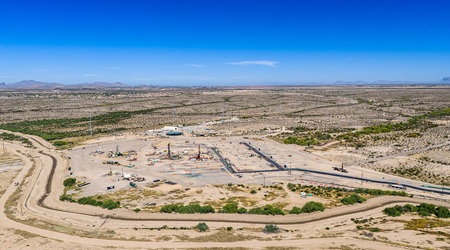
Project Blue Data Center

TUCSON, AZ (April 17, 2026) — After months of discussion and limited visible activity, site work is now underway on the proposed Project Blue data center campus near Houghton Road and Interstate 10.

The site, located just north of the Pima County Fairgrounds, is beginning to show signs of movement as this year’s fair gets underway. Recent drone footage shows a newly installed gate allowing construction equipment onto the property, one of the clearest indications yet that early-stage development has begun.

The Pima County Fair runs from April 16-26 this year, and traffic is already emerging as a concern for fairgoers and nearby residents. The Pima County Fair Authority said it has a traffic plan in place and expects fair operations to continue running smoothly.

Dust control is another issue as crews begin grading the desert site. Removing vegetation and disturbing native soil can increase airborne dust during large-scale site preparation. The Pima County Department of Environmental Quality said it has issued a dust control permit to Project Blue contractors and provided requirements intended to limit dust from leaving the site.

Beale Infrastructure, the company developing the data center complex, said the Houghton Road project remains on track to be operational in 2028.

“The Houghton Road data center project is anticipated to be operational in 2028. Construction is currently underway – including clearing and grading – for early stage site development. Dust mitigation plans are in place and being managed on a daily basis, and closely monitored at all times,” the company said in a statement.

For now, the start of clearing and grading marks the most visible sign to date that the Project Blue site is entering its first phase of development.