ULI Panel: Give Free Market a Chance Tucson (Part 2 of 2)
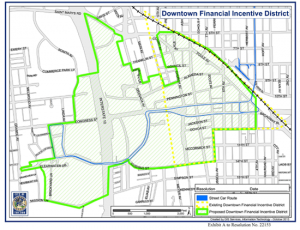
District Map studied by Urban Land Institute Panel

We reported recommendations made by the independent panel from the Urban Land Institute for Downtown Tucson Market Forces, Retail Trade Area and Tucson Convention Center. Part One was published yesterday, and this is the second part of our report.

The Urban Land Institute (ULI) advisory panel presented their findings to a room of about 200 people at the Tucson Convention Center on Friday. The ULI panel consisted of seven independent volunteers from real estate related disciplines were commissioned to address such issues as: market forces, best land use, retail, quality of life issues, and implementation for Downtown Tucson development. The panel interviewed 150 people during their week-long stay in Tucson.

The candid and unbiased input from these professionals was summarized in their report that stressed the importance of prioritizing projects, taking small steps towards long-term goals, while creating synergy within the community and leveraging limited public resources to encourage private sector investment.

The study area as shown in the map included the panel focusing on downtown Tucson, the TIF District, the Streetcar route and east and west side of I-10 in this area.

Streets in the District
Street have a role in setting the desert scale and serve to match service to demand. Parking needs to be strategically thought out for development and temporary events. Fortunately, the district is walkable, given proper signage of walkways for people to park and get to their destinations.

There are currently oversized streets for their traffic volume. Streets such a Church north of Broadway could be converted for street parking. The panel warned to beware of closing any streets and suggested adding streets back to the super blocks where possible.

Quality of life is closely related to how easy it is to move around downtown. The panel emphasized that bikes and streetcars are not compatible, and bike paths should be separated away from the streetcar route. The fixed Stravenues could also help bikers get around and keep them safely separated from the streetcar.

Implementation
The implementation of revitalization in downtown depends upon the strengthening of civic engagement and cooperation between the stakeholders. It is recommended that an ongoing advisory committee be established that would comprise one member from each of the following: City of Tucson, Pima County, Rio Nuevo, University of Arizona, Public Transportation, Neighborhood Groups, Retail, Developers, Non-governmental agencies, and office owners. The panel stressed the importance of an advisory committee being representative of the stakeholders and not comprise elected officials of the government organization. The advisory committee members would act as liaisons to serve on the advisory committee.

Other recommendations the panel made were to have an IT master plan that would include data collection, for instance pedestrian count today should be measured for date to compare later in the district. Transparency was also brought up as important to engage civic participation and support. A Citizen Ombudsman would go a long way in assisting developer and citizen issues / problems as they arise.

Downtown Tucson Partnership could be used to bring temporary events to the TCC, a temporary miniature golf course that was set up in Philadelphia for 30-days was used as an example of this. This allows for small steps to be taken that would increase pedestrian activities downtown without spending a lot of money.

Another example, was the use of the fountains at TCC which are in disrepair. The panel recommended that not all the fountains be activated at once, but maybe just the one in front of the Music Hall could be made to function and help the aesthetic appearance at this entrance.

Recommended La Placita be donated by the City for activities such as educational activities like children’s visits to the museum.

A digital public walking tour should also be considered, where visitors could click their cell phone to hear a brief history at certain spots, buildings, art pieces, etc.

In Summary:
The panel concluded that a detailed market analysis would be of benefit to determine market rates for multifamily. This would encourage a hotel development to the area and determine current office space in the district.

Economically, there are no sources for funding and fortunately for Tucson the TIF district was established. That, with free market forces working together can make this happen; but it will be done only with patience and teamwork. The public sources cannot do it without private capital and vice versa. Think small steps, a new arena is not needed unless the current TCC would be at full capacity.

It is as Mayor Jonathan Rothschild said in his opening remarks at the meeting, “This may be Tucson’s last chance to get it right.”

The volunteer panel members from the Urban Land Institute consisted of the following members: John Walsh, Alan Billingsley, Michael Berne, Charlie Johnson, Ross Tilghman, Peter Hasselman, and Jan Minana. The study was a public and private joint effort of  Pima County, the City of Tucson, Rio Nuevo, Pima Association of Governments, Visit Tucson, Tucson Electric Power and Holualoa Companies who paid for the study.


HSL Sells Two Projects Totaling 488-Units for $50.5 Million in Scottsdale

Cabrillo Apartments
Cabrillo Apartments

Scottsdale – Tucson-based, HSL Properties, Inc. (Humberto Lopez, principal) sold two apartment projects in Scottsdale totaling a combined 488-units for $50.5 million. The Scottsdale properties are the first direct multi-family acquisitions in Arizona for New York Life Investors, which is a wholly-owned subsidiary of New York Life Insurance Company. Various New York Life entities have previously made loans backed by Valley apartments and the company also holds interests in office project in the Phoenix area. New York Life Investors is interested in buying additional apartment properties in the Arizona. Brad Goff and Dave Lord of Apartment Realty Advisors of Phoenix represented the seller in both transactions.

Casa Santa Fe
Casa Santa Fe

The two transactions closed last Thursday, in which Madison-MF Casa Sante Fe AZ LLC (New York Life company) paid $29.245 million ($110,777 per unit) to acquire the 264-unit Casa Santa Fe apartments at 11105 N. 115th Street in Scottsdale. The seller was HSL Casa Sante Fe Properties LLC. And in a $21.255 million sale ($94,888 per unit), Madison-MF Cabrillo AZ LLC purchased the 224-unit Cabrillo apartments located at 11620 E. Sahuaro Drive in Scottsdale. HSL Casa Sante Fe Properties was also the seller. HSL Properties had paid $28.6 million to purchase both Cabrillo and Casa Sante Fe just over four years ago. In January 2010, HSL paid $12.6 million ($56,250 per unit) to acquire Cabrillo. In December 2009, HSL paid $16 million ($60,606 per unit) to purchase Casa Santa Fe. Both of the apartment projects were developed in 1987 by Fairfield Residential Inc. of San Diego. With the sales to New York Life, HSL Properties still owns 10,000+ apartment units in 39 projects located in the Phoenix and Tucson areas. Omar Mireles, Vice-President of HSL Properties says the company is looking to buy additional apartment projects in Arizona. The contact at New York Life Investors is Chris Hunt, he can be reached at (415) 402-4109. Call Mireles at (520) 322-6994. Goff and Lord are at (602) 252-4232.


Modest Growth Seen in Commercial Real Estate Markets

Real Estate Daily NewsCommercial real estate leasing patterns are showing steady but modest growth, according to the National Association of Realtors® quarterly commercial real estate forecast.

Lawrence Yun, NAR chief economist, projects only modest changes in the coming year. “Jobs are the key driver for commercial real estate, and the accumulation of 7 million net new jobs from the low point a few years ago is steadily showing up as demand for leasing and purchases of properties,” he said. “But the difficulty of accessing loans remains a hindrance to a faster recovery.”

The gross domestic product rose from 2.5 percent in the second quarter to 2.9 percent in the third quarter. NAR’s recent Commercial Real Estate Quarterly Market Survey shows leasing activity rose 2 percent in the third quarter from the second quarter, and higher sales levels than a year ago.

Yun said there have been some shifts in commercial purchases. “Investors have been looking for better yields, and have found good potential in smaller commercial properties, notably in secondary and tertiary markets,” he said. “Sales of commercial properties costing less than $2.5 million in the third quarter were 11 percent above a year ago, while prices for smaller properties were 4 percent above the third quarter of 2012.”

Commercial investment in properties costing more than $2.5 million1 rose 26 percent from a year ago, while prices for large properties were 9 percent above the third quarter of 2012.

National vacancy rates over the coming year are forecast to decline 0.2 percentage point in the office market, 0.6 point in industrial, and 0.5 point for retail real estate. The average multifamily vacancy rate will edge up 0.1 percent, but that sector continues to see the tightest availability and biggest rent increases.

NAR’s latest Commercial Real Estate Outlook offers overall projections for four major commercial sectors and analyzes quarterly data in the office, industrial, retail and multifamily markets. Historic data for metro areas were provided by REIS, Inc., a source of commercial real estate performance information.

Office Markets
Vacancy rates in the office sector are expected to decline from a projected 15.6 percent in the fourth quarter to 15.4 percent in the fourth quarter of 2014.

The markets with the lowest office vacancy rates presently (in the fourth quarter) are New York City, with a vacancy rate of 9.8 percent; Washington, D.C., at 9.9 percent; Little Rock, Ark., 12.0 percent; and Nashville, Tenn., 12.9 percent.

Office rents should increase 2.4 percent this year and 2.5 percent in 2014. Net absorption of office space in the U.S., which includes the leasing of new space coming on the market as well as space in existing properties, is seen at 32.2 million square feet this year and 46.1 million in 2014.

Industrial Markets
Industrial vacancy rates are likely to fall from 9.2 percent in the fourth quarter of this year to 8.6 percent in the fourth quarter of 2014.

The areas with the lowest industrial vacancy rates currently are Orange County, Calif., with a vacancy rate of 3.9 percent; Los Angeles, 4.0 percent; Miami, 6.0 percent; and Seattle at 6.3 percent.

Annual industrial rents are expected to rise 2.3 percent this year and 2.5 percent in 2014. Net absorption of industrial space nationally is anticipated at 97.0 million square feet in 2013 and 104.9 million next year.

Retail Markets
Retail vacancy rates are forecast to decline from 10.4 percent in the fourth quarter of this year to 9.9 percent in the fourth quarter of 2014.

Presently, markets with the lowest retail vacancy rates include Fairfield County, Conn., at 3.9 percent; San Francisco, 4.0 percent; Long Island, N.Y., 5.2 percent; and Northern New Jersey at 5.3 percent.

Average retail rents should increase 1.4 percent in 2013 and 2.2 percent next year. Net absorption of retail space is projected at 11.0 million square feet in 2013 and 18.1 million next year.

Multifamily Markets
The apartment rental market – multifamily housing – is likely to see vacancy rates edge up 0.1 percentage point from 3.9 percent in the fourth quarter to 4.0 percent in the fourth quarter of 2014, with new construction helping to meet higher demand. As a rule, vacancy rates below 5 percent are considered a landlord’s market, with demand justifying higher rent.

Areas with the lowest multifamily vacancy rates currently are New Haven, Conn., at 1.9 percent; Syracuse, N.Y., 2.0 percent; Minneapolis and San Diego, at 2.1 percent each; and New York City, 2.2 percent.

Average apartment rents are forecast to rise 4.0 percent this year and 4.3 percent in 2014. Multifamily net absorption is projected to total 239,400 units in 2013 and 211,300 next year.

The Commercial Real Estate Outlook is published by the NAR Research Division. NAR’s Commercial Division, formed in 1990, provides targeted products and services to meet the needs of the commercial market and constituency within NAR.