Data Centers in the Desert: Why Phoenix is a hotbed for this technology-centered real estate


DataCenterReprint from Commercial Executive Magazine By Tim J. Randall

Entering the complex there is a Fort Knox feeling reminiscent of the classic James Bond movie Goldfinger: security access, cameras, closed-circuit monitors, guards, and badges. While there is no Oddjob at this facility, there is definitely a feeling of control, precision, and protection. The structure itself has the look and feel of a thousand other non-descript commercial buildings, however, once inside the premises the uniqueness of its operation is apparent. This particular building is the home of Phoenix NAP, an operator of one of the many data centers located in the Greater Phoenix Metropolitan area. And in a fascinating juxtaposition, Fort Knox and the data center are both designed to protect a valuable asset – the former gold bullion, and the latter the currency of intellectual property, data, and information.

The modern data center is a relatively new entrant into the technology and real estate space. Specifically, the data center is “the heart and brain behind the storage and transmission of data that empowers computers, phones, smart-phones, hand-held devices, GPS systems and other computer-centric devices.” From their origins as essentially data processing functions housed primarily in the office space of companies, the data center has evolved to service the geometric growth in technology and information over the past 25 years. Mark Bauer, managing director of Jones Lang LaSalle’s Data Center Solutions Group and his associate, Carter Robinson, point to the development of the data center as an outgrowth of companies large and small needing to manage ever-increasing loads of information and data. As these demands mounted, organizations needed dedicated space to house the requisite technology hardware. Mark Krison and Scott German, Data Center Broker specialists with CBRE, agree with this assessment. “Technology has been the main driver of the data center as more and more information must be stored.”

Evolution

The last two decades have been an evolution of the data center from corporate backroom, to enterprise facilities in which large companies owned and operated their custom space, to now third party vendors owning the building and leasing space to clients. Touring Phoenix NAP, the facility is able to house servers and hardware for companies of myriad size and capability for their individual specifications. Bauer and Robinson explain this evolution by citing the cost effectiveness of firms moving their data storage to third party facilities. “With technological obsolescence it becomes the data center operator’s responsibility for equipment, upkeep, and refreshment.”

Cost is a paramount concern for any organization and with technological innovation, the expense of data storage and management is an ever-present concern. Krison and German point to the unique and expensive nature of these facilities both in initial capital expenditure of millions of dollars, ranging from $1,200-$1,700 per-square-foot, and the ongoing cost of upgrades and maintenance. This has propelled the recent data center trend – the positioning of multiple organizational presences inside one third party vendor facility.

Statistics

To say that data centers are big business would be the technology equivalent of the energy boom in Hydraulic Fracturing and Horizontal Drilling. While numbers vary slightly from source to source, total global data center spending in 2012 was, according to Gartner, a leading IT tracking firm, $141 billion. Projected outward, data center spending will reach $218 billion in 2020 according to German and Krison, who cite their resources at Datacenter Dynamics, another leading research organization. Parallel to these findings, U.S. data center spending was roughly one-third, or $50 billion, and Western U.S. investment in data centers was ranked number one in the world in 2012. This last figure is especially interesting because Phoenix has and will continue to play a dominant role in data center expansion.

Why Phoenix? Read more….



Walmart settles with US Labor Department

smiley face starvingWASHINGTON —Walmart Stores, Inc., has entered into a corporate-wide settlement agreement with the U.S. Department of Labor to improve safety and health conditions in all 2,857 Walmart and Sam’s Club stores under federal jurisdiction. The settlement, which resolves two enforcement cases that began in 2011, includes provisions for the Bentonville, Ark.-based retailer to enhance safety and health practices and training related to trash compactors, cleaning chemicals and hazard communications corporate-wide.

“This settlement will help to keep thousands of exposed Walmart workers safe and healthy on the job,” said Assistant Secretary of Labor for Occupational Safety and Health Dr. David Michaels. “We hope this sends a strong message that the law requires employers to provide safe working conditions, and OSHA will use all the tools at our disposal to ensure that all employers follow the law.”

Under the settlement, trash compactors must remain locked while not in use, and may not be operated except under the supervision of a trained manager or other trained, designated monitor. Walmart will also improve its hazard communications training; and, for cleaning chemicals, will enhance its procedures to ensure that employees do not handle undiluted chemicals. Also, the company must ensure that a protective protocol is in place in case of any malfunctions with a store’s cleaning chemicals dispensing equipment. Walmart will ensure employees are trained on the new procedures in a language, format, and vocabulary that the workers can understand.

For the safety citations pertinent to the corporate-wide trash compactor abatement, the settlement affirms one repeat lockout/tagout citation, two serious lockout/tagout citations, two serious confined space citations, and one serious machine guarding citation.

For the health citations pertinent to the corporate-wide cleaning chemical and hazard communication abatement, the settlement affirms two serious citations related to personal protective equipment, and two serious hazard communication citations.

A summary of the agreement will be posted in each affected store.

Settlement negotiations followed issuance of citations from two separate inspections conducted at the Walmart Supercenter store in Rochester, N.Y. A safety inspection was initiated on Aug. 2, 2011, and a health inspection began Aug. 17, 2011. As part of the settlement, Walmart has also agreed to abate other hazards in the Rochester store unrelated to the corporate-wide remedy, and will pay $190,000 in civil penalties.

For the citations not related to the corporate-wide abatement, citations affirmed in the settlement include one repeat electrical hazard citation, one serious citation for obstructed exit routes, two serious machine guarding citations, one repeat other-than-serious platform fall hazard citation, and 11 serious bloodborne pathogens citations.

The settlement agreement can be viewed at https://www.osha.gov/CWSA/walmart2013.html.

Under the Occupational Safety and Health Act of 1970, employers are responsible for providing safe and healthful workplaces for their employees. OSHA’s role is to ensure these conditions for America’s working men and women by setting and enforcing standards, and providing training, education and assistance. For more information, visit https://www.osha.gov


‘May the Road Rise Up To Meet You’ South Tucson

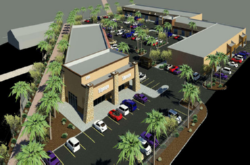
Proposed Madera Center

This article has been archived, please login for access or subscribe now by going to the subscribe tab at the top of page.

This old Irish blessing, “may the road rise up to meet you”, takes on a whole new meaning in a deal struck by the City of South Tucson and local developer, Larsen Baker. Welcoming new jobs, the City Council did not waste any time unanimously agreeing to a rededication of a portion of Old Vail Road in order to make room for redevelopment of an office campus.

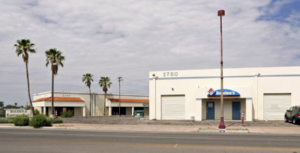
When Larsen Baker of Tucson looked into buying the Madera Business Park at 2750-2760 S 4th Avenue in South Tucson, they went to the City Manager’s office to discuss a problem they saw with regard to the property. That problem being the matter of Old Vail Road bifurcating the property.

“The distressed property sold back in 2007 when prices were high,[mepr-show rules=”58038″] for $2.8 million and had since fallen victim to the recession,” said George Larsen of Larsen Baker. “Our goal when we started was to figure out a way in which we could convert the property from its current industrial incubator use into a gated office campus.”

The 35,200 sq. ft. Madera Business Park had been almost vacant for quite some time, leaving an odd tenant mix of a crematorium and a Domino’s Pizza. The lender, Maple Madera, LLC, held by Trimont Real Estate Advisors of Ivine, CA, sold the property for $650,000 (under $19 PSF) in an REO sale to Larsen Baker.

The City of South Tucson covers a small area of about 1.2 square miles at the junction of Interstate 19 and Interstate 10 and about 1 mile south of downtown Tucson. It is bounded on three sides by two freeways and the Union Pacific railroad tracks, completely surrounded by the City of Tucson, Arizona.

Larsen knows it is a good location, within an empowerment zone and only blocks from downtown Tucson. “That’s exactly what call centres, NGO Health Services and GSA are wanting,” Larsen revealed. “This will be more than a redevelopment, it’s a ‘repurposing’ of the property, with a guard house entry at the front and a wrought iron surround for a new office campus.”

Enrique Serna of the City Manager office met with the developer and presented the project to City Council. He agreed that dedicating the section of Old Vail Road from 4th Ave to 5th Ave in exchange for the appraised value going for landscaping improvements on behalf of the City and the El Paso Greenway project represents the best thing to happen in South Tucson for quite some time.

The developer already has a tentative tenant wanting 18,000 sq. ft. and with the road dedication will be able to develop the project into a 40,000 sq. ft. office campus. With estimated development costs of $50 PSF, or approximately $2 million, there is room to allow for reasonable market rates. If all goes as planned, tenants could start moving in next year, bringing new jobs to South Tucson.

Keri Silvyn, Partner at Lazarus, Silvyn & Bangs, PC acted as legal counsel for the developer in negotiations with the City.

Brandon Rodgers of Cushman & Wakefield / Picor represented the seller and Andy Seleznov and Melissa Lal of Larsen Baker represented the investor in the transaction.

Silvyn should be contacted at (520) 207-4464. Rodgers is at (520) 546-2714. Seleznov and Lal can be reached at (520) 296-0200.[/mepr-show]


Current Madera Business Park

Login for additional information.

[ismember]Sale date was 7/29/2013. The road was valued at $2.50 PSF. Land area prior to road addition was 2.7 acres. We did not research how much additional land are the road brought to the property. [/ismember]