Tucson’s Global Solar Energy Acquired by China’s Solar Leader

This article has been archived, please login for access or subscribe now by going to the subscribe tab at the top of page.
China’s Hanergy now owns Tucson-based Global Solar Energy (GSE). Hanergy’s announcement says “it has completed the equity acquisition of Global Solar Energy, Inc., a manufacturer with the world’s leading copper indium gallium diselenide (also known as CIGS) solar technology, the acquisition follows approval from the Committee on Foreign Investment in the United States and the National Development and Reform Commission, the regulators governing cross-border acquisitions in the U.S. and China, respectively. Global Solar is one of just a few producers able to manufacturer flexible CIGS solar cells on a commercial scale in the world.”
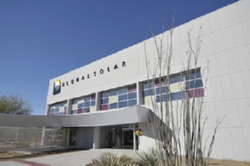
Hanergy did not purchase the 117,000 sq. ft. facility at 8500 S Rita Road in Tucson. It was transferred from Global Solar to Mithril Real Property, Inc., a German-based company owned by Jan-Hendrick Stroher, a former director of Global Solar, for[mepr-show rules=”58038”] $7.3 million in a non-arm’s length transaction to be leased back to Global Solar at undisclosed terms. The real property includes 117,000 sq. ft. in two buildings (built 1979 and 1995) on 14 acres in southeast Tucson. Global Solar bought the property in 2007 for $6.44 million.
Global Solar, a privately owned company, founded in 1996 by UniSource Energy and ITN Energy Systems, a subsidiary to Tucson Electric Power. Solon AG bought out UniSource’s stake in the company for $16 million in 2008.
The 750-kilowatt (kW) solar system covering 310,000 sq. ft, built by Global Solar next to the facility was split off and transferred to MMA Rita Power, LLC, a subsidiary of MMA Renewable Ventures and Municipal Mortgage & Equity, LLC.
California, in December 2012. Tucson Electric Power helped fund the solar project through its agreement to purchase the renewable energy credits generated. These credits were to help TEP pursue its goals under Arizona’s Renewable Energy Standard, which calls on utility companies to secure 15% of their power from renewable resources by 2015. SunEdison will continue to operate the solar system.
For the past several years, Global Solar has concentrated its energies into making flexible solar panels and worked with Dow Chemical to develop a roofing shingle made with CIGS cells.
In December 2012, Global Solar halted production of its portable solar charging equipment, flexible modules and building-integrated PV (BIPV) and laid off about 95 employees.
Global Solar had been selling CIGS products on a flexible substrate for more than eight years and was notable for its small but real production volumes of 11-percent-efficient solar cell product. The plummeting cost of crystalline silicon solar panels from China has eroded the value proposition of CIGS thin-film solar, which so far have not lived up to its promises of low cost and competitive efficiency.
Planning to become the “global leader in flexible thin-film solar,” Hanergy now adds Global Solar Energy to its collection of CIGS companies that include Solibro and MiaSolé, former competitors to Global Solar. In June 2012, Hanergy acquired Solibro, the CIGS operations belonging to Germany’s Q-Cells. MJ Shiao of GTM Research’s Solar Division points out that MiaSolé uses a roll-to-roll sputtering process, while Solibro uses a batch coevaporation process and that’s “pretty much the opposite end of the spectrum, as far as CIGS deposition goes.” Global Solar Energy uses a coevaporation process.
Hanergy America, Inc. a fully owned subsidiary of Hanergy Holding Group Ltd., is responsible for developing solar projects throughout the Americas. It was incorporated in the State of California in 2010 and headquartered near the San Francisco Airport, in the city of Burlingame. Based in Beijing, Hanergy is China’s largest privately owned power generator. It has 6+ GW of generating capacity operating or in construction. One of the operating hydropower stations, Jin’anqiao, has 3GW capacity, which is 1.4 times bigger than Hoover Dam. All of Hanergy’s generating capacity comes from renewable sources, mostly hydro, but also wind and solar.
Solar Power is now Hanergy’s primary focus. It owns and uses some of the world’s most advanced core technology for thin film silicon modules.
A statement adds, “In the past year, Hanergy has acquired Solibro and MiaSolé; both leading players in the CIGS technology field. Those transactions took the conversion rate of Hanergy’s thin-film PV modules to an unrivalled 15.5%. The acquisition of GSE closes the loop of Hanergy’s strategic consolidation of technologies that combine the competitive advantages of flexible thin-film PV modules and large scale production. It also demonstrates Hanergy’s continued leadership and commitment to developing advanced thin-film technology, and is a further step in its investment in leading CIGS technology and efficient alternative cell materials.”
Since it is unlikely that Hanergy is amassing a defensible CIGS PV intellectual property stance, it truly appears that Hanergy is going wide and deep into CIGS thin film just when the U.S. CIGS effort has diminished to a few staunch technologists. Sources have indicated that it’s more than just Hanergy which believes China can win in CIGS. Chinese solar tariffs favoring flexible PV and BIPV won’t hurt Hanergy’s cause, either.
Jeff Britt, Chief Executive Officer of Global Solar, stated, “We are pleased to join with Hanergy, which we believe will best leverage our unique products and technologies to complement Hanergy’s existing ones. Together we are well positioned to implement Hanergy’s strategy of accelerating the growth of the flexible solar market and exploit new market potentials.”
Global Solar will become a wholly owned subsidiary of Hanergy, an 8,000-employee wind and hydropower developer which claims to have entered into solar-power plant construction agreements with a combined capacity of approximately 10 gigawatts.
Currently, Hanergy predominates seven of the world’s leading thin-film technology lines, including amorphous silicon – germanium and copper indium gallium diselenide. The mass production of thin film solar modules conversion rate has reached 15.5% whereas research has reached the maximum conversion rate of 18.1%. According to the data in “Global Renewable Energy Report 2013” published by Hanergy, China’s investment in renewable energy is ranked first in the world. By 2013, China is expected to surpass Germany and become the world’s largest PV application market.
In 2011, Hanergy built two 300 MW/year solar panel production plants. The company will expand its production capacity to 2+ GW by the end of 2012, by adding an additional five plants. Panels from these factories will be used on rooftops and in solar parks throughout the world. In November, 2011, Hanergy acquired a $4.72 billion credit line with China Development Bank for project development and advanced solar technology acquisition. Hanergy’s current development pipeline is 4+ GW, of which 540 MW is already under construction.
Hanergy has also acquired Solyndra, SoloPower, and Nanosolar as well.[/mepr-show]