Sahuarita Voters Approve Proposition 420, Ratifying Updated General Plan
SAHUARITA, ARIZ. (July 24, 2026) — Sahuarita voters have approved Proposition 420, formally ratifying the town’s updated General Plan, a long-range policy document that will guide growth, development, infrastructure investment and land-use decisions over the next two decades.

The General Plan serves as Sahuarita’s blueprint for future development, addressing housing, employment, transportation, economic development, public facilities, water resources, open space and environmental planning. It is designed to help the town accommodate anticipated growth, coordinate infrastructure investment and preserve community priorities.

For developers, property owners and investors, the plan offers insight into Sahuarita’s vision for future residential, commercial and employment growth. It will also serve as the policy foundation for subsequent planning, zoning and infrastructure decisions.

Approval of Proposition 420 does not authorize any specific project, rezoning or development entitlement. Individual proposals will continue to be reviewed through the town’s established public hearing and approval processes.

Arizona law requires municipalities to adopt comprehensive General Plans and submit updated plans to voters at least once every 10 years. With Proposition 420 approved, Sahuarita’s updated General Plan will serve as the town’s primary policy guide as it prepares for continued growth and investment.

The updated General Plan and supporting documents are available on the Town of Sahuarita’s website


University of Arizona Breaks Ground on $250 Million Catalina Residence Hall

Catalina
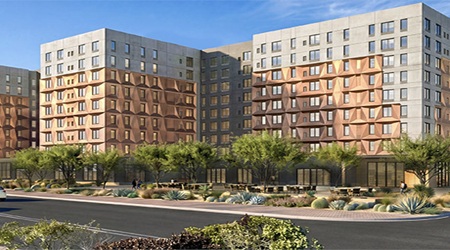
The Catalina will offer 1,300 rooms for students attending the University of Arizona for Fall 2028

TUCSON, AZ (July 23, 2026) — The University of Arizona and its development partners have broken ground on The Catalina, a nine-story, suite-style residence hall that will add more than 1,300 beds at the northwest corner of Speedway Boulevard and Campbell Avenue in Tucson.

The development is planned on approximately 3 acres, including the former Palm Shadows Apartments property and adjacent university-owned land. Completion is scheduled for fall 2028.

Previously released Arizona Board of Regents documents placed the project’s total development cost at up to $250 million, including approximately $145 million in direct construction costs.

Mortenson Development is leading the project, with Mortenson providing development, design and construction services. Gensler prepared the architectural renderings. The project also includes a dining hall, student programming space and support services intended to create a living-learning environment for first-year students.

Collegiate Housing Foundation will finance, own and operate the residence hall under a long-term ground lease with the university. Tax-exempt financing is being arranged in partnership with RBC Capital Markets and is expected to be repaid through residence-hall revenues, leaving the university without a direct debt obligation.

The Catalina will help accommodate the university’s new expectation that first-time, full-time freshmen live on campus beginning in fall 2026, subject to exemptions for students living within 30 miles of campus and those facing qualifying hardships or other circumstances.

University of Arizona President Suresh Garimella said students who live on campus for at least one year have a 50% higher four-year graduation rate than students who never live on campus.


Wild Horse Advocates Call for Scientific Review Before Salt River Herd Removals

Wild Horse Advocates

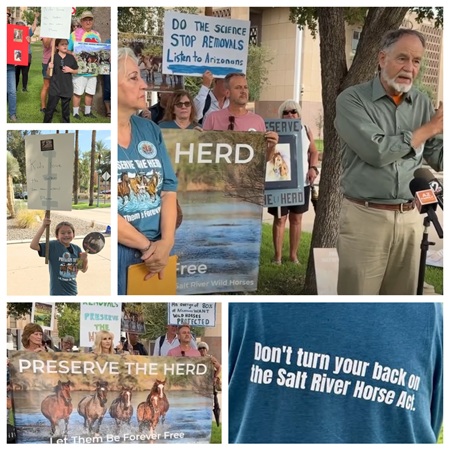
PHOENIX, Ariz. (July 23, 2026)  — Approximately 100 wild horse advocates gathered at the Arizona State Capitol Wednesday morning, calling on Governor Katie Hobbs to pause planned removals of Salt River wild horses until an independent scientific review determines whether the remaining herd would be genetically healthy and self-sustaining.

The July 22 Preserve the Herd — Follow the Science Rally challenged an Arizona Department of Agriculture plan to reduce the herd from approximately 271 horses to between 120 and 125 by the end of 2030.

“Arizona should not remove a single healthy horse until the public is shown that the remaining herd will be genetically viable,” said Susie Bell of Friends of the Salt River Wild Horses.

Wildlife ecologist and author Craig C. Downer warned that a population target cannot be evaluated solely by counting horses. He said scientists must also consider the number of unrelated breeding animals, representation of family lines, age and sex distribution, foal recruitment and the continuing effects of fertility control.

Dr. E. Gus Cothran, a nationally recognized equine population geneticist and professor emeritus at Texas A&M University, has said populations of 150 to 200 horses are generally considered a minimum for protecting long-term genetic health, although herd viability depends on several factors.

The Salt River herd has already declined by more than 40% over the past five years, falling from approximately 450 horses to about 271 due to fertility control and natural attrition. Advocates contend the current program could reduce the population to approximately 165 to 168 horses within five years without permanent removals.

Public records have also raised questions about how the proposed population target was selected. Requested documents indicate the original recommendation of approximately 100 horses emerged from a straw poll rather than an independent population study. The number was later negotiated upward, but advocates say no independent scientific analysis supporting the final target has been released.

Representative Cody Reim, who attended the rally following his primary victory Tuesday, pledged to introduce new legislation requiring science-based protections for the herd.

“The Salt River Horse Act was never intended to justify removing these horses,” Reim said. “It was enacted to protect the herd and prevent exactly this from happening.”

The Salt River wild horses are a popular attraction for visitors, photographers and recreationists along the Lower Salt River. Advocates are asking Hobbs to pause permanent removals, release the data supporting the proposed population target, and commission independent genetic testing and a population viability analysis before the state proceeds.