Cavan Cos. Sells Phoenix Bungalows on Camelback Build-to-Rent Community for Record $112.5 Million
Bungalows on Camelback

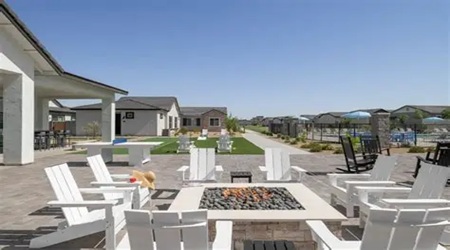
PHOENIX, AZ (July 13, 2026) — Cavan Cos. has sold Bungalows on Camelback, a 334-unit build-to-rent community in Phoenix, for $112.5 million.

The transaction represents the highest-priced sale of a build-to-rent property in Arizona and ranks as the fourth-largest multifamily sale in the Valley so far in 2026.

Cavan completed the community in 2022 at 4747 N. 99th Ave. An entity tracing to Marlowe D. Moy acquired the property, according to Tempe-based real estate database Vizzda LLC.

The transaction closed on June 30. Berkadia Phoenix Senior Managing Directors Mark Forrester, John Cunningham, Charles Steele and Ric Holway, Managing Directors Andrew Curtis and Dan Cheyne, and Senior Director Ryan Boyle represented the seller, Scottsdale-based Cavan Companies.

Another major multifamily transaction also closed that day: the $124.5 million sale of Camden Gilbert, a 320-unit apartment community at 3150 E. Ray Road in Gilbert.

Built in 2021, Camden Gilbert was sold by an entity tracing to PGIM Real Estate to an entity tracing to Camden Living, according to Vizzda.

The sale ranks as the Valley’s third-largest multifamily transaction of 2026. It trails the $142.5 million sale of The Residences Kierland in June and the $125 million cash purchase of Cortland Biltmore by Arte Moreno in March.

Multifamily Investors Remain Cautious

Multifamily investment activity increased during the second quarter of 2026 compared with the first quarter, although transaction volume for the first half of the year remained below the year-earlier level.

Peter O’Neil, national director of research for Northmarq, said six multifamily properties sold for more than $100 million during the first half of 2026—the same number of nine-figure transactions recorded during the first half of 2025.

Recently completed communities are providing investors with additional acquisition opportunities. Approximately one-third of the multifamily properties sold during the first half of 2026 were built within the past five years, O’Neil said.

Although transaction activity increased from the first quarter, elevated interest rates, declining rents, and broader economic uncertainty continue to weigh on the investment market.

“In the first half of last year, there was a lot of uncertainty surrounding the potential impact of tariffs on construction costs, the pace of economic growth, inflation and interest rates,” O’Neil said. “This year, there are similar uncertainties surrounding inflation and interest rates, but the war in Iran and the corresponding rise in gas and fuel costs has been what has driven these concerns and complicated the outlook.”

The 21st Century ROAD to Housing Act also introduced another layer of uncertainty for the build-to-rent sector during the first half of the year.

“For the bulk of the investment market for traditional multifamily properties, the housing bill wasn’t really seen as an obstacle to doing deals,” O’Neil said. “It wasn’t a driver of activity either—mostly neutral for traditional multifamily.”

O’Neil said the primary challenges facing the multifamily investment market remain elevated borrowing costs and rents that are lower than they were one year ago.

Despite those pressures, multifamily investment activity appears to be gradually improving in Phoenix and nationally, although the pace of growth remains modest.


The Watermark at Oro Valley Sells for $23 Million Rebrands to The Ironwood at Oro Valley

Watermark
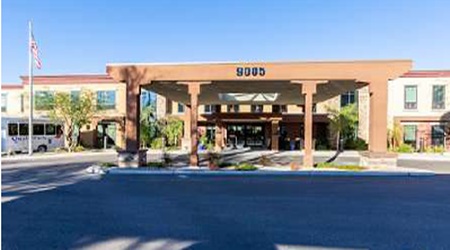
The Watermark at Oro Valley, 9005 N Oracle Rd., Oro Valley, AZ

ORO VALLEY, ARIZONA (July 10, 2026) — The Watermark at Oro Valley, a 101-unit assisted living community at 9005 N. Oracle Road in Oro Valley, sold for $23 million in an investment sale recorded on June 30, 2026. The sale works out to approximately $227,722 per unit and $276.91 per square foot.

The buyer was 9005 North Oracle Owner LLC, c/o 9055 North Oracle Investments LLC / Steller Senior Living of Midvale, Utah. The seller was SHP V Oro Valley LLC, c/o PGIM Real Estate of Atlanta, Georgia. Nevena Vujic represented the seller, and Artemis North Oracle Members represented the buyer.

Built in 2018, the two-story assisted living facility contains 83,059 square feet on 3.42 acres in the Shadow Mountain Estates area. The property is located in Tucson’s northwest submarket near Oracle Road and Hardy Road in Oro Valley.

The community includes studio, one-bedroom, and two-bedroom units, along with an on-site theater, a fitness center with daily exercise classes, a lounge, a bar, a library with a fireplace, a beauty salon and barber shop, a courtyard, and outdoor gathering spaces. The property is also near Tohono Chul Park and other recreation areas.

The property will now be rebranded as The Ironwood at Oro Valley, Assisted Living & Memory Care.

Source: RED Comp #12576. 


Tucson Job Growth Stalls as Arizona’s Labor Market Slows

Tucson Job Growth

(JULY 10, 2026) — Arizona’s labor market continues to show resilience, but the latest employment data shows a clear slowdown—especially in Southern Arizona.

Statewide, Arizona added 2,000 seasonally adjusted jobs in May, while the unemployment rate rose to 4.8%, above the national rate of 4.3%. On a non-seasonally adjusted basis, the state lost 14,300 jobs during the month, reflecting the usual seasonal slowdown that often accompanies the start of summer.

Economists say employers remain cautious as they navigate economic uncertainty, elevated borrowing costs, rising energy costs and a shrinking labor force. While Arizona is still outperforming many states over the longer term, the pace of hiring has moderated considerably.

For Tucson, the slowdown is more pronounced.

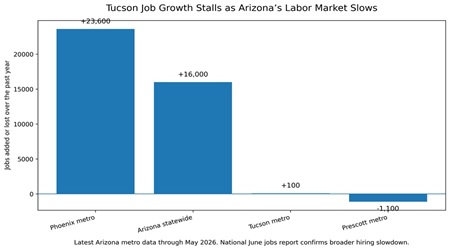
The Tucson metropolitan area added just 100 jobs over the past year, representing virtually flat employment growth of 0.02%. Through May, Tucson employment was down 0.5% year over year, underscoring the region’s continued struggle to build sustained job momentum.

Tucson’s strongest gains came from professional and business services, private education and health services, and other services. But those gains were offset by losses in several key sectors, including leisure and hospitality, government, construction, manufacturing, financial activities, and trade, transportation, and utilities.

The weakness in leisure and hospitality is particularly notable because it mirrors a broader national trend. Across the country, slower consumer spending has weighed on jobs in the accommodation and food services sector, which shed 55,000 positions in June. Those jobs are often an important entry point for younger workers, and the decline points to a softer hiring environment for early-career employees.

Nationally, the June jobs report confirmed a broader hiring slowdown, while the latest Arizona metro data show Tucson’s labor market remained nearly flat through May. According to the U.S. Bureau of Labor Statistics’ Employment Situation Summary for June 2026, employers added just 57,000 jobs nationally, the lowest monthly gain since March. Revisions to April and May job gains lowered prior job gains by 74,000, suggesting the labor market remains fragile even as the unemployment rate ticked down to 4.2%.

That decline in the national unemployment rate was not necessarily a sign of stronger hiring. Economists say it reflected a shrinking labor supply, with more than 700,000 people leaving the labor force in June. Labor force participation fell to 61.5%, down 80 basis points from a year earlier.

The labor supply challenge is being driven by several forces, including retirements, restrictive immigration policy, and slower population growth. The effects are being felt across age groups, but the steepest recent decline in participation came among workers ages 25 to 34. At the same time, employers appear to be favoring more experienced workers and productivity-enhancing technology investments over entry-level hiring.

For Tucson, that trend raises important economic development questions. A region already struggling to generate job growth cannot afford prolonged weakness in sectors that support young workers, service employment, construction activity and small business formation.

Phoenix continues to perform better than the rest of the state. The Phoenix metro area added 23,600 jobs over the past year and posted 0.3% year-to-date job growth through May, slightly ahead of the national pace. Its gains were led by private education and health services and professional and business services.

Tucson, by contrast, remains nearly flat.

Arizona’s overall economy continues to show resilience, but the divide between Phoenix and the rest of the state is widening. In Southern Arizona, the latest numbers point to a labor market that is not collapsing but is not gaining enough ground either.

With higher financing costs, rising operating expenses, and a shrinking pool of available workers, many employers appear content to hold current staffing levels until conditions become clearer. That caution may be understandable, but for Tucson, the challenge is larger: converting long-discussed economic development opportunities into measurable job growth.

U.S. Bureau of Labor Statistics, “The Employment Situation — June 2026