GCON CEO Mike Godbehere named EY US Entrepreneur of the Year
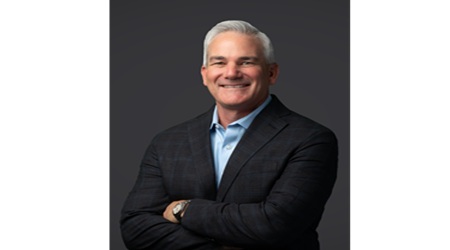
Mike GodbehereGCON CEO Mike Godbehere – 2026 Pacific Southwest award winner

PHOENIX, (July 2, 2026) – Phoenix-based GCON Co-Founder and CEO Mike Godbehere has been named an EY US Entrepreneur Of The Year® 2026 Pacific Southwest Award winner. Godbehere was selected from nearly 1,000 program participants, including 592 finalists across 17 regions, competing for the title.

Now in its 41st year, Entrepreneur Of The Year honors business leaders for their ingenuity, courage, and entrepreneurial spirit. In the case of Godbehere, this includes his successful infusion of innovation, expertise, and corporate culture to catapult GCON’s growth in line with the company’s core values of unconventional thinking, value delivery, setting a new standard, continuous improvement, and stewardship.

“This award is an incredible honor, and I am humbled to be considered among these extraordinary and impactful leaders,” said Godbehere. “We built GCON around elevating how projects are delivered by treating clients like true partners and putting the right specialized talent on every job. Over 23 years, we’ve grown into a company of remarkable people driving our culture, results, and ultimately our success. This award belongs to everyone at GCON and I could not be more proud of where we are today.”

Sinnce launching GCON in Phoenix in 2003 with his long-time friend and industry colleague, Gabe Gavriilidis, Godbehere has helped the full-service construction management firm grow to more than 200 employees operating in 28 states. In late 2025, GCON was acquired by Webcor LP, a full-service commercial builder headquartered in San Francisco.

The partnership increases GCON’s ability to actively expand on all of its product fronts, including critical high-tech environments, aviation, healthcare, education, office and industrial.

Godbehere has more than 30 years of experience in the construction industry. This includes nearly a decade at Intel, where he managed projects in excess of $500 million and held responsibility for all US and South America based construction contracts.

Godbehere was selected as an Entrepreneur of the Year by an independent panel of past winners, top CEOs and business leaders. Judges assessed candidates on long-term value creation, entrepreneurial spirit, purpose-driven commitment, and significant growth and impact

As a Pacific Southwest award winner, Godbehere will now be considered by the national judges for the Entrepreneur Of The Year 2026 National Awards, which will be presented in November at the annual Strategic Growth Forum®, where high-growth CEOs, Fortune 1000 executives and investors converge to shape the future of business. The National Overall Award winner will move on to compete for the EY World Entrepreneur Of The Year™ Award in May 2027.



ARTO Relocates from California with Former Sam Levitz Warehouse Acquisition in Tucson

ARTO Relocates

TUCSON, ARIZONA (July 1, 2026) — ARTO Brick, a Southern California-based manufacturer of handmade ceramic, porcelain, concrete tile, pavers, brick veneers, and architectural surfaces, is relocating and expanding part of its California manufacturing operation to Tucson with the acquisition of the former Sam Levitz warehouse at 3430 E. 36th St. This move marks a pivotal moment as ARTO relocates to enhance its production capabilities.

Arto 3430 LLC purchased the 123,394-square-foot building from 36th & Palo Verde Investors, LLC for $8,635,920 ($70 PSF). The building will become ARTO’s new Tucson production facility, marking a significant manufacturing expansion for the nearly 60-year-old family-owned company.

Stephen D. Cohen and Paul Hooker, SIOR, Principals and Industrial Specialists with Cushman & Wakefield | PICOR, represented the seller. Rick Borane with Volk Company represented the buyer.

Founded in 1966 by Arto Alajian, ARTO is a second-generation, family-run company with nearly 60 years of history in handcrafted tile, brick, and architectural elements. The company says Arto Alajian, a classically trained artist born in Alexandria, Egypt, passed the business to his sons, Armen and Vod Alajian, who continue the company’s legacy of handmade ceramic and concrete products.

In a 2024 interview, Armen said ARTO manufactures in California and sells online, through Los Angeles showrooms, nationwide, and internationally.

The Tucson acquisition marks a significant expansion for the company and brings new life to a property long associated with another family-owned business. Sam Levitz announced liquidation sales at its East 36th Street and West Orange Grove Road stores in October 2024, closing a 71-year run for one of Tucson’s best-known homegrown retailers. At the time, second-generation owner Sam R. Levitz described the decision as “incredibly bittersweet,” saying the family was proud of the legacy it left behind in Tucson.

While the sale marks the end of a long chapter for a Tucson institution, the property is now in the hands of a company with a similar spirit: family-owned, craft-driven, and committed to quality over convenience.

Armen first walked into the building in the summer of 2024, while it was still operating as a furniture store, and the visit stayed with him. He returned that December while spending Christmas in Tucson and arranged a Sunday walkthrough with Cohen to take a closer look at the property. As the deal progressed, he credited Cohen and Hooker for consistently making the site available for architects, consultants, and inspectors, which was especially important as an out-of-town owner evaluating a long-term manufacturing expansion.

The building’s mix of warehouse, distribution, showroom, and manufacturing areas was well-suited to ARTO’s needs. The acquisition also comes as federal tax policy is creating new incentives for domestic manufacturers to invest in production capacity. Under the One Big Beautiful Bill Act, certain qualified production property and production-related improvements may be eligible for accelerated first-year expensing, subject to detailed eligibility rules. For an owner-user investing in long-term operations rather than a buyer looking to flip the asset, those incentives could make future manufacturing improvements more attractive as ARTO evaluates how best to adapt the Tucson property for production.

“It’s like the dog that finally caught the UPS truck,” Armen Alajian said of the move. “You spend so long chasing something that you never really stop to think about what you do if you actually catch it. We caught it. Now we figure out what’s next. It is a big step for us, but like the saying goes, how do you eat an elephant? One bite at a time.”

ARTO manufactures concrete tile, ceramic tile, glazed brick veneer, clay, artazzo, porcelain, and natural stone products. The company serves architects, designers, distributors, and dealers across residential and commercial projects, from kitchens and bathrooms to large-scale commercial and exterior applications. Its products are sold across the United States and internationally.

Arto Alajian passed away in 2014, but his sons, Armen and Vod, continue to operate the company from the Southern California factory their father started after selling handmade clay brick veneers along his milk delivery route in Venice, California.

With the Tucson acquisition, ARTO is planting roots in a new market and bringing nearly 60 years of craftsmanship to Southern Arizona.

Source: RED Comp #12545.


Tucson Rents Rise in June but Remain Below Year-Ago Levels

Tucson RentsTUCSON, ARIZONA (July 1, 2026) — Tucson apartment rents moved higher in June, but the market remains more affordable than most large U.S. cities and continues to post year-over-year rent declines, according to the latest Apartment List Rent Report.
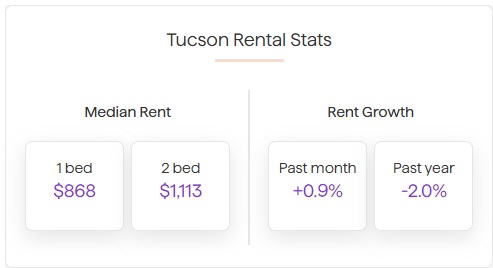
Apartment List’s July 2026 report shows Tucson’s overall median rent at $1,040, following a 0.9% increase in June. Despite the monthly gain, rents remain 2.0% lower than a year ago.

The report places Tucson among the more affordable major rental markets in the country. Among the nation’s 100 largest cities, Tucson ranked as the 98th most expensive large city, with median rents of $868 for a one-bedroom apartment and $1,113 for a two-bedroom apartment.

Nationally, the median rent stood at $1,385 overall, with a median of $1,217 for a one-bedroom and $1,371 for a two-bedroom. By comparison, Tucson’s overall median rent is approximately 24.9% below the national median.

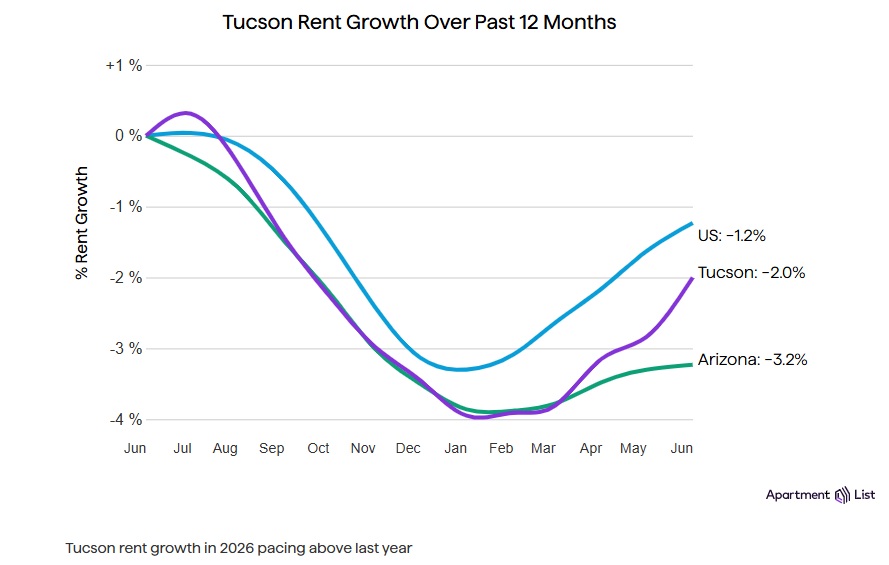
While rents are still down on an annual basis, Tucson’s rental market is showing stronger momentum than it did at the same point last year. Through the first six months of 2026, Tucson rents have increased 2.0%. During the same January-to-June period in 2025, rents had decreased 0.6%.

Apartment List reported that Tucson’s 0.9% monthly rent increase outpaced the national monthly increase of 0.4% and ranked Tucson No. 25 among the nation’s 100 largest cities for June rent growth. Similar monthly increases were reported in New Orleans and Seattle.

The report also noted that Tucson’s year-over-year rent decline of 2.0% compares with a 3.2% decline statewide in Arizona and a 1.2% decline nationally.

Apartment List calculates rent estimates using U.S. Census Bureau median rent statistics and extrapolates current-month trends using listing data and a same-unit analysis designed to track rent changes over time.

Source: Apartment List July 2026 Tucson Rent Report.