Tucson Adds Jobs in April, But Phoenix Continues to Outpace Region Year Over Year
Jobs in April

TUCSON, AZ (May 29, 2026) — Tucson added jobs in April, but the region continued to trail Phoenix and the state in year-over-year employment growth, according to the latest employment data released May 21, 2026, from the Arizona Office of Economic Opportunity and U.S. Bureau of Labor Statistics.

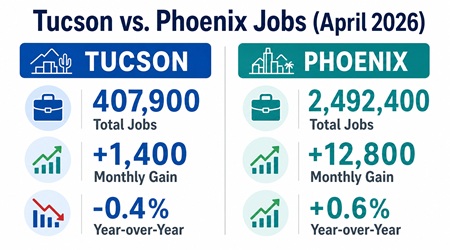
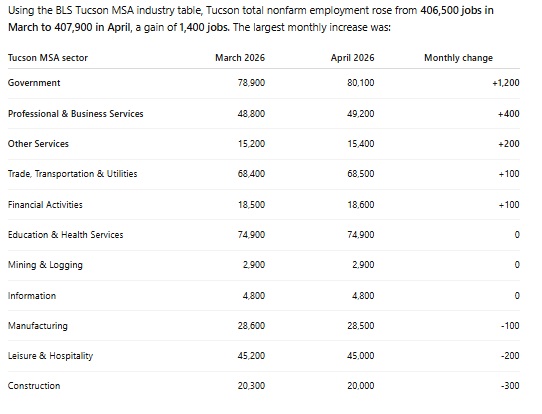
The Tucson metro area posted 407,900 nonfarm jobs in April 2026, up from 406,500 jobs in March, a gain of approximately 1,400 jobs for the month, with about 1,200 in government. Tucson remained slightly below its year-earlier level, with total nonfarm employment down 0.4% from April 2025. That equates to an estimated loss of roughly 1,600 jobs year over year.
Phoenix, by comparison, recorded 2,492,400 nonfarm jobs in April 2026, up from 2,479,600 in March, a gain of approximately 12,800 jobs for the month. Unlike Tucson, the Phoenix metro area was also up year over year, with employment increasing 0.6% from April 2025.

The contrast highlights the different scale and momentum of Arizona’s two largest metro economies. Tucson’s April increase shows some short-term improvement, but the region has not yet matched Phoenix’s ability to generate sustained year-over-year job growth.

Statewide, Arizona added 16,300 not-seasonally adjusted nonfarm jobs from March to April, according to the Arizona Office of Economic Opportunity’s April employment report. The state’s seasonally adjusted unemployment rate held at 4.7%, while the U.S. unemployment rate was 4.3%.

For Tucson, the data present a mixed picture. The month-over-month gain is positive, especially after a period of slower employment growth, but the year-over-year decline suggests the region is still experiencing softer job creation than in Phoenix and the state overall.

Phoenix’s larger employment base gives it a natural advantage in raw job gains, but its positive year-over-year growth also reflects continued expansion in sectors tied to population growth, corporate investment, logistics, health care, advanced manufacturing, and technology-related development.

Tucson’s economy remains more concentrated in government, education, health care, defense, and university-related activity. Those sectors provide stability, but they do not always produce the same level of rapid private-sector job growth seen in the Phoenix metro.

The April report underscores a central economic development challenge for Southern Arizona: Tucson is adding jobs, but not yet at the pace needed to close the gap with Phoenix or capture a larger share of Arizona’s growth.

For regional leaders, the numbers reinforce the importance of business attraction, infrastructure readiness, workforce development, and site availability. Tucson’s competitive advantages remain significant, including its university research base, defense and aerospace presence, cross-border trade position, and relative affordability. But the latest jobs data shows that converting those advantages into faster employment growth remains an unfinished task.

Bottom line: Tucson gained jobs in April, but Phoenix continues to carry more of Arizona’s employment momentum. Tucson’s challenge is not simply to grow, but to grow consistently enough to turn monthly gains into sustained year-over-year expansion.


Two Tucson Multifamily Properties Sell for Combined $2.125 Million

Tucson Multifamily
925 E Drachman St., Tucson

TUCSON, AZ (May 28, 2026) — Two Tucson multifamily investment properties sold in separate transactions for a combined $2.125 million, with Allan Mendelsberg and Joey Martinez, Principals and multifamily specialists with Cushman & Wakefield | PICOR, representing both parties in each sale.

The larger of the two sales by unit count involved a 12-unit apartment complex at 5757 E. 23rd Street in Tucson. John Francis Kopecky, Trustee, purchased the property from RW 5757 LLC, c/o CHW Property Holdings LLC, for $1.05 million. The 6,650-square-foot complex was built in 1964 and sits on 0.76 acres in Tucson’s east submarket. The sale equates to $87,500 per unit and $157.89 per building square foot. The property includes three fourplex buildings with a mix of studio, one-bedroom, and two-bedroom units, as well as laundry facilities.

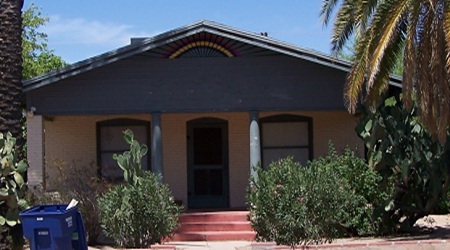
In a separate central Tucson transaction, 9th Drachman LLC, c/o SVP Holdings LLC, purchased a 9-unit apartment property at 925 E. Drachman Street from JW Elizabeth Properties LLC for $1.075 million. The 4,028-square-foot complex was built in 1936 and sits on 0.38 acres near the University of Arizona and Banner University Medical Center. The sale amounts to $119,444 per unit and $266.88 per square foot of building area. The transaction includes the 925 E. Drachman property as well as related parcels at 1236–1240 E. 9th Street and 147 N. Mountain Avenue.

Both sold around 6.7% cap rates, and together, the two sales reflect continued investor demand for small multifamily properties in established Tucson infill locations, particularly assets near major employment, education, and medical anchors.

Allan Mendelsberg and Joey Martinez of Cushman & Wakefield | PICOR served as listing and selling broker representatives for both transactions.

For more information, Mendelsberg can be reached at 520.546.2721, and Martinez at 520.546.2730.

Source: RED Comp #12502 and #12483.


Buckeye’s Next Growth Wave May Not be Rooftops, but Megawatts

Buckeye
With two gigawatt-scale data center campuses planned or proposed, the West Valley city is becoming one of Arizona’s most closely watched digital infrastructure markets.

BUCKEYE, AZ (May 28, 2026) — Buckeye is quickly becoming one of Arizona’s most closely watched data center markets, with multiple large-scale projects positioning the West Valley city as a future hub for artificial intelligence, cloud computing, and digital infrastructure.

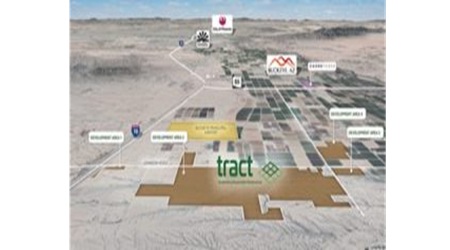
The largest known project is Tract’s Buckeye Technology Park, a master-planned data center campus on the west side of Buckeye near the Palo Verde nuclear power plant and the I-10 corridor. Tract acquired approximately 2,069 acres in 2024 for what the company said could become one of the largest data center parks in the United States. At full buildout, the project could include up to 20 million square feet of data center space across as many as 40 individual data centers. Tract said it is working with the local utility on long-term power infrastructure plans that could support up to 1.8 gigawatts.

The project reflects a major shift in how Arizona’s growth corridors are being evaluated. Buckeye has long been associated with master-planned housing, logistics, and population growth. Now, large land positions, power access, fiber connectivity, and proximity to regional infrastructure are making the West Valley a target for hyperscale technology campuses.

Data Center Dynamics described the Tract project as a 1.8-gigawatt campus, underscoring the planned power demand and the scale of the opportunity for Buckeye. The project is expected to be built in phases over many years, with individual campuses serving cloud, AI, and high-performance computing users.

Buckeye may also see another data center proposal on land once planned for a hydrogen production hub. Fortescue Future Industries, through Phoenix Hydrogen Hub LLC, has sought changes tied to approximately 158 acres near State Route 85 and Patterson Road after canceling plans for a $550 million hydrogen project. The revised direction could allow the site to be used for a future data center campus, according to reporting on the zoning request.

Together, the projects show how quickly the data center market is reshaping land-use conversations in the Phoenix region. What was once primarily a housing and industrial expansion story is now increasingly tied to energy capacity, water policy, cooling technology, and digital infrastructure.

For Buckeye, the upside could be substantial. Large data center campuses can generate long-term property tax base, infrastructure investment, and construction activity while requiring fewer public services than residential development. Buckeye Mayor Eric Orsborn, quoted in Tract’s project announcement, said the city’s work with Tract positioned Buckeye to host one of the country’s largest data center technology parks and replaced an outdated planned community concept with a long-term economic growth plan.

But the scale of the development also raises questions that are increasingly following data center projects across Arizona: how much power will be needed, where that power will come from, how water will be used for cooling, and how cities should balance high-value industrial development with long-term resource planning.

Circle of Blue reported that the former Cipriani Holdings land west of the Buckeye Municipal Airport, now part of the Buckeye Tech Corridor, is expected to shift from a residential community concept to commercial space serving cloud infrastructure, illustrating the broader land-use trade-offs facing fast-growing desert communities.

The bigger takeaway is that Buckeye’s next growth wave may not be measured only in rooftops. Increasingly, it may be measured in megawatts.

As artificial intelligence and cloud computing drive demand for larger campuses, Arizona’s ability to deliver certainty in land, power, water, planning, and permitting will play a larger role in where the next generation of data center investment lands. For Buckeye, that has already placed the city at the center of one of the largest digital infrastructure plays in the state.