Editor’s Insight: Culture Is an Asset — But It Is Not a Substitute for Economic Development
Economic Development

TUCSON (May 11, 2026) — “Expanding Tucson’s Cultural Heritage Economy,” Tucson’s Bloomberg Harvard project, as discussed at the Mayor and Council meeting on April 21, deserves careful public attention because the city’s cultural identity is one of its greatest strengths. Its food traditions, artists, festivals, historic neighborhoods, and UNESCO City of Gastronomy designation are real assets that deserve recognition and support.

But there is also reasons for caution.

A government-led effort to turn cultural heritage into an economic development strategy can avoid unintended consequences only if it is clearly grounded in the needs of residents, small businesses, and the broader economy. If culture becomes a branding exercise primarily, Tucson should ask how the city will ensure the benefits do not flow mainly to tourism campaigns, consultants, favored nonprofits, downtown programming, and politically connected organizations while the community’s deeper economic problems remain unresolved.

Before Tucson moves further down the path of turning cultural heritage into an economic development strategy, residents should ask an important question: Who benefits from this strategy? Will it help small businesses, local employers, and households across the city, or will it primarily benefit tourism campaigns, consultants, downtown programming, and politically connected organizations? Will it really create private-sector jobs, or mostly more studies, events, designations, and branding efforts? And who gets to define Tucson’s culture — the community itself, or City Hall and outside institutions?

Tucson does not suffer from a lack of identity. It suffers from lagging job creation, limited private-sector growth, infrastructure constraints, public safety concerns, permitting delays, weak regional coordination, and too few high-wage opportunities. A strategy built around festivals, designations, conferences, streetcar tourism, and cultural programming may create visibility, but visibility is not the same as economic competitiveness.

The Bloomberg Harvard project page cites Tucson’s existing creative economy as supporting more than 52,000 jobs and contributing $4.1 billion to the city’s economy, but it does not identify the source, methodology, geography, or timeframe for those figures. Nor does it specify how many new jobs, new businesses, or additional city revenues the proposed cultural heritage strategy is expected to produce.

Before Tucson treats cultural heritage as an economic development strategy, the city should define what success would actually look like. How many new businesses would be created? How many existing small businesses would see measurable revenue growth? How many private-sector jobs would result? How much new tax revenue would be generated? Which neighborhoods would benefit, and how would residents know whether the strategy worked? Without clear answers, this risks becoming another initiative measured by meetings, reports, events, and visibility rather than economic outcomes.

There is also a real risk that cultural heritage becomes managed from the top down. The very people who created Tucson’s authentic identity — local families, small restaurants, neighborhood businesses, artisans, makers, and longtime residents — could be reduced to props in a larger marketing campaign. If the strategy is not carefully handled, it could commercialize culture without meaningfully improving the lives of the people and communities it claims to celebrate.

Downtown revitalization through cultural tourism can also produce uneven results. It may help certain districts, venues, and events, but it does not automatically strengthen neighborhood businesses across the region. Nor does it solve the deeper issues that determine whether companies invest here, whether graduates stay here, whether workers can afford to live here, or whether entrepreneurs can navigate City Hall.

The question Tucson should ask is not whether culture matters. It does.

The question is whether cultural branding is being used to supplement a serious economic development strategy — or to distract from the absence of one.

If Tucson is going to build an economic strategy around cultural heritage, it should do so with clear goals, local ownership, measurable outcomes, and relevance to the private sector. Otherwise, the city risks mistaking branding for economic development and promotion for progress.

The concern is not that Tucson should avoid cultural policy, but that any cultural heritage economy must be rooted in cultural stewardship, local ownership, community benefit, and measurable outcomes for the residents, small businesses, artists, makers, and neighborhoods whose work created Tucson’s identity in the first place.

Even if “Expanding Tucson’s Cultural Heritage Economy” is framed as support for local entrepreneurs, artists, and small businesses, Tucson should be cautious about treating cultural programming as a form of economic development. The city’s most urgent needs are not more branding exercises, studies, designations, or downtown events. They are private-sector job creation, infrastructure readiness, public safety, permitting reform, regional coordination, and a clearer path for business investment. Without those fundamentals, a cultural heritage economy risks becoming another well-intentioned initiative that generates visibility but no measurable economic progress.

Tucson’s heritage should be honored, protected, and supported by the people who built it. But it should not be politicized, packaged, or promoted as a substitute for the harder work of building a stronger economy. Unless this effort is tied to measurable job creation, private investment, and real benefits for local businesses and residents, Tucson should be wary of turning culture into another city-managed strategy that mistakes promotion for progress.

Culture can help tell Tucson’s story, but it cannot substitute for the fundamentals that make a city economically competitive.



Openings & Closures: Tucson Market Remains Active as New Concepts Open and Legacy Businesses Exit

Openings & Closures

TUCSON, AZ (May 11, 2026) — Tucson’s retail, restaurant, healthcare, and service sectors continued to show steady movement this spring, with openings & closures showing several new openings, relocations, and expansions across the region, even as long-running local businesses announced closures.

As the Tucson market evolves, the theme of Openings & Closures continues to play a significant role in shaping the local economy.

Among the notable openings, Atmosphere Commercial Interiors relocated its Tucson showroom to a new Worklab location at 1820 E. River Rd., Suite 110, moving from its former downtown office at 88 E. Broadway Blvd. The company provides workplace furniture, interior solutions, space planning, and workplace design services for corporate, healthcare, education, and hospitality clients.

Nonprofit and healthcare users also expanded. Big Brothers Big Sisters of Southern Arizona opened its new Mentoring Activity Center at 2562 N. Alvernon Way on May 7, while Tucson Rehabilitation Hospital celebrated the grand opening of its inpatient rehabilitation facility at 820 E. Tucson Marketplace Blvd. on April 1. The hospital adds to the healthcare-related growth occurring in the Tucson Marketplace and Bridges area.

Restaurant activity remained active across Tucson. Shake Shack opened a new East Tucson restaurant at 5545 E. Broadway Blvd., while Lin’s Grand Buffet opened a new restaurant at 4420 N. Stone Ave. near Tucson Mall, in the former Sweet Tomatoes space. Bubba-Que Smokehouse BBQ and Tex-Mex Catering opened its first brick-and-mortar restaurant at 5005 S. Campbell Ave. in a 5,900-square-foot former restaurant building.

Local food and beverage operators also continued expanding. Desert Drifter Coffee opened its second Southern Arizona location at 10335 N. La Cañada Dr. in Oro Valley and is planning additional cafés on Broadway Boulevard and Grant Road. The Hills, a new Flores Concepts neighborhood café and restaurant, opened at 6960 E. Sunrise Dr. in the former Commoner & Co. space, while Tucson Chocolate Factory opened a new retail location at 431 N. Fourth Ave.

Experiential and specialty retail also added to the market. BoxLunch opened at Tucson Mall, expanding the center’s pop-culture and entertainment-oriented retail mix. Color Me Mine opened a second Tucson studio at 4386 N. Oracle Rd., Suite 156, in Oracle Wetmore Shopping Center. The Southern Arizona Arts Guild relocated its SAAG Gallery from La Encantada to Joesler Village at 1745 E. River Rd., Suite 135.

In Northwest Tucson and Catalina, healthcare services continued to expand with Sanova Urgent Care opening a new facility at 15883 N. Oracle Rd. The new location adds another medical user along the Oracle Road corridor, where healthcare, retail, restaurant, and service-related activity continue to follow residential growth.

Downtown Tucson may also see new entertainment activity, with Block A Sports Bar & Grill planned for the former Hi Fi Kitchen & Cocktails space at 345 E. Congress St. The approximately 9,000-square-foot venue is expected to bring a University of Arizona-focused sports bar concept to the Congress Street entertainment district. An opening date has not yet been announced.

At the same time, Tucson is seeing notable closures among legacy and independent businesses. Miller’s Surplus closed permanently after 75 years in business, citing financial reasons. Takamatsu has permanently closed after more than 30 years at 5532 E. Speedway Blvd., while Taegukgi Korean BBQ and The Korean Rose closed at 6118 E. Speedway Blvd.

Other closures include Dolce Vita, which closed after 47 years in Tucson following the passing of owner Harry Katerelos; Transplant Pizza at 4605 E. Speedway Blvd.; and Craft, A Modern Drinkery, which closed in January. The closures reflect continued pressure on independent restaurant and retail operators from rising costs, changing consumer habits, and ownership transitions.

Outside Tucson, the Picacho Peak Dairy Queen Travel Center, a favorite spot to stop between Tucson and Phoenix, is expected to close at the end of May after more than 40 years in business along the Interstate 10 corridor. While outside the city, the closure is notable because of the site’s long-standing regional visibility among commuters, tourists, truck drivers, and statewide travelers.

The Real Estate Daily News is also watching Purple Penguin Candy Emporium, which has not closed, but whose owner has warned that the ongoing 22nd Street Bridge closure has put the shop at risk by reducing customer traffic. The situation underscores how major road and infrastructure projects can affect small businesses that depend on visibility, access, and repeat local customers.

Together, the openings and closures point to a Tucson market that is still moving, but not all businesses are moving through it with the same momentum. National brands, healthcare providers, experiential retail concepts, and emerging local operators are finding opportunities in high-traffic corridors, neighborhood centers, and growing trade areas. At the same time, the loss of long-running independent businesses reveals another side of the market: rising costs, changing consumer habits, access disruptions, and ownership transitions are reshaping Tucson’s commercial landscape. The question is not whether Tucson has activity, visibility, or cultural character. The question is whether the market and the policies shaping it can keep making room for the local businesses and legacy operators that helped define Tucson in the first place.


Institutional Property Advisors Brokers Multifamily $33M Asset Sale in Tucson

Institutional Property Advisors
River Oaks at 7730 East Broadway Blvd in Tucson

TUCSON, Ariz., (May 8, 2026) – Institutional Property Advisors (IPA), a division of Marcus & Millichap (NYSE: MMI) dedicated to serving the company’s institutional clients, announced today the sale of River Oaks, a 300-unit multifamily property at 7730 East Broadway Blvd in Tucson, for $33 million, or $110,000 per unit. 

“Post-Covid multifamily operational headwinds realized throughout the Greater Tucson market in 2024 and 2025 are beginning to subside in 2026, and data supports a recovery in 2027,” said Clint Wadlund, IPA senior managing director investments. “Buyers entering the Tucson market this year, or adding to their existing portfolios, are well-positioned to benefit from forecasted rent growth in 2027 and beyond.”

“River Oaks presented the buyer with an attractive opportunity to acquire an asset with 300-unit scale and capitalize on the next growth cycle,” said Hamid Panahi, IPA senior managing director investments. Wadlund and Panahi represented the seller and procured the buyer.

River Oaks is located in East Tucson on Broadway Boulevard, a key east-west transportation corridor that provides direct access to Interstate 10 and Downtown Tucson. Broadway Plaza is directly across the street, and the property benefits from proximity to a diverse set of employment sectors, including healthcare, defense contracting, military, business and professional services, retail, and hospitality. Raytheon, Davis-Monthan Air Force Base, Banner Health, Tucson Medical Center, and Carondelet Health Network represent a sample of major employers in the area.

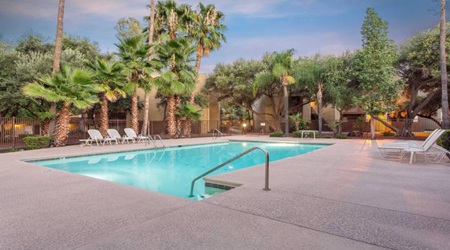
Completed in 1982 on over 10 acres, River Oaks features a mix of studio, one-, and two-bedroom apartments with full-size kitchens, air conditioning, and smart home features. Select units have walk-in closets and enclosed patios or balconies. Community amenities include a stand-alone clubhouse, two swimming pools, a playground, and three laundry facilities.

For more information, Wadlund can be reached at 520.615.1100, and Panahi is at 520.719.6511.

See also, RED Comp #12477.