How Slowing Job Growth Is Affecting Multifamily, Office, Retail and Industrial Real Estate
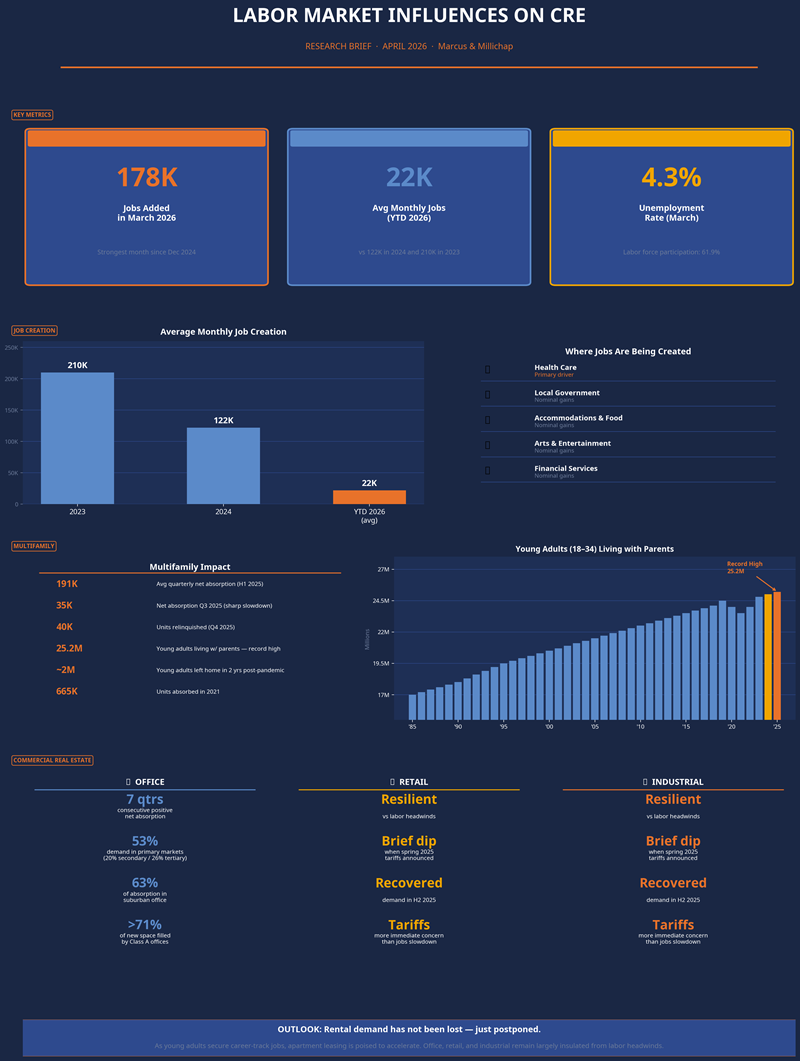
(April 17, 2026) — Marcus & Millichap’s April 2026 research brief offers a useful snapshot of how a softer labor market is beginning to influence commercial real estate, with the clearest effects showing up in multifamily rather than across all property types. The brief argues that while the broader economy continues to expand, the pace of job creation has slowed sharply, labor force participation has weakened, and those shifts are changing how quickly some sectors can absorb space.
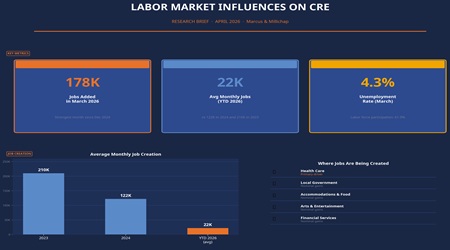
One of the report’s strengths is that it does not overstate the problem. It notes that March job growth was relatively solid at an estimated 178,000 positions, but places that in the broader context of a much weaker trendline. Average monthly job creation over the past year fell far below 2023 and 2024 levels, and hiring has become increasingly concentrated in fewer sectors, especially health care. That framing makes the report more credible because it recognizes that the issue is not a collapsing labor market but a narrowing, less dynamic one.
The most compelling part of the brief is its discussion of multifamily. The report links slower job growth and lower labor force participation among younger adults to softer apartment demand, noting that more young adults are living with family and that this trend has now exceeded even pandemic-era levels. That is an important observation because it directly links labor conditions to household formation, one of the clearest demand drivers for apartments. At the same time, the brief makes the important point that this demand may be delayed rather than destroyed. Its historical comparison to the post-pandemic rebound helps support the argument that once young adults regain confidence in job prospects, apartment absorption could recover quickly.
The report is also useful in drawing distinctions across property types. Office, retail, and industrial are portrayed as less directly affected by current labor-market softness. The office section is especially notable because it points to seven straight quarters of positive net absorption through the end of 2025, with suburban and Class A product capturing most of that demand. That suggests tenant preferences and flight-to-quality trends are still shaping the office market more than headline employment weakness alone. Retail and industrial sectors, meanwhile, are described as more sensitive to tariffs than to current hiring trends.
The brief is somewhat limited in its scale and specificity. It is a national research note, so it does not break down how these trends may differ by market, which matters a great deal in CRE. Conditions in places with strong in-migration, university-driven economies, or major industrial expansion pipelines may not track neatly with the national average. The report also points to declines in labor force participation among workers aged 55 and older and those aged 20 to 24, but it does not fully explore what those shifts mean for local labor availability, wage pressure, or sector-specific space demand.
Overall, this is a solid and measured brief that persuasively argues that labor-market cooling is having its biggest immediate impact on multifamily, while office, retail, and industrial remain influenced more by sector-specific dynamics. Its central takeaway is clear: weaker job growth is delaying some space demand, especially apartment demand tied to young adult household formation, but that demand could return quickly when labor conditions improve.
Read the full report here.