Raytheon Tops Arizona Manufacturing List, Reinforcing Tucson’s Defense-Industry Clout
Arizona ManufacturingTUCSON (April 10, 2026) — Arizona’s manufacturing story is often told through semiconductors, electric vehicles, and the industrial growth of metro Phoenix. But it may come as a surprise to many that the state’s largest manufacturer is actually in Tucson. The latest Phoenix Business Journal ranking is a reminder that Southern Arizona still holds one of the most important positions in Arizona’s industrial economy and that its influence remains closely tied to a single company.

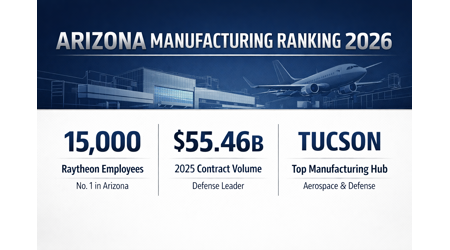
At the top of the 2026 list is Raytheon’s Tucson operation, ranked as the largest manufacturer in Arizona by employee count. With 15,000 employees in Arizona, Raytheon led the statewide list ahead of Intel in Chandler, which reported 9,600 employees. The ranking is significant not only because of Raytheon’s size, but because it reinforces Tucson’s role as home to one of Arizona’s most consequential industrial operations.

For Southern Arizona, the ranking is more than a point of civic pride. It highlights the way Tucson’s manufacturing identity is concentrated in a single, highly specialized employer whose reach extends far beyond its campus. While metro Phoenix dominates much of the current conversation around industrial growth, advanced manufacturing investment, and supply chain expansion, Tucson continues to anchor one of the state’s deepest concentrations of aerospace and defense production.

That distinction matters. Raytheon’s scale in Tucson supports a manufacturing ecosystem distinct from the warehouse-heavy or distribution-led growth often seen elsewhere in Arizona. The company’s local presence is tied to high-value production, engineering, systems development, testing, research, and skilled technical employment. This is not simply a large employer occupying industrial space. It is a foundational operation that helps define a regional business cluster.

Tucson has long benefited from that positioning. Aerospace and defense have been central to the region’s economic identity for decades, shaping everything from labor force specialization to supplier networks and educational partnerships. Raytheon’s continued prominence reinforces that legacy while also signaling that Tucson remains competitive in one of the most strategically important corners of U.S. manufacturing.

The ranking also reveals an important truth about Southern Arizona’s industrial profile: Tucson’s manufacturing presence is not built on a long list of similarly scaled employers. It is anchored, decisively, by Raytheon. With the next Tucson manufacturer appearing much farther down the statewide list, the implication is clear. Tucson’s place in Arizona manufacturing remains substantial, but it is concentrated. Raytheon is not just one of several large manufacturers lifting the region’s numbers. It is the company that defines the category locally.

That concentration creates both strength and visibility. Raytheon’s scale in Tucson is reflected not only in employment, but in the volume of defense work continuing to flow through its missile manufacturing operations. The Tucson-based business secured major awards in 2025, and recent contract activity suggests that momentum is continuing into 2026.

On March 18, the U.S. Missile Defense Agency awarded Raytheon an $8.41 billion contract modification tied to Standard Missile-3 work, raising the ceiling of an original 2020 contract from $3.33 billion to more than $11.74 billion. The award covers support services for Standard Missile-3 Block missile variants for the United States and foreign partners, with work scheduled to continue through October 29, 2029. While the contract includes work in Alabama, a significant share will be performed at Raytheon’s Tucson operation, reinforcing Southern Arizona’s role in one of the nation’s most important defense manufacturing programs.

That was not the company’s only recent win. Raytheon also received a separate $266.9 million contract modification for Standard Missile-3 Block IB production, bringing the total value of that 2024 award to more than $1.365 billion. In another recent action, the U.S. Navy awarded Raytheon $10.76 million to exercise options related to the rolling airframe missile, with all work under that award to be performed in Tucson through March 2028.

The broader picture is notable. According to research from the Phoenix Business Journal, Raytheon secured $55.46 billion in contracts during fiscal 2025, making it the contract leader among Arizona defense contractors. That volume helps explain why Tucson remains so important to Arizona’s manufacturing economy. Raytheon is not simply a large employer based here. It is a production platform tied to some of the country’s most consequential missile and defense systems, and that translates into jobs, supplier demand, industrial investment, and long-term relevance for the region.

That standing has broader real estate implications as well. Large, advanced manufacturers shape demand differently than conventional industrial users. They influence land planning, infrastructure, talent pipelines, transportation networks, and the long-term appeal of a market to complementary employers. In that sense, Raytheon’s footprint extends beyond direct employment. It reinforces the institutional and economic framework that makes Tucson viable for other users in technology, aerospace, and precision manufacturing.

At the same time, the ranking underscores the importance of growing the bench behind the leader. A market anchored by a single dominant manufacturer has a powerful economic engine but also a clear incentive to deepen the surrounding ecosystem. That means continuing to attract suppliers, smaller advanced manufacturers, research-based firms, defense-adjacent users, and specialized industrial operations that can build on Tucson’s existing strengths.

The broader Phoenix Business Journal list reflects the scale of Arizona’s manufacturing economy. The publication reported that the 75 largest manufacturing firms in the state employ more than 1 million people globally and more than 63,000 in Arizona. For Tucson, the takeaway is validation and opportunity. Raytheon’s No. 1 ranking is not just a list item. It is a signal that Tucson remains one of Arizona’s manufacturing centers, shaping the statewide conversation.



2026 State of Marana – Balancing Big Infrastructure Plans with Small-Town Identity

Marana
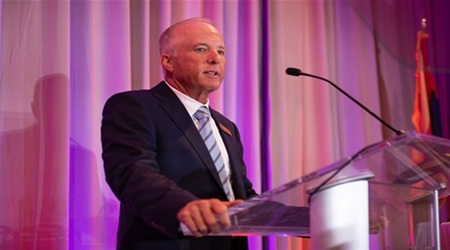
Mayor Jon Post at the 2026 State of Marana

MARANA, AZ (April 10, 2026) — Delivered under the theme “Building the Town of Tomorrow,” Marana’s 2026 State of the Town address highlighted a year of growth, community engagement, and major infrastructure planning, while underscoring the town’s effort to preserve the character that has long defined it. Mayor Jon Post told attendees that Marana is “built on a strong foundation,” crediting town employees, business leaders, and residents as the driving force behind the community’s continued momentum. The luncheon was held on Thursday, April 2, at The Ritz-Carlton Dove Mountain.

Town leaders framed that approach as both strategic and inclusive, emphasizing that Marana is guided not only by master plans and long-range strategy, but by participation from residents, businesses, and community partners. The message was that growth is being managed deliberately, with a focus on proactive planning, regional collaboration, and strategic infrastructure investment.

Transportation remains a central focus. Tangerine Road Phase 2B will extend from Marana Tech Drive to Dove Mountain Boulevard, strengthening a key east-west corridor to Oro Valley, while a new Moore Road interchange is planned to improve access and reduce congestion. Several of Marana’s major transportation priorities are also being advanced through RTA Next, including the Moore Road and Cortaro Road interchanges at Interstate 10, the modernization of Ina Road from I-10 to Thornydale, and the widening of Thornydale Road from Cortaro to Tangerine.

At the Tangerine interchange, officials highlighted both short-term and long-term improvements. Interim work known as the “Great Tangerine Squeeze” is adding lanes and improving traffic flow beneath the overpass, while a future flyover interchange is planned to eliminate the railroad crossing and provide a more permanent solution similar to Twin Peaks. Additional road improvements are also planned along Silverbell Road and the Tangerine Farms Road extension.

But the town’s message was not simply about building more roads. Officials tied those investments to connectivity, quality of life, and the goal of creating a community where people want to live, work, and spend time. That same philosophy is reflected in the Barnett Linear Park project in north Marana, which combines major drainage infrastructure with recreational space and a connection to the Chuck Huckleberry Loop. Mayor Post described it as an example of “the Marana approach,” turning something functional into something that also enhances quality of life.

Airport improvements also fit that broader vision. Construction of a new control tower at Marana Regional Airport is expected to strengthen operations, improve safety, and support future economic development. The town also noted that Marana Regional Airport recently earned Airport of the Year honors from the Arizona Aviation Safety Advisory Group.

Community amenities remain another important part of the equation. Expansion of the Marana Aquatic & Recreation Center (the MARC), including aquatics improvements, year-round operations, additional lifeguard staffing, and new facilities, reflects Marana’s effort to keep pace with growth by investing in facilities that support families and daily life. The town also highlighted the creation of an in-house stormwater maintenance team to improve efficiency and long-term service.

Just as important, Marana continues to reinforce its identity through recognition and civic engagement. In addition to outlining major infrastructure and growth priorities, the town used the event to honor residents and organizations making a difference in the community, including Lyla Grubbs, who received the Youth Legacy Award; Strength & Shield, which received the Branding Iron Award for Organization; Joe Kiser, who received the Branding Iron Award for Individual; and Councilmember Patti Comerford, who received the Mayor’s Branding Iron Award. Those recognitions reinforced the town’s emphasis on volunteerism, leadership, and community connection even as Marana continues to grow.

Support for local business and regional collaboration also remained part of the message. The sold-out event was held in partnership with the Marana Chamber of Commerce, and Chamber President and CEO Amanda Wiggins highlighted record membership and the importance of alignment between business and local government.

Taken together, the projects outlined in the address suggest Marana is trying to strike a careful balance: accommodating growth while protecting the qualities residents value most. The town’s message was that infrastructure, recreation, drainage, airport investment, and economic development are not simply expansion projects, but part of a broader effort to keep Marana connected, resilient, and grounded in its community spirit.


Swing Into International Dance & Jazz Days in Tucson!

Jazz DaysCelebrate the Powerful Connection Between Two Iconic American Art Forms

Tucson, AZ (April 10, 2026) –– International Dance and International Jazz Days celebrations kick off this month on April 29 with three days of music, rhythm, and community.  Beginning on Wednesday, April 29th, International Lindy Hop champion Naomi Uyama returns from Minneapolis to teach her signature swing dance lessons at the Tucson Creative Dance Center.

Those lessons will be put into practice the following evening, April 30, at the Hotel Congress Plaza as guests dance to the music of the award-winning Tucson Jazz Institute Ellington Big Band directed by Brice Winston.  Naomi Uyama will bring her signature electrifying performance style to the stage as well with Naomi & Her Handsome Devils, a 7-piece swing band featuring local artists Jason Carder/trumpet, Aidan Schofield/trombone, Brice Winston/saxophone, Ed DeLucia/guitar, Leo Stealey-Euchner/piano, Scott Black/bass, and Arthur Vint/drums. 

The public is invited to enjoy this Swing Era big band themed evening presented by the Tucson Jazz Music Foundation & The Century Room at Hotel Congress, made possible by a grant from the Arizona Commission on the Arts. Student tickets are only $10, and students under 18 are free!

“Naomi is one of the best bandleaders I’ve had the privilege of working with – she is uniquely qualified to lead a dance band because she knows all the songs and tempos that the dance community does! I’m excited for this event, which hopefully turns into an annual celebration of jazz and swing dance!” – Arthur Vint, Century Room Artistic Director

For those who want more – Ms. Uyama and her band will appear at the Century Room at Hotel Congress on May 1st for two evening shows – dancing in your chair encouraged!

IMG_8875.heic
Naomi and Her Handsome Devils

SCHEDULE OF EVENTS

April 29, 6-9pm – Dance Lessons at Tucson Creative Dance Center, 3131 N Cherry, Learn the 8-count Lindy Hop, Charleston, and Solo Jazz Routine from Naomi Uyama—perfect for beginners and seasoned dancers alike. To register visit  tjmfdn.org/international-jazz-day-international-dance-day-celebration/

April 30, 6-10pm – Live Music by the Tucson Jazz Institute Ellington Big Band and Naomi Uyama and Her Handsome Tucson Devils on the Plaza at Hotel Congress

A beginner 6-count Lindy Hop dance lesson kicks off the event with Naomi Uyama, followed by the award-winning TJI Ellington Big Band directed by Brice Winston playing some high energy swinging classics. Naomi & Her Handsome Devils close the event with dancing until 10 pm.

Purchase Tickets  online or at the gate on the evening of the event.

May 1- 6:30pm and 8:30pm -Naomi and Her Handsome Tucson Devils at the Century Room at Hotel Congress,  For tickets visit Century Room

This 3-day celebration is sponsored and organized by the Tucson Jazz Music Foundation and the Century Room with support from the Arizona Commission on the Arts. The Foundation is dedicated to making jazz music education accessible. Thanks to the support from donors and sponsors, those 18 and under can attend the Plaza celebration for free, and scholarships are available for Naomi’s dance workshops.

image.png