ACC Approves First-Ever Formula Rate Case for UNS Gas; Commissioner Márquez Peterson Dissents

UNS Gas PHOENIX, Ariz. (February 25, 2026) — The Arizona Corporation Commission voted 4–1 on Feb. 19, 2026 to approve UNS Gas, Inc.’s request to implement an Annual Rate Adjustment Mechanism (ARAM)—marking Arizona’s first regulated utility rate case in which the Commission considered and approved an alternative ratemaking method, often referred to as a “formula rate” approach.

Under the ARAM methodology, UNS Gas rates may be adjusted annually using a Commission-approved formula and review process, rather than relying solely on the traditional multi-year cadence for full-rate cases. ACC Chairman Nick Myers said the new structure is intended to reduce “regulatory lag,” promote “rate gradualism” for customers, and create regulatory efficiencies, while noting the Commission will closely monitor implementation “to make sure the ARAM operates as intended and results in just and reasonable rates.”

Commission leadership also framed the ARAM as a mechanism designed to increase transparency and oversight, reduce administrative costs, eliminate several existing adjustor mechanisms, and potentially lower borrowing costs for the utility benefits, they said, could flow through to customers. The process includes public notice requirements, informal and formal challenge periods, ACC Staff review of submitted data, and a Commission vote on any proposed rate adjustment.

Vice Chair Rachel Walden emphasized that the ARAM requires the Commission to review and approve company expenditures annually, including capital investments, rather than focusing primarily on test-year financials in periodic rate cases. She said savings—citing “One Big Beautiful Bill corporate tax cuts” would be passed on to customers through the ARAM structure. Walden also argued that in states using formula ratemaking, electric rates tend to be below the national average, and annual increases have been modest relative to inflation.

As part of the final decision, commissioners adopted several amendments they said strengthened oversight and reduced the utility’s revenues. The Commission approved a 9.61% return on equity and lowered the Fair Value Increment (FVI) to 0.00%, which commissioners said would reduce bill impacts, limit utility profits, and could improve the company’s credit profile and cost of debt.

Commissioner Kevin Thompson said the outcome “strikes a fair balance” between protecting customers from dramatic increases and maintaining a financially healthy utility able to provide safe, reliable service. He added that commissioners have repeatedly heard customers prefer gradual rate changes rather than larger increases spaced further apart.

Commissioner Lea Márquez Peterson cast the sole dissenting vote and issued a statement saying she was not persuaded that the record contained enough information to demonstrate customer benefits from the formula rate design or the ARAM. She noted that she voted against adopting the formula-rate policy statement in 2024, citing concerns about transparency and opportunities for stakeholder input, and said her Feb. 19 vote was based on the specifics of the UNS Gas rate case.

Márquez Peterson said she offered an amendment to disallow the ARAM structure, which did not receive majority support. She also expressed concern that the approved approach may not deliver the “gradualism” the company projected and could create upward pressure on bills. In addition, she said she supported an Administrative Law Judge proposal to treat the ARAM as a pilot program—a compromise she viewed as an opportunity for the Commission to evaluate real-world impacts during a limited period—but that pilot approach was not adopted by the majority.

“I remain unconvinced that the ARAM or formula rates are a benefit to ratepayers in this case, nor that they will lower the overall cost to UNS Gas customers in the long run,” Márquez Peterson said.

Case materials are available in the ACC’s eDocket system under Docket No. G-04204A-24-0237.
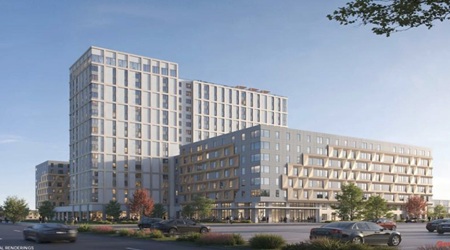


UA Housing Push goes High-Rise: 250M 19-Story Dorm Proposed near Main Gate

UA Housing
The Arizona Board of Regents approved plans for a future residence hall located on the NWC East Speedway Blvd and North Campbell Avenue. Scheduled to open in time for the fall 2028 semester, the new facility will house more than 1,200 students and support the U of A’s expectation that all first-year students live on campus.

TUCSON, AZ (Feb. 24, 2026) — The University of Arizona is moving forward with a roughly $250 million, 19-story residence hall planned for the northwest corner of East Speedway Boulevard and North Campbell Avenue, a major infill redevelopment that will add more than 1,200 student beds along with dining, amenities, and student-support space, according to university materials.

The project structure is designed to keep construction debt off the university’s balance sheet. Under the plan outlined in published documents, Mortenson Development would acquire the 2.49-acre former Palm Shadows Apartments site at 1815 E Speedway Blvd., then sell it to the nonprofit Collegiate Housing Foundation (CHF) at fair market value once CHF secures tax-exempt bond financing. CHF would then convey the land to the university and independently finance, develop, construct, and operate the residence hall under a 50-year ground lease with UA. The bond financing is expected to be repaid over approximately 40 years through residence hall-related fees, with UA having no debt obligation.

UA said the Arizona Board of Regents approved plans for the new residence hall, with an opening targeted in time for the Fall 2028 semester. The development also supports the university’s housing policy shift: UA expects first-year students to live on campus beginning Fall 2026, with exceptions including students living within 30 miles of campus or other hardship circumstances.

University leadership framed the project as a student-success initiative.

“Living on campus is a proven predictor of student success,” UA President Suresh Garimella said in the university announcement, adding that the project helps meet on-campus housing goals and “invests in our students.” Regent Fred DuVal also cited the importance of expanding the on-campus residential experience as the university pursues “ambitious goals.”

UA noted the building will align with student demand for more suite-style units, provide programming and support services, and replace more than 600 residential beds that are expected to be phased out elsewhere on campus.

CHF, a 501(c)(3) nonprofit established in 1996, describes its mission as helping colleges and universities develop student housing using third-party nonprofit financing. CHF reports it has been involved in 70 student housing facilities totaling over 47,000 beds across 26 states, with total project costs exceeding $4.6 billion.

From a real estate and development standpoint, the dorm tower continues the long-running evolution of the Speedway/Campbell corner, previously tied to high-rise mixed-use and student-housing concepts, into one of the most closely watched vertical infill sites near the university.


Pima County Economic Development Director Takes Message on the Road: Golf, GTL, and “Meet Them Where They Are” Recruitment

Economic Development Director
Pima County Economic Development Director, Heath Vescovi-Chiordi at Phoenix Open, February 23, 2026

TUCSON, AZ (February 24, 2026) — Pima County Economic Development Director Heath Vescovi-Chiordi is extending the department’s work beyond day-to-day operations by investing time in community leadership and high-impact business recruitment events. He says the effort helps open doors for new connections and development opportunities across Southern Arizona.

A key example came Feb. 5, when Vescovi-Chiordi attended the Waste Management Open in Scottsdale as a guest of the Arizona Commerce Authority (ACA) alongside a group of invited businesses. The golf tournament, formerly known as the Phoenix Open, has a long history in Arizona and is widely viewed as a relationship-focused setting where recruiters and decision makers can connect outside the conference room.

“This was such a great opportunity to meet new contractors, companies and developers to create some new connections and relationships,” Vescovi-Chiordi said. “It helped me open up new development opportunities for Southern Arizona and Pima County.”

The week of Feb. 9, 2026, continued that outreach focus locally through Greater Tucson Leadership (GTL), where Vescovi-Chiordi serves on the organization’s board. GTL runs programs to build stronger civic and business leaders in the region.

On Feb. 12, he served as the first speaker for GTL’s Lead Tucson program during its Economic Development Day, delivering an “Economic Development 101” session to frame the day’s discussions. He also led a panel with regional economic development leaders focused on the push-and-pull factors that influence business expansion and attraction, and on the importance of meeting companies where they are, both geographically and in the lifecycle of their growth decisions.

On Feb. 14, Vescovi-Chiordi returned to GTL programming alongside Amanda Jones of Tucson Water, speaking to the organization’s Civic and Political Leadership Academy cohort. Their discussion centered on how younger employees can help bring innovation to government operations, from process improvements to new ways of delivering public services.

“I always appreciate so much the work Greater Tucson Leadership does in our community,” Vescovi-Chiordi said. “I’m so thankful to serve on their board and help the amazing staff execute their programming by speaking at events with my colleagues from across the region and state. It’s a privilege to talk about my work in economic development.”

Taken together, the February schedule reflects a deliberate strategy that pairs community leadership development with real world business engagement. The goal is to strengthen the region’s talent pipeline, sharpen its economic development message, and build the relationships that often precede major investment decisions.