Liles Industrial Team Joins Colliers

Ted Liles, David Perez and Adrea Pringle Bring Additional Tenant Advisor Expertise to Phoenix Brokerage

Phoenix (April 30, 2026) – The Liles Industrial team has joined the Phoenix office of Colliers, bringing years of expertise in tenant representation to the brokerage firm.

Ted Liles, SIOR, joins Colliers as an Executive Vice President. David Perez is a Senior Associate and Adrea Pringle serves as an Associate Vice President and transaction manager.

“We are thrilled to welcome Ted Liles and the Liles Industrial Team,” says Bryce Terveen, executive managing director of Colliers in Arizona. “Their experience, energy, and deep understanding of the industrial market further strengthen our platform in Phoenix and reinforce our commitment to delivering best-in-class service for our clients. This is an exciting step forward as we continue to grow thoughtfully and invest in top talent.”

Liles has worked in industrial real estate for more than 19 years, beginning his career working with tenants and properties in the Long Beach port area. Liles advises companies on complex lease negotiations, site selection, portfolio strategy, risk mitigation, and operationally driven real estate decisions. Prior to joining Colliers, Liles spent 14 years at Cresa, where he built a reputation as a trusted advocate for industrial occupiers across Arizona and North America. His client-focused approach is rooted in strategic planning, disciplined execution, and protecting the business interests behind every real estate decision.

David Perez, who joined the Liles Industrial Team a year ago, represents industrial occupiers with a dedicated tenant-only approach. He focuses on aligning real estate strategy with each client’s broader business objectives, helping companies make informed, long-term decisions. Perez advises on lease negotiations, renewals, restructures, relocations, expansions, acquisitions, and dispositions, and incorporates labor analytics into site selection and operational planning.

Adrea Pringle has worked in the real estate field since 2019, serving in a diverse set of roles. A member of the Liles Industrial Team for nearly five years, Adrea advises occupiers on lease negotiations, renewals, relocations, and multi-market portfolio strategy, supporting both expansion and consolidation initiatives. Her work is focused on helping businesses operate more efficiently and make strategic real estate decisions — enabling them to better serve their customers, support their workforce, and contribute to the local economy.

Marcus & Millichap: What Stabilizing Interest Rates Mean for Commercial Real Estate

TUCSON, AZ (April 29, 2026) — Commercial real estate investors and lenders are entering a more stable, but still cautious, interest-rate environment as inflation remains above the Federal Reserve’s target and expectations for near-term rate cuts continue to fade.

Federal Reserve policy remains constrained by the central bank’s dual mandate of maximum employment and price stability. Labor conditions have softened, but unemployment remains in the low- to mid-4 percent range, a level still historically consistent with full employment. That limits the urgency for aggressive policy easing. At the same time, inflation pressures have reaccelerated, with the Consumer Price Index rising 3.3 percent over the 12 months ending in March, after increasing 2.4 percent over the prior 12-month period. Energy costs were a major factor, with the energy index up 12.5 percent year over year.

The monetary policy outlook has also drawn renewed attention as Kevin Warsh, President Trump’s nominee to succeed Federal Reserve Chair Jerome Powell, moves through the confirmation process. Warsh has acknowledged that the labor market remains near full employment, while inflation remains above the Fed’s 2 percent target, complicating any push for rapid rate cuts.

For commercial real estate, the key issue is not only whether rates move lower, but whether they remain predictable enough for lenders, buyers, and sellers to price risk with more confidence.

After a period of volatility tied to geopolitical conflict and inflation concerns, long-term Treasury yields have settled into a more stable range. Marcus & Millichap noted that the 10-year and 5-year Treasury yields rose roughly 50 basis points at the onset of the Iran conflict, prompting some CRE lenders to widen spreads and temporarily increase the cost of debt capital. Treasury yields later retreated from their late-March peak, suggesting a more rangebound interest-rate environment unless another shock occurs.

That stabilization matters for property transactions. When benchmark rates move sharply, lenders typically build in more cushion, buyers lower their bids, and sellers may resist repricing. A steadier Treasury market can help narrow bid-ask spreads, bolster underwriting confidence, and enable transactions to move forward, even if borrowing costs remain elevated relative to the low-rate era.

Commercial real estate financing has begun to recalibrate across capital sources. Bank lending for commercial properties is generally holding in the low- to mid-6 percent range, consistent with late 2025 levels. CMBS debt remains more expensive, with borrowing costs generally in the 7 percent range. Multifamily continues to benefit from more attractive agency financing, with agency debt in the low- to mid-5 percent range and bank lending in the low-6 percent range.

For borrowers, the current environment is not necessarily easy, but it is becoming more understandable. Stable rates allow investors to better evaluate refinancing options, acquisitions, development feasibility, and asset pricing. For lenders, reduced volatility may support greater confidence and potentially narrower spreads over time.

Commercial real estate may also regain appeal as an inflation hedge. In a higher-inflation environment, income-producing real estate can benefit from durable cash flows, rent growth potential, and long-term hard-asset value. However, that advantage depends heavily on property type, tenant strength, lease structure, debt maturity, and local market fundamentals.

The near-term outlook remains cautious. Market expectations for multiple rate cuts by year-end have diminished sharply, with the probability of three or more cuts falling from 48 percent before the conflict to 25 percent currently, according to the source data. For CRE, that means the market may not get meaningful rate relief quickly.

Instead, the more important development may be stability. If borrowing costs remain rangebound, commercial real estate investors can begin underwriting with greater confidence, lenders may become more competitive, and transaction activity could gradually improve after a period of rate-driven disruption.


Apartment List Tucson Rent Report: May 2026

Tucson Rent

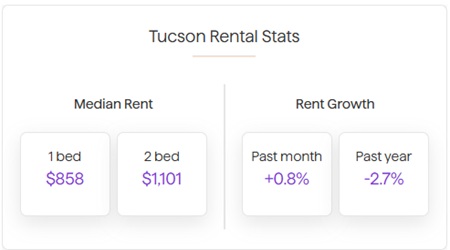
TUCSON, AZ (April 29, 2026) — Apartment List reports that Tucson rents edged higher in May, with the city’s overall median rent rising 0.8% from the previous month to $1,029. Despite the monthly increase, rents remain 2.7% lower than they were a year ago.

The latest figures suggest Tucson’s rental market is seeing modest near-term movement while still reflecting softer pricing compared with last year. Read on for a closer look at local rent trends and how Tucson compares with rental markets across the country.

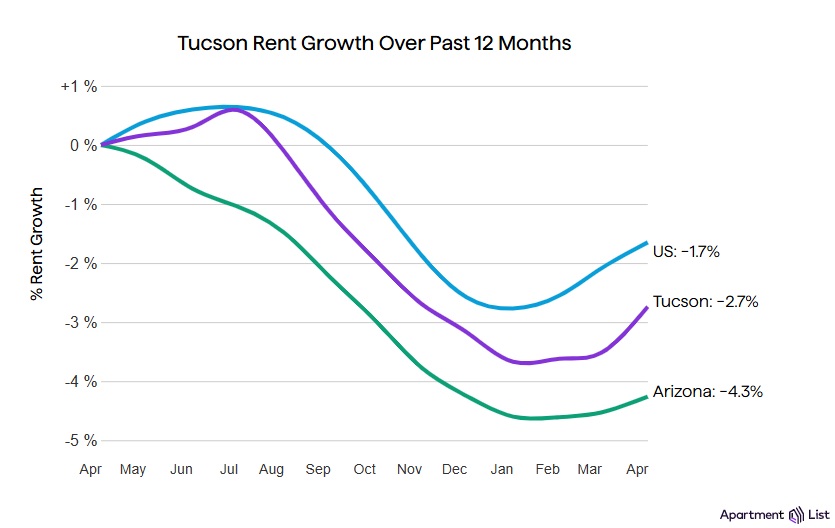
Tucson rents are up 0.8% month-over-month and down 2.7% year-over-year

The median rent in Tucson rose by 0.8% in April and has now decreased by 2.7% over the past 12 months. Tucson’s rent growth over the past year has outpaced the state average (-4.3%) but fallen behind the national average (-1.7%).

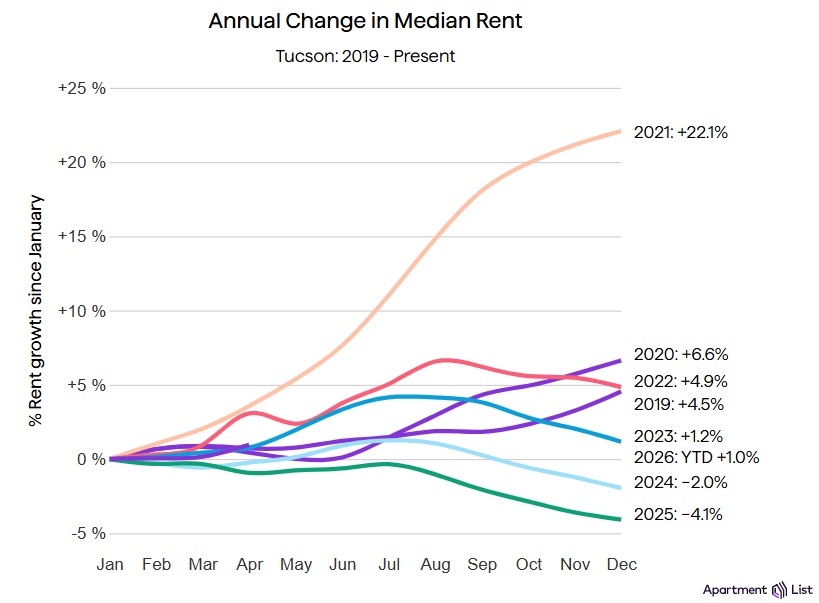
Tucson rent growth in 2026 is pacing above last year

Four months into the year, rents in Tucson have risen 1.0%. This is a faster rate of growth compared to what the city was experiencing at this point last year: from January to April 2025, rents had decreased 0.9%.

April rent growth in Tucson ranked #30 among large U.S. cities

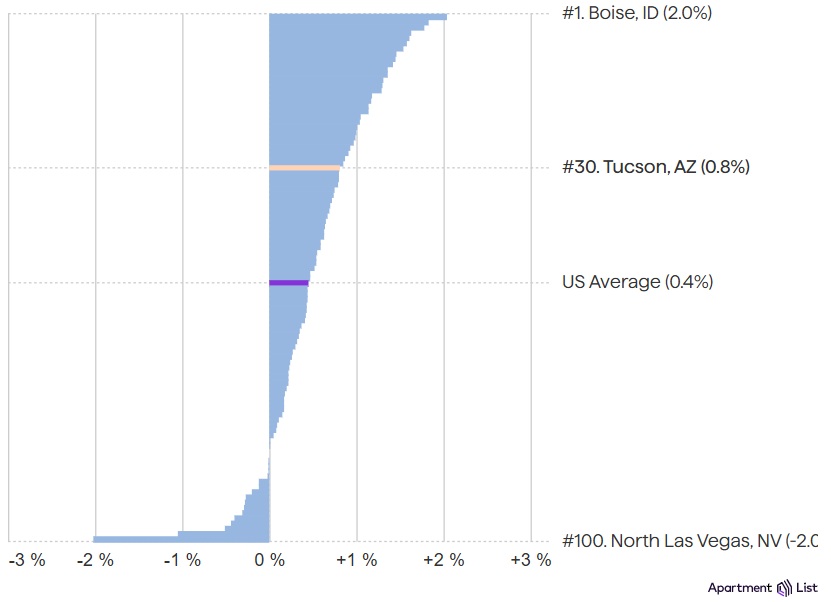
Tucson rents rose 0.8% over the past month, compared with the national rate of 0.4%. Among the nation’s 100 largest cities, this ranks #30. Similar monthly rent growth took place in Arlington, VA (0.9%) and Madison, WI (0.8%).

Month-over-Month Rent Growth Among 100 Largest Cities In the U.S.

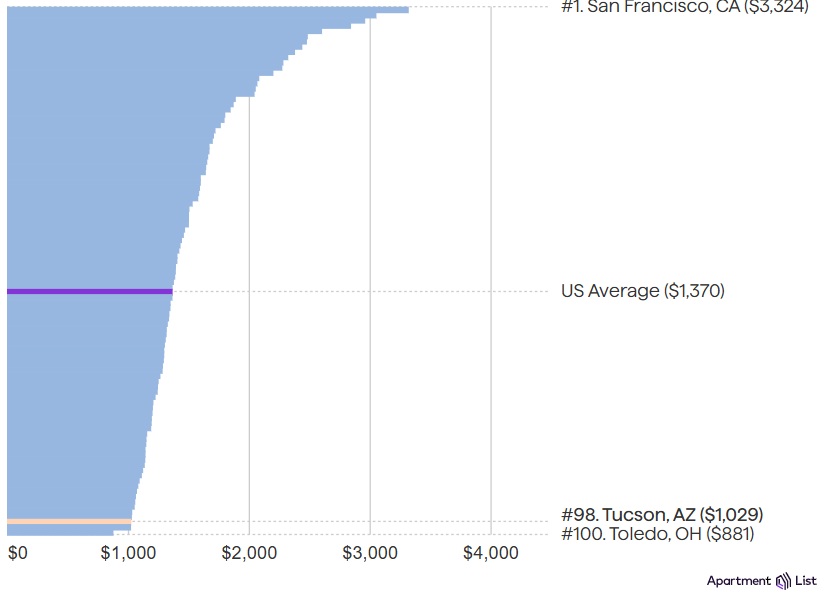
Tucson is the #98 most expensive large city in the U.S., with a median rent of $1,029

Citywide, the median rent currently stands at $858 for a 1-bedroom apartment and $1,101 for a 2-bedroom. Across all bedroom sizes (ie, the entire rental market), the median rent is $1,029. That ranks #98 among the country’s 100 largest cities.

For comparison, the median rent nationwide is $1,204 for a 1-bedroom, $1,356 for a 2-bedroom, and $1,370 overall. The median rent in Tucson is 24.9% lower than the national median, and is similar to the prices you would find in Cleveland, OH ($1,034) and Wichita, KS ($1,027).

Median Overall Rent Among 100 Largest Cities In the U.S.

Methodology

Apartment List is committed to the accuracy and transparency of our rent estimates. We begin with reliable median rent statistics from the Census Bureau, then extrapolate them forward to the current month using a growth rate calculated from our listing data. In doing so, we use a same-unit analysis similar to Case-Shiller’s approach, capturing apartment transactions over time to provide an accurate picture of rent growth across cities nationwide. Our approach corrects for the sample bias inherent in other private sources, producing results that are much closer to statistics published by the Census Bureau and HUD. For more details, please see the Apartment List Rent Estimate Methodology.

Data Access

Apartment List publishes monthly rent reports and underlying data for hundreds of cities nationwide, as well as aggregated data for counties, metros, and states. These data are intended to be a source of reliable information that help renters and policymakers make sound decisions. Insights from our data are covered regularly by journalists across the country. To access the data yourself, please visit our Data Downloads Page.