Beating the Heat: Getting your Arizona commercial property summer-ready
Arizona commercial property
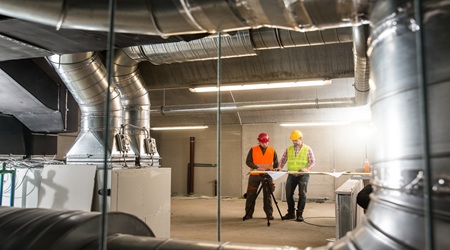
Workers making final touches to HVAC system. HVAC system stands for heating, ventilation and air conditioning technology. Team work, HVAC, indoor environmental comfort concept photo.

By Keith Pomonis

(April 7, 2026) — In Arizona, the window for spring maintenance is famously short. Before the first triple-digit day hits, commercial property managers have a narrow opportunity to fortify their buildings against the relentless desert sun.

A proactive approach this month isn’t just about curb appeal; it’s about ensuring your operating budget doesn’t evaporate when the heat peaks.

The absolute priority for any Arizona facility is the HVAC system. In this climate, air conditioning isn’t a luxury;07 it’s a life-safety requirement. Now is the time to bring in a technician to go beyond a simple filter swap.

You need a deep cleaning of the condenser coils to remove the fine desert dust that acts like an insulating blanket, forcing motors to work twice as hard. Checking refrigerant levels and recalibrating thermostats now prevents the dreaded “emergency call-out” in July when every repair crew is booked three weeks out.

While the cooling system takes center stage, the building envelope is your first line of defense. Arizona’s intense UV radiation is incredibly destructive to sealants and roofing membranes. Walk the perimeter to check for brittle caulking around windows and expansion joints. If you can feel heat bleeding through a seal in April, that gap will become a massive energy drain by June.

A quick roof inspection to clear debris and check for sun-scorched, brittle patches or surface cracking can save you from a catastrophic leak when the first heavy monsoon rains finally hit. Don’t overlook your water infrastructure. If your property features desert landscaping, your irrigation system has likely been dialed back for months. As the plants wake up, run a full zone-by-zone test.

Plastic emitters in Arizona become brittle and snap easily; a single broken line can waste thousands of gallons of water before it’s even noticed on a utility bill. Adjusting your timers now to water during the pre-dawn hours will also minimize evaporation losses as humidity drops.

Finally, take a moment to walk your parking lots and walkways. The shift from cool nights to blistering days causes asphalt to expand and contract, often worsening existing cracks. Filling these gaps now prevents them from becoming potholes that pose liability issues for tenants and visitors.

By tackling these “big four” areas, cooling, sealing, irrigation, and pavement, you transition your property from a reactive state to a predictive one. It’s the difference between a smooth, profitable summer and one spent managing crisis after crisis in the heat.

Keith Pomonis is the President of Mesa-based EHS Restoration. For more information, call (480) 306-5777 or visit ehsrestoration.com.


Stevens-Leinweber Completes Fully Leased 27th Ave. Merit Partners Industrial Project

Merit Partners Industrial Class A Metro Phoenix development transforms vacant school campus into mid-sized industrial property

PHOENIX, Arizona, (April 2, 2026) – Leading Phoenix-based general contractor Stevens-Leinweber Construction (SLC), representing Merit Partners Inc., has completed and delivered Merit 27 Buckeye, a unique industrial infill redevelopment that is now fully leased in Phoenix’s emerging 27th Avenue Corridor.

Located on 18 acres at the southeast corner of 27th Avenue and Buckeye Road, Merit 27 Buckeye transforms a former and vacant Murphy Elementary School District campus into a modern, two-building, 256,813-square-foot industrial property within a re-emerging commercial area.

The project is supported by a City of Phoenix initiative for ongoing beautification within the 27th Avenue Corridor, designed to add roadway capacity, improve safety and access, and elevate visual appeal through elements such as new sidewalks, ADA ramps, traffic signals, and street lighting.

“Merit 27 Buckeye was an exciting assignment for our team,” said Stevens-Leinweber Construction Executive Vice President Erik Powell. “It highlights Merit’s dedication to delivering all categories of Class A metro Phoenix industrial space, including adaptive, forward-looking developments like this one. It was a great effort that has created a productive new chapter for this strategic land site.”

Before construction could begin, the Merit 27 Buckeye site required six months of extensive demolition and remediation to make the land shovel-ready. This included clearing 12 buildings that had been vacant for several years, cutting back old utilities to the main source, and installing a new water line and meters. In the process, SLC and Merit made the project’s original buildings available to the Phoenix Fire Department for critical hands-on training.

Now complete, Merit 27 Buckeye spans two fully modernized buildings, a 191,227-square-foot Building A and a 65,586-square-foot Building B, at 1515 S. 27th Ave. and 2675 W. Buckeye Rd.

Meeting contemporary standards for efficiency, sustainability, and tenant satisfaction, the buildings feature 32’ to 36’ clear height, 59 total dock-high and eight total drive-in doors, ESFR sprinklers, and generous and secure auto and truck parking. Energy-efficient features include LED lighting, R-38 and R-11 insulation, exterior canopies for heat mitigation, and clerestory windows to increase natural interior light.

These advantages propelled the project to 100% occupancy, with Building A fully leased to Daikin and Building B fully leased to Mazak, Reliable Garage Doors, Hajoca and Impilo Inc.

SLC served as the general contractor for Merit 27 Buckeye. Butler Design Group is the architect. Jackie Orcutt, John Werstler, Cooper Fratt and Jonathan Teeter of CBRE are the project’s exclusive leasing brokers.

Merit 27 Buckeye sits in the heart of Phoenix’s transportation network. It is less than one mile west of Interstate 17, two miles south of Interstate 10 and four miles east of the Loop 202 South Mountain Freeway, a new 22-mile extension linking the East and West Valleys. Merit 27 Buckeye is also minutes from Phoenix Sky Harbor International Airport and a host of supporting regional airports.


Arteris Bio Relocates into UA Tech Park to Advance Novel Topical Technology Platform 

Arteris Bio
Arteris Bio Founder and CEO Bruce Register, Ph.D.

TUCSON, Ariz. (April 2, 2026) – The University of Arizona (UA) Tech Park is pleased to welcome Arteris Bio, a life sciences company developing advanced topical technologies focused on skin physiology, microcirculation, and peripheral comfort. The company is led by founder and CEO Bruce Register, Ph.D., whose more than 30 years of experience span scientific research, global pharmaceutical leadership, and entrepreneurial ventures.

Arteris Bio is moving forward with Redoxiv, a new topical platform created to help keep skin healthy and comfortable. The company combines research and product development in the United States with clinical work overseas, allowing it to test and refine its technology efficiently while upholding high scientific and regulatory standards.

Redoxiv features a recently patented formulation that incorporates amino acid–based systems, bioactive cofactors, and lipid-compatible delivery components, designed to support localized physiological function, oxidative balance, and skin barrier dynamics. Early-stage internal studies have demonstrated measurable localized physiological effects, supporting continued development and evaluation.

“We chose to relocate from California to the UA Tech Park because it offers not only an exceptional environment for science-driven companies, but also a significantly more capital-efficient path for building and scaling a life sciences business,” said Dr. Register. “Its collaborative ecosystem and proximity to academic and clinical expertise make it an ideal setting as we advance our topical technology platform. This is about more than a single product—we are building a platform to unlock entirely new approaches to supporting both localized and potentially systemic physiological function through topical science.”

After decades spent advancing therapies within both startup environments and Fortune 500 pharmaceutical companies, Dr. Register founded Arteris Bio to pursue an innovation that is both scientifically rigorous and commercially scalable. As the company expands its presence at UA Tech Park, it is focused on building the infrastructure and partnerships necessary to support continued development and future market entry.

Arteris Bio’s arrival further reinforces UA Tech Park’s role as a catalyst for translating scientific innovation into real-world applications. By joining the UA Tech Park community, the company is positioned to accelerate development, foster collaboration, and expand access to innovative, non-invasive topical technologies worldwide.