Phoenix Continues to Power Arizona Growth as New Census Data Shows Another Strong Year
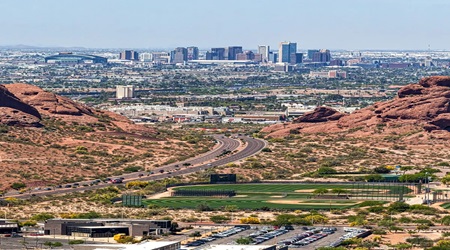
New Census Data

PHOENIX, AZ (March 27, 2026) — The Phoenix-Mesa-Chandler metro remained one of the nation’s leading growth markets in 2025, adding 59,065 residents and reaching a population of 5,228,938, according to new Census Data estimates.

The gain ranked metro Phoenix fourth nationally for numeric population growth and kept it the 10th-largest metropolitan area in the country. Among major U.S. metros, only Dallas and Houston posted faster growth rates during the 12-month period ending July 1, 2025.

Phoenix recorded a 1.14 percent growth rate from July 1, 2024, to July 1, 2025. While that was below the 1.62 percent pace recorded a year earlier, it still came in well above the national growth rate of 0.52 percent, reinforcing Arizona’s position as a continuing draw for new residents and business expansion.

Only New York, Los Angeles, Chicago, Dallas, Houston, Atlanta, Washington, D.C., Miami, and Philadelphia have larger metro populations than Phoenix. Even so, the Valley continues to stand out for its sustained momentum, with only Dallas and Houston growing faster among the nation’s largest markets in 2025.

The Census figures also offer a reminder that Arizona’s growth story extends beyond the Valley. While metro Phoenix added more than 59,000 residents in 2025, Tucson remained the state’s second-largest city. Tucson’s 2025 population estimate was not yet available at press time. The most recent Census figure showed the City of Tucson at 554,013 residents in 2024, while the Tucson metro stood at 1,086,634 in 2024 based on the most recent metro figure.

One of the biggest factors behind Phoenix’s slower growth in 2025 was a steep decline in international migration. The metro gained 25,543 residents from other countries, down from 48,833 the year before. Even with that drop, international migration still outpaced domestic migration, as Phoenix added 22,256 residents from other parts of the United States.

Natural change also remained a contributor to the metro’s expansion. Births exceeded deaths by 13,169, with 56,215 births and 43,046 deaths recorded during the period. That was slightly below the 14,548 natural increase posted a year earlier.

Since 2020, the Valley has added 377,643 residents, a cumulative gain of 7.25 percent. Over that period, domestic migration accounted for 195,135 new residents, international migration added 127,758, and natural change contributed 55,364 more births than deaths.

Although the pace of growth has moderated, the latest Census estimates make it clear that metro Phoenix remains one of the nation’s most important centers of population and economic growth. For Arizona, that continued expansion carries implications well beyond housing demand, shaping everything from transportation planning and infrastructure investment to retail, office, and industrial development across the state.



Build-to-Rent Communities Gain Traction in Arizona as Affordability Pressures Persist

Build-to-Rent Communities

MESA, AZ (March 27, 2026) — As housing affordability continues to squeeze would-be homebuyers, build-to-rent communities are gaining momentum in Arizona and across the Sun Belt as an alternative that offers the feel of a single-family home without the cost and long-term commitment of ownership.

The concept is simple: developers build detached homes specifically for renters rather than for-sale buyers. For many residents, the appeal lies in more privacy, no shared walls, and reduced maintenance responsibilities, all without the financial hurdles of buying a home. In the NPR report, Mesa was highlighted as one of the Arizona markets where this model is already taking hold.

The trend comes as the nation continues to struggle with a significant housing shortage. Realtor.com estimated the U.S. housing shortfall at just over 4 million units in 2025, while Redfin reported that a household now needs about $110,000 in annual income to afford a typical home — roughly 29 percent more than the median household earns.

Supporters of build-to-rent argue the model helps address that imbalance by adding new housing supply that might not otherwise be built. About 7 percent of new single-family homes coming to market are now rentals rather than homes for sale, and the number of build-to-rent completions in 2024 was more than 10 times higher than it was a decade ago.

Arizona is well-positioned for that growth. Population gains, available land, and continued affordability challenges have made the state a natural fit for the sector. Companies specializing in build-to-rent housing have expanded in markets like Mesa, where renters range from young professionals to older residents who want the space and privacy of a house without the burdens of ownership.

The format may also face less neighborhood opposition than traditional apartment projects. According to the report, some developers say detached rental homes, often designed as one-story cottage-style units, can be easier for nearby residents to accept than larger multifamily developments.

For Arizona markets such as Phoenix and increasingly Tucson, the rise of build-to-rent reflects a broader shift in housing demand. As mortgage costs, home prices, and maintenance expenses remain elevated, more households are choosing flexibility over ownership, at least for now.

In that environment, build-to-rent is becoming more than a niche product. It is emerging as another tool in the housing supply conversation, especially in fast-growing markets where the gap between what people want and what they can afford continues to widen.


Full Building Lease Brings Lincoln’s Park303 to 100% Occupancy

Park3033PL leader commits to almost 630,000 s.f. at 3.75 million s.f., 210-acre logistics campus

GLENDALE, Arizona, (March 26, 2026) – Full-service commercial real estate firm Lincoln Property Company (Lincoln) today announced that a global 3PL provider has signed a full-building, 629,835-square-foot lease at Park303 in Glendale, Arizona. The commitment brings the 210-acre, 3.75 million-square-foot, LEED Certified industrial project to fully leased.

The new tenant will lease all of Park303 Building A and use its new space to serve a Fortune 250 client.

Located along the Loop 303 at Glendale Avenue in Glendale, Arizona, Park303 includes a 1.25 million-square-foot, single-building Phase 1 and a 2.5 million-square-foot, three-building Phase 2.

Phase 1 is fully occupied under a long-term lease by Walmart and was purchased by BentallGreenOak in 2021 for $186 million, marking the highest single-building industrial sale price in Arizona history.

Phase 2 is now also fully occupied, with Logisticus Group LLC leasing the entire 483,300-square-foot Building B, and Building C was sold in October 2025 to Dollar Tree for $147 million. Dollar Tree will fully occupy Building C, using the space for the company’s first regional distribution facility in metro Phoenix.

“The success of Park303 proves that Phoenix is competing and winning at the highest levels of the industrial and logistics markets,” said Lincoln Property Company Executive Vice President John Orsak. “It is also a powerful validation of the project’s caliber, which is something we’re very proud of. We welcome our newest tenant to Park303, and all of the tenants who have committed to this campus, and look forward to their future here.”

Park303 follows Lincoln’s “creative industrial” approach to Class A industrial development, incorporating expanded amenities often only found in office buildings. At Park303, this includes high-end speculative office space, an outdoor pickleball and basketball court, and an outdoor entertainment area with gourmet barbeques, overhead fans and seating designed for employee comfort.

This expanded amenity package adds to Park303’s market-leading, LEED-Certified buildings, where features include 40’ clear height, 25’ tall glass entries, up to 12,000 amps of power, 7” slabs over 4” of crushed rock, and steel moment frame shear bracing supporting highly modern, automated racking and picking equipment.

Building interiors are bordered with 5’ x 10’ clerestory windows, providing employees with access to sky views and natural light. Together, the buildings offer 430 dock doors, 778 trailer stalls, and more than 1,556 parking stalls.

“Park303 represents a new generation of industrial development, delivering operational excellence while also elevating the employee experience,” said Lincoln Property Company Senior Executive Vice President David Krumwiede. “Today’s top users are looking for environments that support long-term efficiency and the greatest employee attraction and retention. This campus was designed to meet those expectations at the highest level.”

The logistics campus is situated between two full-diamond Loop 303 freeway interchanges, creating quick access to nearby Interstates 10 and 17, and Northern Parkway. The project is also Foreign Trade Zone-capable, able to reach more than 33 million consumers within a one-day truck haul.

Park303 continues Lincoln’s robust development, leasing and sales activity within the metro Phoenix industrial market. This includes the newly delivered, 2.4 million-square-foot Luke Field, where Walmart has purchased one of three buildings for $152 million, marking Arizona’s largest industrial building sale of 2025.

Luke Field also recently achieved LEED Gold v4 certification for a Core & Shell and Warehouse Distribution Center. This makes the project Arizona’s highest-scoring LEED industrial building, surpassing Park303 Phase 2 (which previously held this number one ranking) by just one point.

In 2025, Lincoln and Harvard Investments delivered Goodyear AirPark Phase I, totaling 1.6 million square feet across six Class A industrial buildings located directly south of Phoenix-Goodyear Airport and near Goodyear Civic Square. The project’s next phase is underway – a retail component called Estrella Gateway, offering 15 pads designed to accommodate full-service retail tenants.

Lincoln serves as the property manager and leasing agent for Park303, Luke Field, and Goodyear AirPark. At Park303, the new Building A tenant was represented in its lease by Marc Hertzberg, Kelly Royle, Charlotte Elstob, and Dan McGillicuddy from JLL.

To discuss leasing and development opportunities with Lincoln, call Krumwiede or Orsak at (602) 912-8888.