29-Acre Land Parcel in Florence, Arizona Sells for $4.7M

Land Parcel in Florence

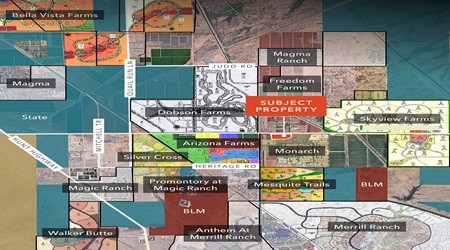
Phoenix, Ariz. (March 17, 2026) – A 29-acre land parcel located at the southeast corner of Felix Road and Arizona Farms Road in Florence, Arizona, in Pinal County, has sold for $4.7 million. Kidder Mathews Senior Vice President Brian Rosella represented the sellers, Aspen Nevada SPE LLC and Dolores Darnold, in the transaction. The buyer was Entitlements, LLC.

The property is located south of Metro Phoenix’s rapidly growing San Tan Valley submarket, an area experiencing significant residential and commercial expansion. The planned Florence Tech Park, a large employment center slated for the west side of Felix Road, further enhances the parcel’s appeal and positions the site to benefit from future job creation and development in the surrounding area. Florence Tech Park will be developed by Ryan Companies and EdgeCore.

“This transaction highlights the continued growth across Metro Phoenix,” said Rosella. “Investors and developers remain confident in the long-term residential and employment expansion occurring throughout the Southeast Valley.”

The Florence, Arizona area has experienced long-term population growth and significant development planning, with increasing interest from homebuilders and investors due to its location in one of the region’s fastest-growing corridors.

Kidder Mathews is the largest fully independent commercial real estate firm in the Western U.S., with over 900 professionals in 19 offices across Washington, Oregon, California, Nevada, and Arizona. We offer a complete range of brokerage, appraisal, asset services, consulting, and debt & equity finance services for all property types. Kidder Mathews averages $9 billion in transaction volume, manages more than 55 million square feet of space, and conducts nearly 2,700 appraisal, consulting, and cost segregation assignments annually. For more information, visit kidder.com.


Tucson House rehab begins, preserving affordable housing for older adults

Tucson House rehab

TUCSON, AZ (March 13, 2026) — Rehabilitation is underway at Tucson House, 1501 N. Oracle Road, to preserve and modernize affordable housing for older adults.

Arizona Governor Katie Hobbs and Tucson Mayor Regina Romero today led the celebration of the much-anticipated Tucson House rehabilitation, which will reconstruct an aging infrastructure, improve safety, and accessibility needs.

The groundbreaking ceremony represents a major milestone in the City of Tucson’s Thrive in the 05 Transformation Plan and the Mayor and Council’s continued investment in affordable housing preservation.

“Tucson House is more than walls and windows; it is a beacon of hope, a symbol of resilience, and a demonstration of the rich culture that defines this city,” said Arizona Governor Katie Hobbs. “Today Tucson House and the older adults who will reside in its nearly 400 renovated units become part of our story to transform affordable housing.”

Originally built in 1963, Tucson House is a 17‑story public housing structure that has long required significant reinvestment to address aging infrastructure, accessibility needs, and system obsolescence. Through a $50 million Choice Neighborhoods Implementation (CNI) grant awarded in 2023, the City of Tucson, working in partnership with Gorman & Company as co‑developer, general contractor, and future property manager, will undertake a full transformation of the property to ensure it will remain a safe, dignified home for older adults for decades to come.

“Tucsonans need housing that meets their needs across the continuum, from emergency housing to workforce housing to homeownership. With these upgrades, Tucson House will offer the comfort, accessibility and on-site services residents deserve,” said Tucson Mayor Reginia Romero. “Pursuing this grant was one piece of the City’s larger Thrive in the 05 strategy to provide modern, comfortable housing for more Tucsonans. It’s good to see that strategy bearing fruit in traditionally underinvested neighborhoods.”

The governor and mayor were joined in the ceremony by Housing and Community Development (HCD) Director Ann Chanecka, Arizona Department of Housing Director (ADOH) Ruby Dhillon-Williams, District 5 Pima County Supervisor Andrés Cano, City of Tucson Assistant City Manager Liz Morales, and Sally Schwenn, with co-developer Gorman and Company.

HCD Director Chanecka said, “HCD is excited to be at this point of construction after years of engagement with residents. We heard loud and clear that residents want to rehabilitate Tucson House and many want to remain living here, and they want security enhancements and upgrades. We are proud to fulfill our promise to residents to preserve this iconic building to continue serving older residents for another 60 years.”

The CNI grant from the U.S. Department of Housing and Urban Development (HUD) has enabled the City to develop mixed-income housing on three additional sites to establish an extensive support system for residents in the Tucson House and strengthen ongoing public investments in the 2.3 square mile Oracle Road and Miracle Mile area known as Thrive in the 05. The grant has allowed the City to leverage federal funds for an additional $300 million from public, private, and non-profit sources.

“Tucson House holds an important place in this community, and preserving it is essential to meeting today’s housing needs,” said Sally Schwenn, Market President at Gorman & Company. “By reinvesting in existing public housing, we demonstrate how older properties can be modernized thoughtfully, without displacing residents, and continue serving the people who have long called them home. We are honored to be a part of this impactful project.”

The Thrive in the 05 Transformation Plan adopted by Tucson Mayor and Council in 2022 identified a community-driven vision for investment in the area.

The property will be reconfigured into 358 modern, affordable apartment homes for older adults ages 55 and older, with upgraded systems, new community and amenity spaces, and enhanced outdoor areas. Although units are being reduced at Tucson House, they are being replaced as “replacement units” at a greater-than-1:1 ratio in other development projects, resulting in an overall increase in affordable housing in our community. This rehabilitation will ensure Tucson House remains a safe, dignified, and vibrant home for generations to come.

Transformation work on Tucson House has begun. Some residents have vacated their apartments, which have begun to be renovated, and have moved to vacant Tucson House apartments or off-site. Tucson House Resident Services has been working with Tucson House residents for the past three years in preparation for the multi-year remodeling initiative.

Project partnerships include City of Tucson and El Pueblo Housing Development (EPHD), the City’s non-profit development arm; co-developer and Choice Implementation Entity Gorman & Company; Tucson architects PMM, ADOH; HUD; Tucson IDA; National Parks Service; AZ SHPO; Pima County; Fannie Mae; J.P. Morgan Chase; Hudson Housing Capital; Citi; and Praxis Consulting Group.

About El Pueblo Housing Development
EPHD is tasked with building and rehabilitating housing to provide affordable units to people making up to 120% of the Area Median Income, with the priority on housing for low-income residents. EPHD has 10 affordable housing projects in planning or under construction, totaling more than 1,200 units of and nearly 2000 bedrooms.

About Gorman and Company
Gorman & Company is a leader in community revitalization through a steadfast dedication to high-quality, affordable, workforce, public, and senior housing nationwide.


TEP, City Tie Franchise Renewal to $56M Energy Collaboration

TEP, City

TUCSON, AZ (March 13, 2026) — Tucson Electric Power (TEP) and the City of Tucson are advancing a proposed 25-year Energy Collaboration Agreement tied to renewal of the utility’s franchise, a package that would direct an estimated $56.18 million toward climate, resiliency and low-income energy programs while asking voters to approve a new framework for TEP’s continued use of city rights-of-way.

According to TEP, the companion Energy Collaboration Agreement would begin at $2 million annually, with 2% increases every other year, for a projected total of about $56.18 million over 25 years. TEP says those funds would come from company resources and would not be recovered through electric rates, although the utility remains subject to the Arizona Corporation Commission’s regulation of its broader rates, rules, and operations.

The proposed franchise agreement would give TEP a non-exclusive 25-year right to construct, maintain, and operate its electric transmission and distribution system in city streets, alleys, and other rights-of-way. In addition to governing the utility’s use of public property, the agreement addresses construction, maintenance, permits, undergrounding, outage reporting, emergency coordination, and utility planning with the City.

TEP spokesperson Joe Barrios said the franchise agreement helps ease the utility’s work in city rights-of-way. While the current franchise agreement is set to expire in April, TEP officials said it would remain in place for another year regardless of whether voters approve a renewal.

A key point of debate is the proposed 2.25% franchise fee on applicable revenues, payable quarterly. Under the proposed agreement, those funds may be used by the City for low-income energy assistance, underground and renewable energy incentive programs. The current franchise agreement, approved by Tucson voters in November 2000, established a 2.25% franchise fee on customer bills.

TEP Director of Communications Joe Salkowski said franchise fees function much like other taxes collected from customers and remitted directly to the City of Tucson, with the utility not retaining or profiting from that revenue.

The proposal comes after Tucson voters rejected Proposition 412 in 2023. That measure would have renewed the City’s agreement with TEP and added an additional 0.75% fee on top of the existing 2.25% franchise fee to help fund undergrounding of midtown power lines.

The Tucson Mayor and Council are scheduled to review both the proposed Energy Collaboration Agreement and franchise renewal at a study session on March 17. If city officials move the measure forward, Tucson voters would have the final say. Before the item goes to an election, TEP must also deposit the estimated election cost with the City Clerk, as determined by the Council.

At a public meeting on Tuesday hosted by TEP and city officials, about a dozen residents attended in person. Fatima Luna, the City’s chief resiliency officer, said the proposed agreement reflects community input gathered through seven town halls held last year. She said residents asked for support for low-income programs that could help reduce energy bills, including retrofits, weatherization, solar panels, and workforce development, and wanted those efforts funded by shareholders rather than ratepayers.

Luna said the proposal was also shaped by public suggestions made to the Mayor and Council after Proposition 412 failed.

During the presentation, Salkowski said the agreement could be modified or terminated at any time by either TEP or City officials. That prompted questions from attendees about how voters could approve the framework while the City and utility would still retain the authority to amend or cancel it later without another public vote.

The meeting also drew protest, with three attendees interrupting the presentation by chanting “Public Power Now!” and raising questions about TEP’s work with data center developers in Pima County.

During public comments, some audience members questioned the 2% increase scheduled every other year, in addition to the initial $2 million annual commitment. Others suggested TEP should provide the entire projected funding amount as a lump sum so the City could address community needs sooner. Some also voiced support for municipalizing the electric grid as a possible affordability measure.

TEP is also framing the proposal with a broader message about its economic and civic role in Tucson. In a recent fact sheet, the utility said it serves about 457,000 customers in Southern Arizona, employs 1,800 people, including 760 union workers represented by IBEW 1116, contributed $47 million in 2025 to City operations through sales tax, utility tax, and franchise fee revenues, and invested more than $800 million in 2025 in grid upgrades and battery storage projects.

TEP said Tucson residents may continue submitting public comments on the proposed Energy Collaboration Agreement through Sunday, March 15. Comments can be made here: Tucson’s Energy Future – Community Input