Johnson Camp Mine Produces First Copper Using Rio Tinto’s Nuton Technology
Nuton

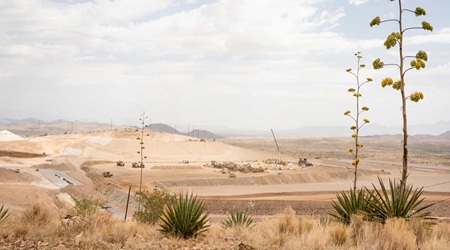
TUCSON, AZ (March 9, 2026) — A new copper recovery process being tested in Cochise County could help open a much larger share of the world’s copper resource to commercial production, as Rio Tinto’s Nuton venture reported its first copper output late last year at the Johnson Camp Mine south of Willcox. Rio Tinto released Dec. 4 that Nuton had produced its first copper at Johnson Camp using its proprietary leaching technology, marking what the company described as a key step toward scaling a process for hard-to-leach sulfide ores such as chalcopyrite.

The Johnson Camp deployment matters because chalcopyrite is the most abundant copper mineral in the world, but it has historically been more difficult and energy-intensive to process than oxide ores. In recent reporting by AZPM, Nuton Chief Technology Officer Harald Muller said chalcopyrite contains about 70% of the world’s copper and is likely to be a major target if supply is to keep pace with future demand.

Nuton, a Rio Tinto venture focused on bioleaching and related recovery technologies, uses naturally occurring microbes, an acidic solution, and heap leaching techniques to recover copper from low-grade chalcopyrite material that would often be considered too difficult or too marginal for conventional processing. Rio Tinto says the system is designed to recover copper from primary sulfides while lowering water use, energy intensity, and emissions compared with more traditional processing methods.

Rio Tinto is also promoting the Johnson Camp project as a lower-impact model for copper production. In its Dec. 4 release, the company said Nuton’s process could use up to 80% less water and generate up to 60% lower greenhouse-gas emissions than conventional copper processing routes, while also extending mine life by extracting value from material that might otherwise be treated as waste. The company has further said that Johnson Camp is targeting what it describes as the lowest-carbon-footprint copper in the United States, supported in part by renewable energy certificate purchases that match the site’s electricity use.

Johnson Camp, owned by Gunnison Copper, is in Cochise County, along Interstate 10 south of Willcox, and has become the first commercial-scale deployment site for the Nuton process. Gunnison described the project as part of the restart of mining operations at Johnson Camp, and both Gunnison and Rio Tinto said the Nuton phase at the site is expected to run for four years. During that period, Nuton expects Johnson Camp to produce about 30,000 tons of copper cathode.

Rio Tinto has also emphasized the carbon profile of the Arizona project. In its Dec. 4 announcement, the company estimated Johnson Camp’s mine-to-metal carbon footprint at 0.82 kilograms of CO2-equivalent per kilogram of copper.

The Cochise County test is not just a standalone mining story. It is also being positioned as part of a much broader push to secure domestic copper supply for power infrastructure, electrification, and data centers. On Jan. 15, Rio Tinto announced a two-year agreement with Amazon Web Services (AWS) to supply low-carbon Nuton copper produced in Arizona to AWS component manufacturers serving U.S. data centers. Rio Tinto said AWS will also provide cloud and analytics support intended to help optimize Nuton’s technology at Johnson Camp.

That agreement puts a Southern Arizona mining project directly into the conversation around AI infrastructure and domestic critical mineral supply chains. Reuters reported that Rio Tinto’s AWS deal reflects growing demand for copper tied to data centers and electrification, while industry forecasts continue to warn of future supply shortfalls.

Nuton’s Arizona work is also part of a wider strategy to form partnerships with copper projects in the western U.S. Rio Tinto’s prior disclosures tied Nuton to the Cactus project in Arizona Sonoran’s portfolio and to the Yerington project in Nevada. More recently, Nuton announced a $30.5 million payment to advance the Yerington Copper Project, while Arizona Sonoran disclosed in February that it and Nuton had terminated their option to form a joint venture on the Cactus Project. That leaves Johnson Camp as one of the clearest active demonstrations of the technology at commercial scale in Arizona.

For Arizona, the implications go beyond one mine. If Nuton’s process proves technically and economically viable at scale, it could reshape how miners think about lower-grade sulfide deposits across the state, especially in places where conventional processing has been too capital-intensive or environmentally challenging to justify. That does not eliminate the usual questions around mining economics, permitting, water, and long-term operations. But it does suggest that Cochise County is now hosting one of the mining industry’s most closely watched copper recovery experiments.



Small Deal, Big Fix: JTED Land Buy Unlocks Safer Parking at Camino Seco Campus

JTED

Tucson, (March 6, 2026) — A $350,000 land purchase near Pima County Joint Technical Education District #11’s (JTED) Camino Seco campus is set to ease a growing parking crunch—and improve safety for students and neighbors alike—as enrollment and programs continue to expand.

“Sometimes it’s not the size of the deal, but the problem it solves,” said Molly Gilbert, CCIM, Office Specialist with Cushman & Wakefield | PICOR.

Gilbert recently helped Pima County Joint Technology Education District #11 (JTED) address a major problem affecting student and community safety at its Camino Seco campus. JTED provides career and technical education programs for high school students across Pima County, equipping young people with hands-on skills for in-demand careers.

Greg D’Anna, Director of Public Relations at JTED, explained that as programs at the Camino Seco campus grew in popularity and enrollment increased, the campus began running out of parking. Students were forced to use overflow parking on the residential street outside, creating a dangerous situation for both students and neighbors.

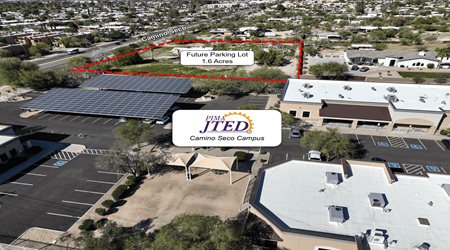
JTED had its eye on 1.6 acres of land at 8715 E. 21st Street, situated just slightly off campus from the school at 8727 E. 22nd St, Tucson, AZ 85710, but had little success reaching the owner to start the conversation about selling. Gilbert made contact, opened the door, and got the deal rolling.

The property used to be a suburban ranch but had long since been abandoned. Over time, it had become an eyesore and a genuine hazard; overgrown landscaping, stables collapsing, and rodent burrowing. The result of this $350,000 acquisition was a win for everyone involved. JTED gained parking for their growing student population; the property owner was compensated and relieved of the burden of an abandoned ranch; the neighbors finally saw a long-standing eyesore removed from their block; and they no longer had to deal with the chaos of students parking on the street.

The new lot will be fenced and secured, with a highly visible crosswalk on 21st Street, keeping safety at the forefront.

Getting the deal done wasn’t without its challenges. Gilbert had to secure an appraisal, ALTA Survey and Phase I Environmental in less than 30 days. Additionally, Gilbert had to research whether there was a well and septic on-site which both presented challenges since neither was registered with the State or Pima County.

D’Anna shared, “We are very happy with the work Molly did on this. It’s something we had our eye on for a while, and she was able to make it happen!” He also noted that the additional space opens the door for JTED to grow further, accommodating more students, events, parents, and staff down the road.

JTED’s campuses are expanding and have growing waiting lists. The waiting list was 800 last year, and now it’s 400. Camino Seco’s campus has struggled to keep pace with Tucson’s growing population, and this acquisition finally gives them the space and opportunity to do so. If students aren’t able to attend, they age out and never get the opportunity to be served by JTED, losing out on career skills that could shape their futures.

It’s not the size of the deal, but the problem and opportunities it solved. This is a great investment and improvement for the kids of Tucson.


Tucson’s Phantom Space Acquires Vector Launch Assets and Intellectual Property, Accelerating Daytona Launch Vehicle Development

Phantom Space

06TUCSON, AZ (March 6, 2026) — Phantom Space Corp. is moving to accelerate development of its Daytona small-launch rocket after acquiring assets and intellectual property from Vector Launch Inc., the former Tucson-based startup that filed for bankruptcy in 2019.

Phantom Space, also headquartered in Tucson, said it acquired Vector Launch’s design elements, engineering data, and proprietary technologies and will integrate them into Daytona’s vehicle architecture as it advances toward orbital flight for government and commercial customers. Financial terms were not disclosed.

“Phantom’s agility and founder-led approach make the company the right steward for this intellectual property,” Phantom Space cofounder and CEO Jim Cantrell said in a statement. “This acquisition strengthens the small-launch ecosystem at a time when demand for responsive launch has never been higher.”

Daytona is a two-stage rocket designed to deliver dedicated launch services for small satellites and spacecraft. Phantom Space said it has progressed through vehicle subsystem testing, including hot-fire tests of Daytona propulsion assemblies, and plans to begin integration and qualification work immediately. Stage-level testing and additional vehicle milestones are scheduled throughout 2026, the company said.

Phantom Space is also developing “Phantom Cloud,” an orbital data center constellation. A company spokesperson said Phantom’s first Daytona launch attempt remains targeted for the second half of 2027, with the first Phantom Cloud demonstration mission planned for the second quarter of 2027.

Founded in 2019 by two of the original five members who helped build SpaceX, Phantom Space is led by Cantrell and co-founder Adam Thompson. Cantrell previously served as SpaceX’s first vice president of business development and has worked at NASA’s Jet Propulsion Laboratory and the French Space Agency; he also cofounded Vector Launch. Thompson led development of Falcon 1 and Falcon 9 rockets and Dragon capsule structures while at SpaceX.

Phantom Space said the Vector Launch transaction helps keep U.S. launch technology and intellectual property active within the domestic space industrial base, and it expects the move to support additional high-tech hiring in Tucson. The company said it has about 30 employees and plans to add 20 more this year.

The acquisition arrives alongside another Arizona-linked space sector deal: Rocket Lab Corp. (Nasdaq: RKLB) said it acquired Tucson-based Optical Support Inc. (OSI) and will integrate the company into Rocket Lab Optical Systems—its Arizona-based payload arm. Rocket Lab said the deal adds 20 employees and includes continued operations at OSI’s 22,000-square-foot machining, test, and integration facility at 1661 S. Research Loop in Tucson.

OSI designs and manufactures high-precision optical and optomechanical systems used in commercial and national security space applications. Rocket Lab said OSI’s lenses and subsystems support missions including space protection and missile warning, tracking, and defense. OSI’s project work has included NASA’s James Webb Space Telescope, Sphere Las Vegas, and U.S. government defense and intelligence missions, according to the company.

Financial terms of the acquisition were not disclosed.

Source: Phantom Space press release (Feb. 26, 2026); Rocket Lab press release (Feb. 26, 2026).

For more information, please visit phantomspace.com.