Youth On Their Own (YOTO) earns Pima County’s top small business honor
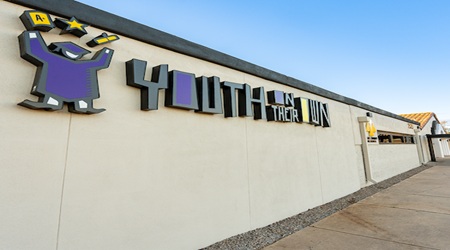
YOTO
TUCSON, AZ (Oct. 26, 2026) — For 40 years, Youth On Their Own has helped young people experiencing homelessness in Pima County overcome obstacles, stay in school and earn their high school diplomas. 

Now, the Tucson nonprofit has been named the Best Overall Small Business in the 2026 Pima County Small Business Commission Awards, recognizing its commitment to the community, the young people it serves and the employees who make its work possible. Youth On Their Own is a Tucson nonprofit that focuses on helping young people experiencing homelessness in Pima County.

Founded in 1986, YOTO employs 40 people and works with staff at more than 100 Pima County schools to support students experiencing homelessness who lack the care of a parent or long-term guardian.

Its mission is straightforward: A young person’s housing situation shouldn’t determine their future.

For Sam Brown, Chief Civil Deputy Attorney in the Pima County Attorney’s Office, that mission made a difference during a difficult time in his life.

“I was introduced to YOTO at a very vulnerable time in my life. As a teenager living with my teenaged older sister and my nephew, I had to grow up quickly and assume responsibility for things in my life that parents would normally take on. YOTO became a bridge for me that provided resources – money, school supplies, clothes, hygiene products, and a community with similarly situated teens.

“When you encounter a young person, please ask about their interests, their passions, and their situation. You never know when a single conversation will change a young person’s life like the Tucson High counselor who asked about my situation and connected me with YOTO.”

Brown’s experience is one example of the impact YOTO has had on an estimated 20,000 young people who have participated in its programs over four decades.

The organization provides financial assistance, basic necessities and guidance to help students stay in school. Eligible students can receive monthly stipends tied to school attendance, while YOTO’s Mini Mall provides free food, hygiene products, school supplies, and more.

“We’re investing in the future of our County,” said Bethany Neumann, YOTO’s Director of Development & Communications. “These are the young people who will be our doctors, our lawyers, our firefighters. They’ll be the new people in charge someday. And so not only is it a good thing to do and the right thing to do, it’s the smart thing to do.”

During the 2025-26 school year, YOTO served 1,415 students and distributed more than 167,000 basic-needs items. Among high school seniors participating in the program, 91% graduated, according to the organization. YOTO provided nearly $2 million in direct financial support to students last year.

“We know this works,” Neumann said, referencing a recently released longitudinal study examining the long-term outcomes of former YOTO students.

“Sam Brown, Chief Civil Deputy Attorney in the Pima County Attorney’s Office, credits YOTO with making a significant difference in his life. Youth On Their Own not only helps kids graduate from high school, but that graduation in turn leads to better financial outcomes, better post-secondary educational outcomes, and better mental health outcomes. It’s not just the graduation rate, it’s the long-term success.

“If we want this to be the kind of community we want to live in, we have to invest in it.”

Much of YOTO’s funding comes from foundations and individual donors. Pima County also supports the organization, providing $116,195 in academic stipends for this fiscal year through its Outside Agency Program.

Valerie Pullara, chair of the Pima County Small Business Commission, said YOTO’s commitment to young people, its workplace culture and community impact made it stand out among this year’s nominees.

“Youth On Their Own represents the very best of what a community-focused organization can accomplish,” Pullara said.

“Its extraordinary commitment, measurable results, and lasting impact on thousands of young lives demonstrate that organizational success is about more than financial performance. It is also about strengthening our community and investing in its future. Youth On Their Own exemplifies the leadership, compassion, and community commitment this award was created to recognize.”

YOTO was one of five organizations honored in the 2026 Pima County Small Business Commission Awards.

The other category winners were:

The awards are presented by the Pima County Small Business Commission, which advises the Board of Supervisors on policies affecting small businesses and helps strengthen communication between the County and the local business community.




IPA: $2.1 Trillion Debt Maturity Wave Raises Pressure on Multifamily Owners

 Multifamily

(October 23, 2026) — Multifamily owners face a challenging combination of maturing debt, elevated borrowing costs and an uneven recovery in rents, according to Institutional Property Advisors’ third-quarter 2026 U.S. Multifamily State of the Market report. While financing remains available, IPA’s findings suggest that stronger property operations, rather than lower interest rates, will increasingly determine investment performance.

Approximately $2.1 trillion in commercial real estate debt is scheduled to mature from 2026 through 2028, with apartments backing about one-third of that total. The report identifies $864 billion in maturities across commercial property types in 2026, followed by $644 billion in 2027 and $581 billion in 2028.

For apartment owners approaching those deadlines, refinancing presents a growing challenge. Higher borrowing costs can strain cash flow even at properties with stable occupancy, while limited appreciation can complicate efforts to replace existing loans. IPA reports that some lenders are pressing borrowers toward resolutions rather than continuing to extend troubled debt.

Financing Available, but at a Higher Cost

The report distinguishes between the availability of capital and the economics of borrowing. Banks have returned to commercial real estate lending following the regional bank failures of 2023, and overall commercial mortgage origination activity has exceeded its 2015–2019 average for five consecutive quarters.

Lending spreads have also remained relatively stable. However, higher benchmark interest rates have increased total borrowing costs across lender categories, limiting the benefit of competitive loan pricing.

Fannie Mae and Freddie Mac continue to provide financing capacity. Each agency’s 2026 multifamily lending cap was set at $88 billion, but originations through August remained well below those limits. IPA notes that rising base rates have slowed activity and that the agencies are maintaining underwriting standards rather than relaxing requirements to increase volume.

Apartment Sales Recovery Remains Uneven

Single-property apartment sales volume through August was down 6% from the same period in 2025, underscoring the slow recovery in transaction activity.

The broader commercial real estate market has shown improvement, although results vary by sector. Second-quarter transaction volume across commercial property types totaled approximately $130 billion, slightly below the $134 billion quarterly average recorded from 2015 through 2019. Apartment transaction volume increased 6% year over year during the quarter, compared with gains of 38% for industrial properties and 18% for retail.

Those quarterly figures measure a different period and transaction universe from the year-to-date decline in single-property apartment sales. Together, they indicate that improvement has yet to translate into a consistent recovery.

IPA also reports that momentum in U.S. commercial real estate equity fundraising has faded following a rebound in 2025, adding another constraint on investment activity.

Rental Demand Has Support, but Growth Is Slowing

Apartment demand continues to benefit from the high cost of homeownership. IPA reports that the monthly cost gap between owning and renting is more than eight times what it was a decade ago, helping keep households in rental housing.

Wage growth provides additional support. The report cites annual wage growth of 3.8% in August 2026 and notes that wages have outpaced rents since 2023 across Class A, B and C apartments.

Nevertheless, the recovery in rents remains slower and more geographically uneven than in previous cycles. Slower household formation and population growth are also limiting demand momentum. IPA identifies single-person households as the largest contributor to new household formation and cautions that the post-pandemic migration surge has largely subsided.

Property Income Takes Center Stage

IPA’s central conclusion is that owners cannot depend on interest rate relief to restore values. Apartment appraisal values were only 9% above their first-quarter 2020 level, while the trailing annual apartment total return stood at 4.6% in the second quarter of 2026, down from 5% in the preceding quarter.

With financing costs elevated, improving net operating income becomes more consequential. Occupancy, rent collections, resident retention and expense management will play a greater role in supporting property values and refinancing capacity.

Meanwhile, troubled loan volume continues to rise, with apartments and offices driving much of the increase since 2023. IPA expects more borrowers and lenders to confront difficult decisions as maturities approach.

The report portrays a multifamily market with continued demand and accessible financing, but less room for financial assumptions to compensate for weak operating performance. Owners facing near-term maturities will need to evaluate refinancing options early and base expectations on each property’s income and local market conditions.

Source: September SoM IPA MF Q3 2026


Cities in Pinal County Take Different Paths on Data Centers as Jobs and Infrastructure Shape Economic Development Debate

Pinal County
Economic Development leaders from cities within Pinal County discussed their approach toward data center development at the Phoenix Business Journal Growth Summit event on Oct. 20. (Photo Credit: Jim Poulin | Phoenix Business Journal)

PINAL COUNTY, Arizona (Oct. 23, 2026) — Data center and energy developers are encountering sharply different receptions across Pinal County, where recent county-level rejections contrast with some cities’ willingness to consider projects that deliver jobs, infrastructure and economic investment.

The divide highlights the importance of local zoning rules, community engagement and a developer’s ability to explain how a project will address power, water and neighborhood concerns.

In unincorporated Pinal County, developers have faced significant resistance. The county’s Planning and Zoning Commission recently voted again to recommend denial of a proposed natural gas power plant with battery storage, despite the applicant’s proposal to reduce generating capacity from 500 to 250 megawatts.

In August, the county’s Board of Supervisors rejected Vermaland’s proposed La Osa Energy Center, originally envisioned as Arizona’s largest data center campus. The rejection followed a proposed reduction from as many as 59 data center buildings to 11.

Within municipal boundaries, however, some communities are keeping a path open for development.

Casa Grande’s Planning and Zoning Commission recently approved a conditional use permit for Grande Valley Data Center, a proposed 954-acre campus by Scottsdale-based LKY Development. The property is south of Maricopa-Casa Grande Highway and west of Montgomery Road on land zoned for industrial use.

Plans call for data center buildings, onsite natural gas generation, battery energy storage and supporting utility infrastructure. The proposed cooling system would recycle water through a closed loop, with water service provided by Globe Water Resources.

The permit represents a step in the city’s review process. Additional scrutiny will follow as the development advances.

Casa Grande allows data centers in industrial districts with a conditional use permit, giving officials an opportunity to evaluate power arrangements, water demand, noise and concerns raised by nearby residents.

Speaking at the Phoenix Business Journal’s Pinal County Growth Summit on October 20, Casa Grande Economic Development Director Richard Wilkie said developers need to communicate more effectively about how their projects address those issues.

“They have to do a better job of PR and explaining, educating how they’re addressing this,” Wilkie said. “There’s going to be people that are going to say no anyways. But you just have to try your best to educate them about the pros versus the cons.”

Newly incorporated San Tan Valley has adopted a similar approach. Its zoning code requires a conditional use permit for data centers proposed in industrial districts, creating a public review process.

“It’s not intended to screen anyone out, but to make sure that there is a full public process that’s gone through and that we have the support of the community for that type of development,” Town Manager Brent Billingsley said at the summit.

Maricopa is updating its zoning ordinance to address data centers, with city leaders emphasizing employment and infrastructure as central considerations.

The city “desperately needs more jobs,” Chief Strategy Officer Josh Bowman said. Officials would consider a project that creates employment while delivering infrastructure capable of supporting additional businesses on neighboring properties.

“I would say that we are not actively recruiting, but we’re open to it with those kinds of parameters,” Bowman said.

Queen Creek has taken a more restrictive position. Its zoning ordinance explicitly prohibits data centers, although Economic Development Director Doreen Cott said that policy could change.

For developers, the differing approaches make location and early engagement critical. For communities willing to consider these investments, the discussion increasingly centers on whether a project can meet local operating standards while expanding employment opportunities and infrastructure capacity.

The discussion also offers a point of comparison for neighboring Pima County as it weighs economic development, infrastructure needs and community concerns. Although no Tucson or Pima County representative was listed on the summit’s economic development panel, the questions facing Pinal County cities have broader regional relevance: how to evaluate major investments, explain their benefits and impacts, and establish a clear approval process that gives residents a voice while providing developers a predictable path forward.

Source: Phoenix Business Journal’s coverage of the October 20 Pinal County Growth Summit and related development proceedings.