Tucson Rent Trends: Prices Dip 0.5% Monthly, 4.7% Annually
Tucson Rent Trends

TUCSON, AZ (February 4, 2026) — The Apartment List February 2026 Tucson Rent Trends is reporting the city’s overall median rent is now $1,018, after falling 0.5% last month. Rents are down 4.7% year-over-year. Below is a snapshot of recent performance in Tucson and how local trends compare with Arizona and the U.S. overall.

Tucson rental stats (February 2026)
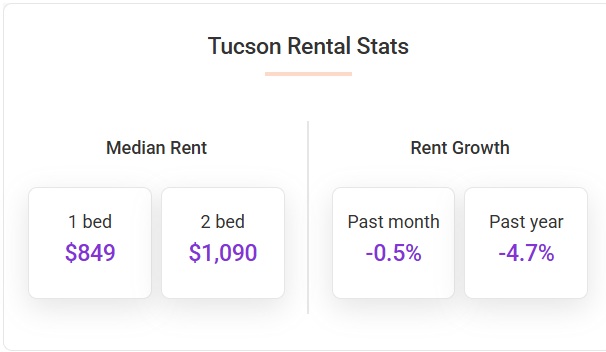
Rents down month-over-month and year-over-year
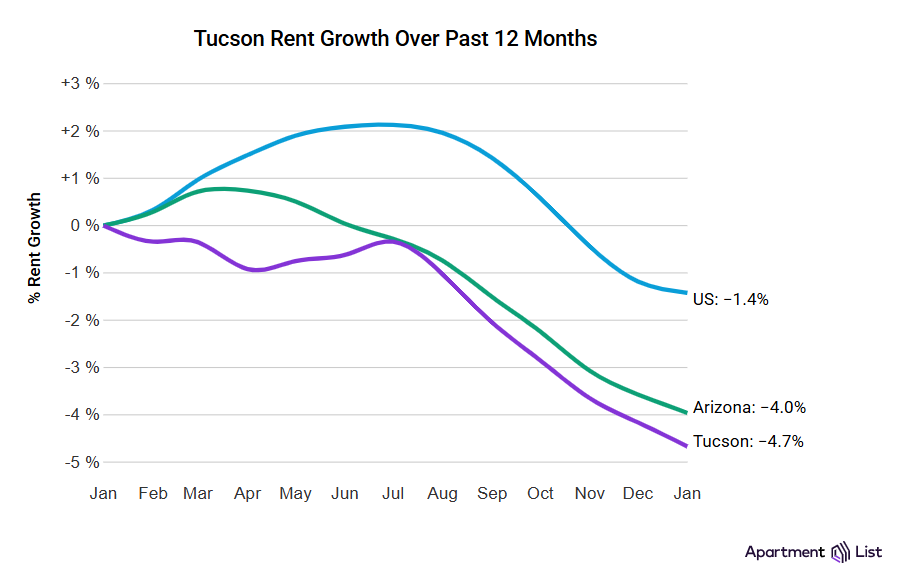
Tucson’s median rent fell 0.5% in January and has now declined 4.7% over the past 12 months. Tucson’s annual rent change is similar to the Arizona average (-4.0%), but has fallen below the national average (-1.4%), reflecting a sharper cooling locally than in much of the country.

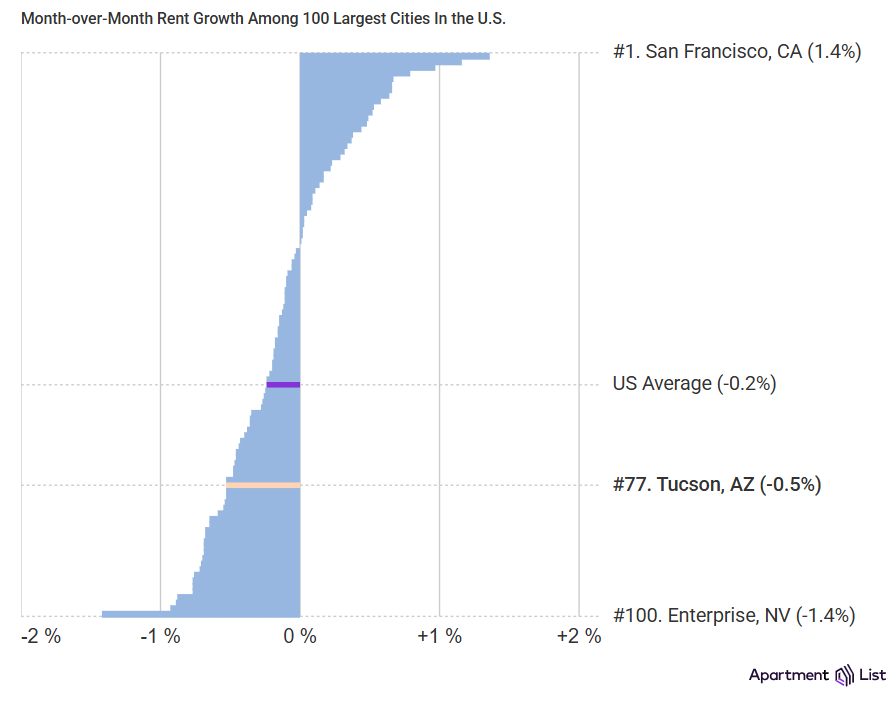
Tucson’s January rent change ranked #77 among large U.S. cities

Tucson rents decreased 0.5% over the past month, compared with a -0.2% decline in the national average across large cities. Among the 100 largest U.S. cities, Tucson ranked #77 for month-over-month rent growth. Cities with similar monthly changes included Tampa, Florida (-0.5%) and Houston, Texas (-0.5%).
Tucson remains among the least expensive large U.S. cities

With an overall median rent of $1,018, Tucson ranks as the #97 most expensive city among the nation’s 100 largest—meaning it sits near the more affordable end of the big-city spectrum.
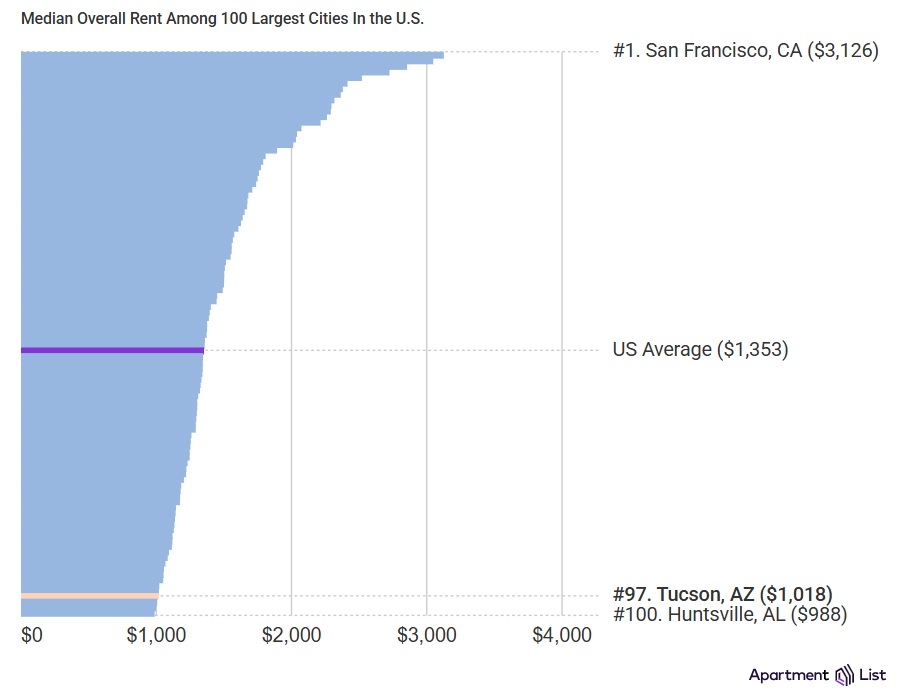
For comparison, the national medians are:

  • 1-bedroom: $1,189
  • 2-bedroom: $1,339
  • Overall: $1,353

Tucson’s overall median rent is 24.8% lower than the national median, and is comparable to markets such as Detroit, Michigan ($1,020) and Wichita, Kansas ($1,007).

Methodology

Apartment List produces monthly rent estimates by starting with median rent statistics from the U.S. Census Bureau, then extrapolating to the current month using a growth rate derived from Apartment List listing data. The methodology uses a same-unit analysis similar to the Case-Shiller approach, tracking rent changes for comparable units over time. Apartment List notes this method helps correct for sample bias present in some private rent sources, with results designed to align more closely with Census Bureau and HUD benchmarks.

Data access

Apartment List publishes monthly rent reports and downloadable datasets for hundreds of cities nationwide, along with aggregated county, metro, and state data. The information is intended to support renters, policymakers, and researchers, and is frequently cited by journalists covering housing markets.


Torch Properties Buys Partial Equity in 100,387-SF Tucson Multi-Tenant Portfolio

Torch Properties
PALMDALE/FREMONT BUSINESS PARK PROPERTIES

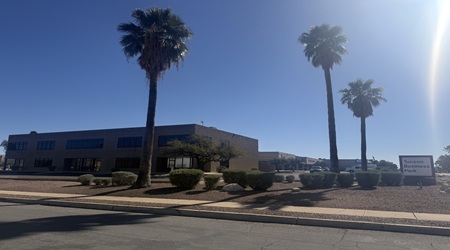
TUCSON, AZ (February 3, 2026) — Torch Properties, owned and managed by Brandon Rodgers, has acquired a partial equity interest in a 100,387-square-foot portfolio of light industrial, retail, and business park properties totaling more than 40 tenants.

The portfolio includes:

  • CAMPBELL VILLAGE – 3025 N. Campbell Ave., Tucson — A neighborhood retail shopping center with tenants including The District Bites and Brews, Chipotle, El Jefe Cat Lounge, Gelish Nail Salon, The Running Shop, Core Nutrition, Dirty Dawgs Pet Care, Mauricio Fregoso Salon, and Secure Nation & Cyber.
  • PALMDALE/FREMONT BUSINESS PARK PROPERTIES – Tucson — 1010 E. Palmdale St., 1020 E. Palmdale St., 1021 E. Palmdale St., and 4100 S. Fremont Ave. These light industrial business park assets offer office suites and small-to-medium industrial bays with roll-up doors, three-phase power, and flexible office/warehouse layouts.
  • 1101 E. 18TH ST., TUCSON — A single-tenant industrial outdoor storage building occupied by Nutrien Ag Solutions.

Torch Properties’ latest investment follows the company’s partial equity buyout last year of Oracle Towers, a light industrial, retail, and business park property at 3811–3889 N. Oracle Road with more than 50 tenants. Torch Properties reports that Oracle Towers is now 100% occupied, citing rapid lease-up, experienced property management, disciplined CAM and expense controls, in-house maintenance, and tenant retention as drivers of improved financial performance in a short period.

Torch Properties and BRD Realty said they are focused on increasing occupancy and delivering experienced, high-quality property management across Campbell Village, the Palmdale and Fremont industrial properties, and Oracle Towers.

Max Fisher of BRD Realty will handle leasing, and Eileen Lewis of Torch Properties will take over the property management.

For additional equity buyout/management opportunities or leasing inquiries, contact Max Fisher at [email protected] or (520) 465-9989.


Value retailers fuel 2026 store-opening wave, with Arizona in the mix

Value retailers

TUCSON, AZ (Feb. 3, 2026) — A new national wave of brick-and-mortar expansion is taking shape in 2026, led by value retailers and discount concepts. Business Insider reports that announced openings are currently set to outpace announced closures this year, with more than 800 new stores expected to open nationwide in 2026.

For Southern Arizona, the signal is clear: value-driven retail is still actively hunting for sites, especially in growth corridors and high-traffic neighborhood centers—while legacy formats continue to be right-sized.

The biggest 2026 expanders to watch

  • Dollar General: The chain says it plans to open about 450 new U.S. stores in 2026, plus thousands of remodels and a small number of relocations. Local lens: This continues to reinforce demand for small-footprint, value-oriented boxes—particularly in underserved and rural trade areas.
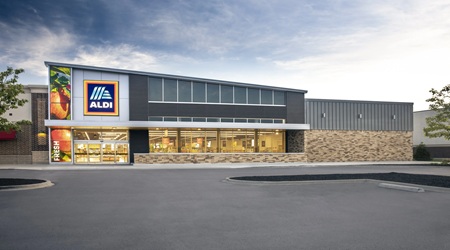
  • Aldi: The grocer announced 180+ new stores across 31 states by the end of 2026, bringing its U.S. total to nearly 2,800. Arizona lens: Regional coverage reports 10 new Aldi stores planned in Metro Phoenix in 2026, part of its broader westward growth strategy. Tucson continues to hope for its first Aldi.
  • Ollie’s Bargain Outlet: The off-price closeout chain is targeting 75 new stores in fiscal 2026, according to company guidance and earnings materials. Local lens: Ollie’s growth is being fueled by “second-generation” big boxes and discounted lease rates in many markets—an ongoing trend that can create backfill demand for large vacancies.
  • Barnes & Noble: The bookseller says it is planning more than 60 new stores in 2026, and its first 2026 opening debuted in Washington, D.C., in mid-January. Arizona lens: Barnes & Noble continues to operate Valley-area stores, underscoring that the brand’s current growth narrative is real—even as department-store traffic softens in many regions.

What it means for Tucson-area retail real estate

Across the country, expansion is concentrating in value retail, discount grocery, and necessity-based formats, which tend to perform best when shoppers are price-sensitive. For the Tucson metro, that typically translates into:

  • More site competition for well-located small-shop and junior-anchor spaces
  • More re-tenanting pressure (and opportunity) for older big-box centers as weaker operators exit
  • Continued divergence between strong neighborhood centers and challenged mall/department-store-driven space

Phoenix area: Discount grocery expansion remains active, adding competitive pressure for well-located grocer-adjacent centers.
Tucson metro: The best-positioned opportunities tend to be (1) neighborhood centers with daily-needs traffic and (2) second-generation retail boxes that can be re-tenanted quickly at a value-driven rent point.

In Southern Arizona, the most consistent leasing demand continues to come from value, grocery-adjacent, and service-driven retail—while second-generation big-box spaces remain the best backfill opportunities for expanding discount operators.