MAG Region Rundown: Vacant Homes, Homelessness Count, and Prop 479 Work Gets Underway

MAG Region
MAG Photo of the Month: “Imagine this Place” by artist Mary Lucking in Bullard Wash Park in Goodyear, AZ

Maricopa County (January 29, 2026) — The Maricopa Association of Governments (MAG) region is entering 2026 with three big storylines that cut across housing supply, homelessness response, and long-range transportation investment: elevated vacancy that doesn’t necessarily translate into available homes, the Valley’s annual Point-in-Time homelessness count, and the first wave of projects tied to Proposition 479.

Vacancy looks high—until you factor in seasonal and investor-owned housing

Housing vacancy rates are often cited as a simple indicator of whether a market has “enough” housing. But MAG is underscoring a key nuance in metro Phoenix: a meaningful share of vacant units are not sitting empty and available for new full-time residents. Instead, seasonal occupancy, short-term rentals, and second-home or investor ownership can inflate headline vacancy while leaving the effective supply of year-round housing far tighter than the raw numbers suggest.

MAG points to Maricopa County Assessor data showing roughly 25% of housing units are investor-owned or second homes—conditions that can make vacancy a misleading shorthand for availability.

More than 1,000 volunteers take part in the annual homelessness count

On January 27, more than 1,000 volunteers spread across the Valley—checking streets, alleys, parks, riverbeds, and other locations—as part of the annual Point-in-Time (PIT) count of people experiencing homelessness.

PIT results help determine how much federal funding the region can compete for, inform how resources are directed among service providers, and establish a baseline for tracking progress year over year.

The most recent published PIT count recorded 9,734 people experiencing homelessness across the region, a 3% increase year over year. Data from the January 27, 2026, count is expected in late spring.

Prop 479 projects begin, starting with major freeway and arterial upgrades

Voters approved Proposition 479 in November 2024, extending a dedicated half-cent transportation sales tax for 20 years. MAG says January marks the start of Prop 479-funded work, kicking off with projects intended to improve freeway connectivity and key regional corridors.

First up is the construction of a new system interchange between Loop 303 and I-17, along with other major efforts, including the El Mirage Road extension between Jomax Road and Loop 303, the completion of State Route 24 (including grade-separated interchanges between Loop 202 and Ironwood Drive), and planned improvements at I-10 and Jackrabbit Trail.

MAG notes 183 projects are currently planned under the Prop 479 umbrella—an ambitious pipeline that will roll out in phases as funding and schedules align.


Photo of the Month: “Imagine This Place” at Bullard Wash Park

MAG also highlighted “Imagine This Place,” a public art installation in Bullard Wash Park, City of Goodyear, by artist Mary Lucking. The project invites visitors to picture the park across different moments in the past and future as they move along the trail.



Wespac Construction Completes Expansion at Rosie’s House to Support Growing Student Community

Wespac Construction
Rosie’s House Piano Lab

PHOENIX, Ariz. (January 28, 2026) — Wespac Construction is proud to announce the successful completion of a facility expansion at Rosie’s House: A Music Academy for Children, a nonprofit organization dedicated to providing free, high-quality music education to young people across the Valley.

As Rosie’s House continued to grow in both staff and student enrollment, the organization was at capacity. The 3,000 SF expansion was designed to support this growth while enhancing the overall learning and working environment for students, instructors, and staff alike. Now encompassing 18,000 SF, the newly completed campus improvements provide much-needed space to accommodate increasing demand and allow the academy to further its mission of accessible music education for all.

The project added significant operational and instructional space, including multiple new music studios, two large classrooms, a boardroom, a mother’s room, a community room, and a piano lab. These enhancements create a more functional, welcoming, and inspiring environment for students to learn, practice, and perform.

Funding for the expansion was made possible through the generosity of individual supporters, local foundations, and national funders, underscoring the organization’s strong community investment and growing national profile.

“It’s always fulfilling to work on a project knowing that we are helping people within our community,” said Steven Crofoot, Project Manager at Wespac Construction. “Being part of a project that directly supports education, creativity, and opportunity for kids makes this work especially meaningful.”

Wespac Construction collaborated closely with the Rosie’s House leadership team, including Rosie’s House CEO Becky Bell Ballard, Marvin Scott, and Kevin Gorman, as well as design partner Aline Architecture Concepts, to ensure the expansion aligned seamlessly with the academy’s vision and day-to-day needs.

“We never want space to be the reason we turn a student away,” Ballard said. “With this expansion complete, we have the capacity to grow and achieve our goal of serving 1,000 students by 2027.”

The completed expansion positions Rosie’s House to meet that growth with enhanced facilities, improved staff support, and an environment designed to continue changing lives through the power of music.


Health Alert: Third confirmed measles case under investigation in Pima County

Measles CasePIMA COUNTY, (Jan. 28, 2026) — The Pima County Health Department (PCHD), in coordination with the Arizona Department of Health Services (ADHS) and local healthcare partners, is investigating a third confirmed case of measles in Pima County involving a Tucson resident.

The individual was not fully vaccinated and developed symptoms following direct exposure to a previously reported measles case in Pima County. The individual is not hospitalized and is isolating and recovering at home.

PCHD is conducting a comprehensive public health investigation to identify and notify individuals who may have been exposed. State, regional, and local public health and healthcare partners remain on high alert and in close coordination.

Public exposure locations

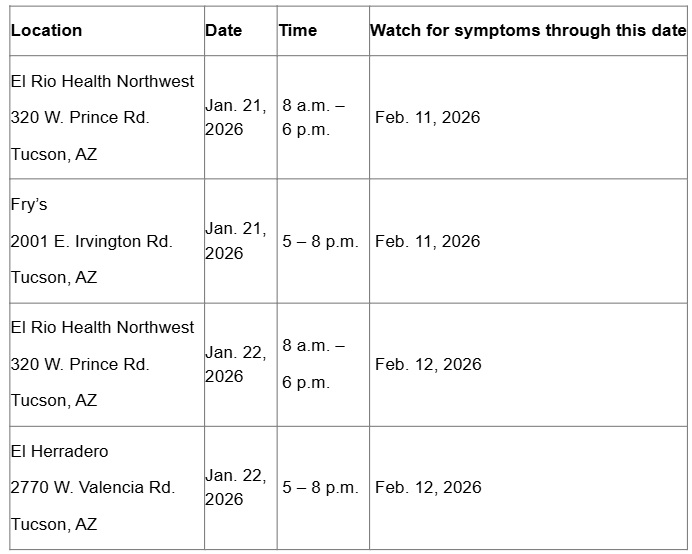
PCHD has identified the following locations where potential exposure to measles may have occurred. Individuals who were present at these locations during the dates and times listed below should monitor for symptoms through the indicated date. The Health Department is working with other jurisdictions where exposures may have occurred.

As part of contact tracing efforts, PCHD will be contacting individuals who may have been exposed. Residents are asked to answer phone calls and respond promptly to public health outreach to support these efforts. Calls from PCHD will come from a (520) 724 phone number.

Symptom monitoring

Anyone who believes they may have been exposed to measles and is experiencing symptoms should:

  • Stay home and avoid contact with others
  • Contact a healthcare provider or PCHD (520-724-7797) before seeking in-person care
  • Follow public health guidance to prevent further spread

Individuals should remain aware and monitor for symptoms if they were present at the locations during the dates and timeframes listed above.

Symptoms typically appear 7–14 days after exposure and may include:

  • Fever
  • Cough
  • Runny nose
  • Red, watery eyes
  • A rash that usually begins on the face and spreads downward

Vaccination information

Measles is a highly contagious but preventable disease. Vaccination remains the most effective protection:

  • One dose of the MMR (measles, mumps, rubella) vaccine is about 93% effective
  • Two doses are about 97% effective
  • Individuals born before 1957 are generally considered immune
  • People who are unvaccinated or under-vaccinated are at higher risk of infection

“While no vaccine provides 100% protection, two doses of the MMR vaccine offer very strong immunity,” said Dr. Theresa Cullen, Pima County Health Director. “Because immune responses can vary from person to person, high community vaccination coverage is essential to protect those who are most vulnerable and to limit the spread of measles.”

MMR vaccinations are available at all Pima County Health Department clinics, regardless of insurance status. Clinic hours and locations are available on the Health Department’s website.

The vaccine is also available at many commercial pharmacies, primary care providers and federally qualified health centers.

For more information about measles and where to get vaccinated, visit pima.gov/measles or contact PCHD Epidemiology at 520-724-7797.

More about measles

  • Measles is a serious viral infection that can cause permanent damage or even death, especially for children under age 5. Measles is one of the most contagious illnesses—it can spread through direct contact, infected surfaces and live in the air for up to two hours.
  • Symptoms can begin about 14 days after being exposed and can include a high fever (104°F to 105.8°F), a full-body rash that usually starts a few days after the fever, cough, runny nose, diarrhea and red, watery eyes.
  • Serious complications can include permanent hearing problems or vision loss, pneumonia, brain damage and death.

More info