In 5 years, Earthworks Environmental has expanded compliance footprint across U.S., continued growth in its Arizona office

MESA, ARIZONA – Five years ago, Cherie Koester left a prominent job with Maricopa County to start her own business. From her residence in Queen Creek, Koester founded Earthworks Environmental LLC.

As the woman- and minority-owned environmental consulting firm celebrates its fifth anniversary, the Mesa-based company now boasts 36 employees and almost 800 projects across the country.

“While our 5-year celebration is local, I’m extremely proud of my staff for the expansion we’ve made across the country,” said Koester, who holds the title of CEO.  “The culture we have created here strives for excellence.

“Last year I said I was prepared to go the distance with this team of elite professionals. I also said I have no plans of slowing down. Earthworks has achieved that goal and more,” she said.

Earthworks Environmental operates in Arizona, Florida, Maryland, Delaware, Pennsylvania, New Jersey, Ohio, Indiana, Illinois, Minnesota, Wisconsin, Iowa, Colorado and Texas. Its Arizona projects are in Phoenix, Tucson, Prescott and Yuma.

Services provided include stormwater pollution prevention, Phase I and II Environmental Site Assessments, dust control, and construction safety compliances. The firm primarily serves land developers, vertical developers, commercial construction, and land-holding companies.

“I’m excited to announce a new service line – drone inspections,” Koester said. “With drone inspections, our clients get access to these videos for their own marketing materials if they would like.”

Koester said the firm is consulting on nearly 800 permits nationally. Recently she hired two additional employees in the Arizona office. Founded in 2014, Earthworks Environmental expanded its operations to Florida and added two employees at its Arizona office in late 2016.

A proprietary program that Earthworks Environmental employs – ERX – has also played a key role in the expansion, Koester said. ERX is an environmental reporting software program that puts all aspects of environmental compliance into one program. This includes any permits and inspections. Koester said nearly 75 percent of the violations in her industry occur in the paperwork process.

A client can hire Earthworks Environmental to handle the entire process including ERX. A client may also decide to opt out of the consulting and use ERX themselves. In that case, Earthworks Environmental will apply a nominal fee for use.

“My motto is, ‘I don’t demand perfection but I do expect excellence,’” Koester said. “At Earthworks, we pride ourselves on being the leader in the industry for technology and customer service. We look forward to the next 5 years.”

To learn more about Earthworks Environmental visit earthworksenv.com.


Arizona’s groundwater replenishment program facing an uncertain future

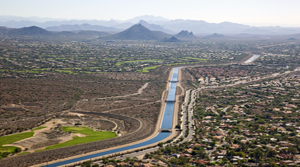
PHOENIX — A key water management tool that sustains housing development in central Arizona does not have a rosy future, according to a new report from Arizona State University.

The report looks at the Central Arizona Groundwater Replenishment District, which the Legislature established in 1993 to assure the replenishment of groundwater that’s tapped for development.

Developers and, by extension, home buyers, can pump and purchase groundwater and then pay into the program; the district then has to replenish the water that serves those homes. This is a way to meet the state’s water management goals and comply with the legally required 100-year water supply.

But the report outlines several concerns about the specific rules that govern the replenishment district and casts doubt on the district’s ability to find water to meet expected obligations.

One concern is that the replenished water does not have to be returned to the same place where it originally was pumped. The district only has to put water back into the larger active management area, and the recharged water doesn’t necessarily migrate to where it’s needed.

“It’s an unsustainable practice,” said Kathy Ferris with ASU’s Kyl Center for Water Policy, the report’s co-author. “There are so many different aquifers and layers. There are seven subbasins. And water doesn’t just move around like it’s in a bathtub. Sometimes it doesn’t move at all, depending on where it’s recharged.”

There are five active management areas in central Arizona. The one in Phoenix, for example, covers 5,646 square miles.

Another concern is financial. As water in Arizona becomes more expensive, some homeowners enrolled in the replenishment district have looked for water that’s cheaper than the original source the developer identified for its required 100-year water supply. A different source may free homeowners from paying an annual charge for replenishment.

The problem, the report said, is that the district still must find and pay for water “to meet the member’s long-term replenishment obligation.”

Depending on how many homeowners use this cheaper-source strategy, it could mean consistent expenses but lower revenues for the replenishment district, which has fixed costs that do not fluctuate depending on how much water needs to be replenished that year.

Ferris cited a consultant’s report from 2017 that said if all of the Phoenix area lands enrolled in the replenishment district used this workaround, the result would be “financially catastrophic.” The consultant’s policy recommendations involved legal or regulatory changes that have not been enacted.

The ASU report also raises concerns over the amount of water the replenishment district is expected to need to meet its current and projected obligations, especially at a time of shortage conditions on the Colorado River, the state’s largest source of surface water.

The district’s board also runs the Central Arizona Project canal system. In a statement, the agency pointed out it “was charged with the statutory obligation to manage the CAGRD since its inception more than 25 years ago,” saying it “has fulfilled this duty effectively, demonstrating fiscal responsibility while securing a robust water supply portfolio that will be available through the mid-2030s.”

CAP also acknowledged in the statement that its part of the discussion over where growth will happen in urban areas especially Maricopa County.

“CAP welcomes the opportunity to be part of it, but given that the focus of this conversation would be beyond CAP’s CAGRD responsibilities, CAP may not be the appropriate entity to convene and lead this conversation.”

The agency does not have the legal authority to reject new enrollees in the groundwater replenishment program. The Arizona Department of Water Resources does have some oversight because it approves a 10-year plan for the district and can later reverse an approval.

But the report said “such a decision will be politically difficult, will not stop the sale of previously enrolled but unconstructed lots, and will not address CAGRD’s continuing replenishment obligations for its current members.” It recommends authorizing the program to deny accepting new members if needed.

A spokeswoman at the water resources department declined to comment on the ASU report, saying it had not yet been reviewed.

The report comes on the heels of the state releasing its own water bombshell: a new model for the Pinal Active Management Area that shows an expected shortfall of more than 8 million acre-feet of water. An acre-foot is enough water to cover 1 acre of land with 1 foot of water, enough to supply a family of four for a year.

“I think that the Pinal situation demonstrates that as time has gone on, we’ve learned more and more about our groundwater resources,” Ferris said. “And our scientific ways of assessing how much groundwater is there have dramatically changed. Nobody’s talking about the fact that, well, even if there was enough groundwater, if it’s all used up, it gets all used up.

“Then what?”


Marcus & Millichap Arranges the Sale of Triple-Net-Leased Black Rock Coffee in Mesa, AZ

MESA, Ariz. – Marcus & Millichap (NYSE: MMI), a leading commercial real estate investment services firm with offices throughout the United States and Canada, has announced the sale of Black Rock Coffee, a triple-net-leased property located in Mesa, Arizona. According to Ryan Sarbinoff, regional manager of the firm’s Phoenix office. The asset sold for $1,375,000 ($722 PSF).

The buyer, a partnership, was procured by Chris Lind, Jamie Medress and Mark Ruble, investment specialists in Marcus & Millichap’s Phoenix office. Black Rock Coffee is located at 1132 South Gilbert Road in Mesa, Arizona, strategically neighboring Mesa High School.

This 1,905-square-foot property was newly constructed in 2019 and sits on 0.36 acres. The tenant, Black Rock Coffee has a brand new 15-year lease. Black Rock Coffee is a modern coffee chain that was founded in 2008 in the state of Oregon. The company has experienced rapid growth throughout the Pacific Northwest and has since expanded to several other markets including California and Arizona, with over 50 locations and plans for more.