Hanley Investment Arranges $23 Million Sale of 50,000-SF Grocery-Shadow-Anchored Shopping Center to Bershon Realty Company in Phoenix Metro
Hanley InvestmentSafeway‑Shadow‑Anchored Center in Goodyear, Arizona, Trades to Los Angeles‑Based 1031 Exchange Buyer
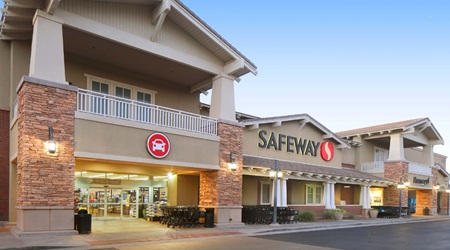
GOODYEAR, Ariz. (January 20, 2026) – Hanley Investment Real Estate Advisors, a nationally recognized real estate brokerage and advisory firm specializing in retail property sales, announced today that the firm has completed the sale of Mountain Ranch Marketplace, a 49,683-square-foot, Safeway-shadow-anchored neighborhood center located in the Phoenix suburb of Goodyear, Arizona. The sale price was $23 million.
Hanley’s Executive Vice Presidents Bill Asher and Jeremy McChesney, in association with Lee Csenar of Hanley Investment Real Estate Advisors, Inc., represented the buyer, Bershon Realty Company, LP, a private investment company based in Los Angeles. The seller and developer, Kitchell Development Company, was represented by CBRE’s Ryan Schubert, Michael Hackett and Zach Aulick.
Hanley helped Bershon Realty procure a strong‑performing, grocery-shadow-anchored shopping center to fulfill a 1031 exchange requirement. In mid‑October, Hanley represented Bershon Realty Company in the purchase of a similar shopping center shadow-anchored by a newly constructed Safeway, The Shops at Laguna Reserve in Elk Grove, California.
Mountain Ranch Marketplace is located on 12.4 acres at the northwest corner of Estrella Parkway and Elliot Road in Goodyear (9860 South Estrella Parkway, 17626 West Elliot Road and 17650–17670 West Elliot Road).
The property offered upside potential with two developable land pads.
The center is 94.6% occupied and features a diverse mix of internet‑resistant tenants, including AutoZone, Phoenix Children’s Academy, Starbucks, Papa John’s Pizza, Subway, Leslie’s Swimming Pool Supplies, Maricopa Ambulance, Verizon, Edward Jones, Enhanced Beauty & Wellness medical spa, North Star Animal Hospital, Oasis Bagels, T&T Martial Arts Academy, Great Clips, a nail salon, a dentistry practice and others. Tenants not included in the sale include Safeway, McDonald’s, Taco Bell, Walgreens, and Chase Bank.
The Safeway grocery store, shadow‑anchoring the center, is a high‑performing location ranked No. 12 in the state out of 105 Safeway stores in Arizona. The center benefits from zero direct grocery competition within a six‑mile radius and serves as the primary retail destination within the Estrella master‑planned community, one of the largest and fastest‑growing in Arizona.
The Estrella community has more than 8,000 homes built, with an additional 29,000 planned or actively under development. The broader trade area includes more than 50,000 residents within a five‑mile radius, supported by high household incomes, strong homeownership rates and a family‑oriented demographic profile.
Originally built in 2009 with additional construction in 2024, Mountain Ranch Marketplace was the first LEED‑Gold‑certified retail center in Arizona. The award‑winning destination offers excellent visibility, convenient freeway access, and newer construction, reinforcing its position as a central hub for the Estrella community.


Missing Middle Weakness in Home Building

Missing MiddleBy: in NAHB Missing Middle Weakness, January 19, 2026

(January 20, 2026) — NAHB says the “missing middle” includes medium-density housing such as townhomes, duplexes, and other small multifamily properties.

But the multifamily slice of that category—apartments in two- to four-unit buildings—has underperformed since the Great Recession. In the third quarter of 2025, there were about 4,000 starts in two- to four-unit properties, a slight decline from the third quarter of 2024.

Over the past four quarters, starts totaled roughly 19,000 units, up 12% from the prior four quarters (17,000). Even with that gain, output remains well below what the market could support, with zoning constraints cited as a key barrier.

Two- to four-unit buildings accounted for just 3% of all multifamily construction in the third quarter—still below historical norms. From 2000 to 2010, this housing type represented just under 11% of total multifamily development.

Overall, missing-middle construction continues to lag in the post-recession era and is unlikely to close the gap without zoning reform that allows “light-touch” density. Even after a modest pickup in late 2024 and early 2025, the sector remains behind.


Investor Share Rises to 34% of Q3 2025 SFR Home Sales, According to BatchData

Investor Share
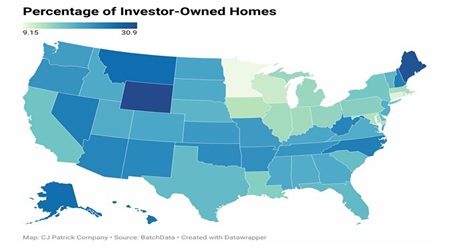
Percentage of Investor-Owned Homes

Five states hold one-third of the nation’s investor-owned single-family homes, and small investors continue to control more than 90% of the market.

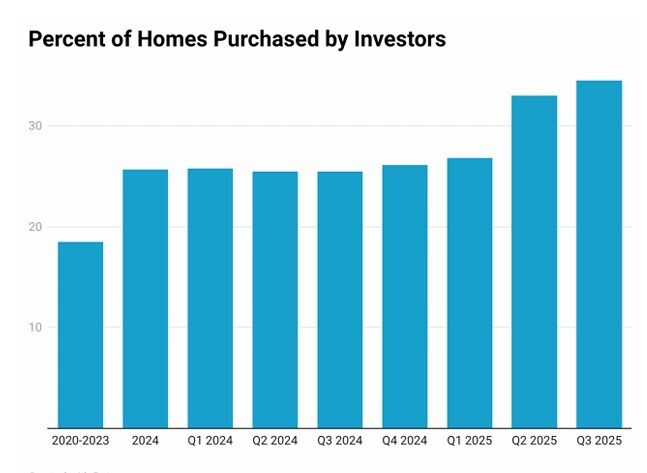
PHOENIX, (Jan. 15, 2026) — Real estate investors bought more than 34% of all single-family homes sold in Q3 2025, the highest share in five years, according to BatchData’s Q3 2025 Investor Pulse™ Report. That’s up from 33% in Q2 2025 and nearly eight percentage points higher than Q3 2024 (25.5%). In total, investors now own about 18% of the nation’s roughly 86 million single-family homes.

Prepared with CJ Patrick Company, the report tracks ownership patterns and transaction trends to inform real estate professionals and policymakers.

BatchData Co-Founder and President Ivo Draginov said the headline increase masks a key shift: investor market share climbed even as the number of homes investors purchased fell by about 23,000 year over year—suggesting traditional owner-occupants pulled back more than investors surged.

Small investors dominate as institutional portfolios shrink

Small-scale investors remain the backbone of the market. Owners of one to five properties account for nearly 92% of investor-owned single-family homes, with owners of six to 10 properties accounting for another 4%. At the other end of the spectrum, institutional owners with 1,000+ homes make up only about 2% of investor ownership. Q3 2025 was the seventh straight quarter in which these large investors sold more homes than they bought (5,798 sold vs. 4,663 acquired).

Percentage of Homes Purchased by Investors

Where investor ownership is concentrated

Investor-owned inventory is heavily clustered in five states—Texas, California, Florida, North Carolina, and Georgia—which together represent about one-third of all investor-owned single-family homes. Texas leads with roughly 1.4 million homes, followed by California (1.2 million) and Florida (1.0 million). Several of these states also exceed the national investor-ownership average, including North Carolina (25%), Georgia (19%), and Texas (18.2%).

Tourism-driven markets also stand out for elevated investor presence, led by Wyoming (30.9%), Maine (29.76%), and Montana (26.78%).

Metro takeaways

Across the 100 largest U.S. metro areas, investors own at least 18% of single-family homes in 48 markets. The Southeast continues to draw the most attention, claiming six of the top 10 metros by investor concentration. Asheville, NC, ranks highest at 30%, followed by Las Vegas (26%) and Memphis (26%). Institutional ownership is most pronounced in Jacksonville (2.67%) and Atlanta (2.63%).

Go to Batch Data Investor Pulse – Q3 2025 for more information.