CBRE arranges $45.8 million refinancing for Scottsdale Towne Center
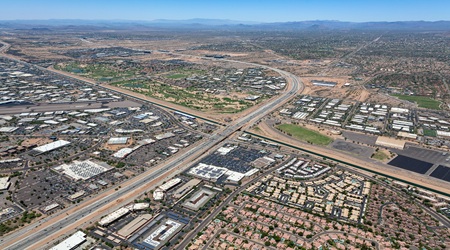
SCOTTSDALE, Ariz. (August 19, 2026) – CBRE has arranged a $45.8 million refinancing for Scottsdale Towne Center, a 168,090-square-foot retail center located at 15444 North Frank Lloyd Wright Blvd. in Scottsdale, Arizona. This is one of the largest retail financings in Scottsdale year-to-date.
“This loan on a shadow-anchored center signals that life company balance sheets have strong conviction in this asset type again, especially in core markets like Scottsdale,” said Moothart, executive vice president at CBRE.
Scottsdale Towne Center is nearly 100% leased. The center is anchored by TJ Maxx, Ross and Mountainside Fitness and shadow-anchored by Target.
The sponsor acquired Scottsdale Towne Center in 2021 and subsequently leased a previously vacant 50,000-sq.-ft. space to Mountainside Fitness’ flagship location, helping increase occupancy to nearly 100% and positioning the asset for refinancing.
The center is located at the southeast corner of Loop 101 and Frank Lloyd Wright Boulevard within Scottsdale Airpark, Arizona’s second-largest employment corridor. According to CBRE Research, North Scottsdale is one of metro Phoenix’s strongest retail submarkets, with rents averaging $30.20 per sq. ft. and vacancies of approximately 4.2%.
TIME Magazine Names The University of Arizona Center for Innovation Among Top Business Incubators
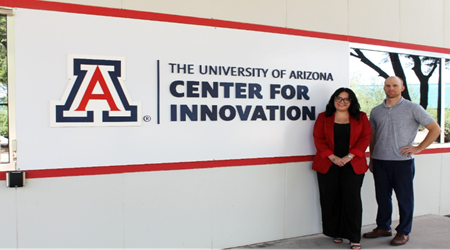
UACI Chief Innovation Officer Casey Carrillo and Paramium Technologies CEO Dr. Justin Hyatt
Tucson, Ariz. (August 19, 2026) – The University of Arizona Center for Innovation (UACI) was recognized as one of America’s Best Incubators & Accelerators in 2026, as published by TIME Magazine, securing national recognition for its success in helping entrepreneurs launch and grow innovative science and technology companies. The ranking spotlights the United States’ most effective entrepreneurial programs that deliver the greatest value and measurable outcomes for early-stage companies.
UACI earned the number 56 ranking through a comprehensive evaluation conducted in partnership with the data firm Statista, which included organization submissions, feedback from startup founders and alumni, and assessments from experienced entrepreneurship and innovation professionals.
As part of Tech Parks Arizona, a not-for-profit focused on university-based economic development, UACI serves as a foundational element of a broader strategy to grow local companies, support business retention, and attract new enterprises. UACI’s impact spans more than 20 years, supporting over 1,500 entrepreneurs and 300 startups that have secured upwards of $200 million in capital. From 2021 to 2023, UACI client companies generated $664.8 million in economic impact, highlighting the organization’s significant contribution to Arizona’s economy.
TIME Magazine’s recognition underscores UACI’s proven track record of helping science and technology startups transform innovative ideas into thriving businesses by enabling founders to build and scale companies across industries, including health and life sciences, climate technology, engineering, software, optics, aerospace, and semiconductors.
The incubator’s impact is best illustrated by the progress of companies like Paramium Technologies, a satellite communications startup based on University of Arizona research, which transformed early-stage innovation into a growth-ready enterprise through UACI’s tailored mentorship. After graduating from the incubator, the company expanded into the UA Tech Park to construct its first Magnum antenna, highlighting UACI’s ability to support the company in refining its business model and go-to-market strategy, creating a clear pathway for growth and expansion.
UACI has expanded its impact through a new digital incubation program, increased support for international companies with its award-winning Soft Landings program, and strengthened partnerships that connect entrepreneurs with mentorship, funding sources, and industry expertise.
“TIME Magazine’s distinction is a testament to UACI’s commitment to fostering innovation and supporting the next generation of entrepreneurs,” said UACI Chief Innovation Officer Casey Carrillo. “It reflects not only the success of the startups we serve, but also the strength of our community partners and the collaborative ecosystem we’ve built across Southern Arizona. We remain focused on helping founders navigate the challenges of being market-ready while building companies that positively impact our communities, industries, and economy.”
UACI’s success is fueled by a strong network of partners that have a shared commitment to economic development, including collaborations with Pima County, Startup Tucson, the Town of Oro Valley, the Town of Sahuarita, the City of Sierra Vista, Tucson Electric Power, PICOR, Tetakawi and others, which have created a thriving environment for founders and international companies wanting to expand to the United States. Together, these organizations have built a robust startup pipeline, attracted investment, supported job creation, and elevated Southern Arizona’s reputation as a hub for innovation.
Economic Growth Holds as Hiring Weakens and Inflation Pressures Persist
(August 18, 2026) — The U.S. economy continues to expand at a moderate pace, but weakening job growth and persistent inflation are creating a more complicated outlook for the Federal Reserve and commercial real estate heading into the final months of 2026.
According to the August Economic Outlook from Marcus & Millichap Research Services, gross domestic product growth is tracking near 2 percent, providing continued support for commercial real estate demand even as labor market momentum slows.
Recent revisions to employment data reduced year-to-date job creation from 550,000 positions to 426,000. Mean monthly hiring has slowed by roughly 50 percent to 61,000 jobs, while the three-month average has fallen to just 20,000 positions. Marcus & Millichap said the revisions, including a nearly 70 percent downward adjustment to May job growth, make the labor market more difficult to assess.
The unemployment rate declined to 4.1 percent, but labor force participation slipped to 61.4 percent. The report attributes much of that decline to increased retirements and an aging workforce rather than widespread worker discouragement.
If the current hiring pace continues, Marcus & Millichap projects that approximately 750,000 jobs will be created in 2026, a level that could temper demand for commercial real estate space in the second half of the year. The report notes that projected job growth would be 52 percent below the 10-year average.
Inflation remains another concern for policymakers. Headline consumer price inflation eased to 3.4 percent year over year, while core CPI, excluding food and energy, declined to 2.5 percent. Both measures fell 10 basis points in the latest reading.
Marcus & Millichap cautions that the improvement could prove temporary. Lower energy costs helped moderate inflation following the temporary reopening of the Strait of Hormuz, but renewed shipping disruptions since early July have contributed to higher fuel prices and increased inflation risk. Inflation also remains above the Federal Reserve’s 2 percent target.
The combination of softer employment growth and elevated inflation leaves the Federal Reserve facing competing pressures. Although labor conditions have weakened, the report says policymakers remain more focused on inflation risk, increasing the possibility of additional monetary tightening before year-end.
Financial markets currently anticipate one additional 25-basis-point interest rate increase during the remainder of 2026. Much of that expected move may already be reflected in borrowing costs, however, with the 10-year Treasury holding near 4.7 percent and the five-year Treasury remaining in the low- to mid-4 percent range.
Treasury yields could move higher if inflation accelerates, but the prevailing outlook calls for relatively stable borrowing costs through year-end. Marcus & Millichap said geopolitical and policy uncertainty will continue to create volatility, although longer-term economic forces remain supportive of the commercial real estate outlook.
For commercial real estate investors and developers, the outlook suggests a market that continues to benefit from economic expansion but operates under tighter financial conditions. Slower hiring could moderate space demand in some property sectors, while borrowing costs are likely to remain elevated even if they stabilize during the balance of 2026.