Improving Economic Momentum Supports Stronger Second-Half CRE Outlook
(July 15 2026) — The U.S. economy is entering the second half of 2026 with improving economic momentum, supported by strengthening labor conditions, expanding business activity and resilient consumer spending. Together, these factors are creating a more favorable outlook for commercial real estate despite continued uncertainty surrounding tariffs, inflation and interest rates.

A July 2026 research brief from Marcus & Millichap reports that the economy has remained durable after navigating approximately 15 months of weak job creation, geopolitical disruptions and inflationary pressures. Recent employment gains now suggest that economic momentum may be strengthening.

Labor market conditions weakened between May 2025 and February 2026, resulting in the cumulative loss of nearly 50,000 jobs and reduced workforce mobility. That trend shifted beginning in March, however, with approximately 550,000 jobs added over the following four months.

Much of the employment growth has occurred in major metropolitan areas, including Phoenix, Dallas, New York, Orlando, Los Angeles, and Houston. The concentration of new jobs in large markets is expected to support demand across several commercial real estate sectors.

If hiring continues and unemployment remains in the low-4% range, Marcus & Millichap expects the labor market to provide additional support for apartment and office demand.

Manufacturing and Services Return to Expansion

Improving business activity is also contributing to the more optimistic outlook.

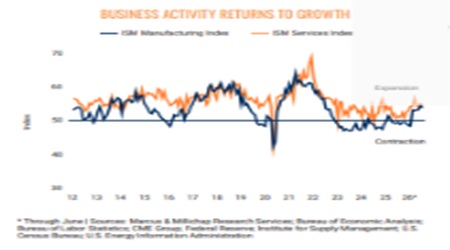
The Institute for Supply Management’s manufacturing and services indexes are signaling renewed expansion after a prolonged period of stagnation. The Manufacturing Index, which remained in contraction territory for much of the previous year, has registered above 50 since January, indicating renewed growth.

The Services Index has strengthened from near-break-even levels into the mid-50s, suggesting continued expansion across the more than 15 industries included in the survey.

The chart included in the research brief shows both manufacturing and services activity moving back above the threshold separating expansion from contraction. Continued improvement in those indicators would support demand for industrial, logistics and retail properties.

Industrial real estate could benefit from increased manufacturing output, inventory movement and business investment. Retail properties may also see stronger tenant demand as service-sector activity and consumer spending remain positive.

Consumer Spending Remains a Key Economic Driver

Consumer spending continues to be one of the strongest components of the economy.

Headline retail sales increased 6.9% year over year in May, while core retail sales rose 5.6%. After adjusting for inflation, core sales increased 2.2%, indicating that consumers were purchasing more goods rather than growth being driven entirely by higher prices.

Household debt remains a concern, but debt-service payments represented approximately 11.2% of disposable income, 60 basis points below the pre-pandemic average recorded between 2012 and 2019.

Continued retail sales growth could support demand for both shopping centers and the warehouses, distribution facilities and logistics networks that supply retailers and consumers.

Risks Remain for Investors

The improved outlook does not eliminate the risks facing the economy and commercial property markets.

Tariff pressures, geopolitical instability, and uncertainty surrounding the renegotiation of the United States-Mexico-Canada Agreement could affect business costs and investment decisions. Inflation also remains a concern, particularly if higher costs force the Federal Reserve to maintain restrictive monetary policy.

According to the report, financial markets were anticipating a potential 25- to 50-basis-point interest-rate adjustment by year-end. Easing inflation, however, could reduce pressure on the Federal Reserve and create a more supportive financing environment.

Stable or declining borrowing costs would help improve transaction activity by narrowing the pricing gap between buyers and sellers and making commercial real estate acquisitions and development projects easier to finance.

While economic risks remain, the combination of stronger hiring, expanding business activity and continued consumer spending is creating a more constructive environment for commercial real estate during the second half of 2026.

Read full source here: Marcus & Millichap Research Services, Economic Outlook, July 2026


CBRE: Phoenix Office Market Gains Momentum as Vacancy Tightens in Q2 2026

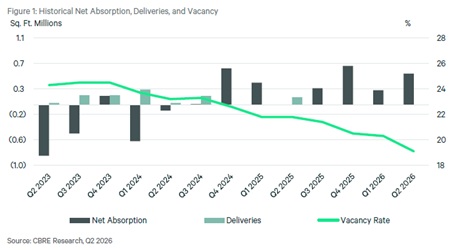
Phoenix Office MarketPHOENIX, AZ (July 14, 2026) — The Greater Phoenix office market continued to strengthen during the second quarter of 2026, posting nearly 490,000 square feet of positive net absorption as vacancy declined and asking rents moved higher.

Phoenix ended the quarter with an overall office vacancy rate of 19.1%, down 120 basis points from the first quarter and 270 basis points from a year earlier. Availability also tightened to 22.8%, while the average direct asking rate increased to $32.30 per square foot, full-service gross.

The improvement represents a substantial shift from the contraction experienced three years ago, when quarterly net absorption stood at negative 798,000 square feet. Second-quarter absorption improved by approximately 263,000 square feet from the previous quarter and by 488,000 square feet year over year.

Class B properties accounted for most of the quarter’s gains, recording 398,000 square feet of net absorption. Class A properties added 79,000 square feet, while Class C buildings posted 13,000 square feet of positive absorption. Year-to-date absorption across the market reached 717,000 square feet.

The positive activity was concentrated largely in the suburban market, which posted 467,000 square feet of quarterly absorption and an overall vacancy rate of 17.6%. By comparison, the urban market recorded 23,000 square feet of absorption and remained considerably softer, with vacancy of 27.3%.

Northeast Valley/Scottsdale led the region with 272,000 square feet of net absorption and the lowest vacancy rate among the major submarkets at 14.1%. West/Northwest Phoenix followed with 176,000 square feet of absorption and vacancy of 15.2%.

The Southeast Valley added 70,000 square feet, while the Central Business District recorded a modest 23,000-square-foot gain. Camelback/Piestewa Peak and Tempe were the only major submarkets to finish the quarter with negative absorption, posting losses of 42,000 square feet and 28,000 square feet, respectively.

Demand also continued to favor higher-quality office space. Class A vacancy declined to 19.3%, while Class B vacancy finished at 19.4%. Both were substantially lower than three years earlier. Class C vacancy stood at 17.1%, but was higher than its level in the second quarter of 2023, reflecting the market’s ongoing preference for better-located and higher-amenity properties.

Average asking rents increased 0.7% during the quarter and 3.4% from a year earlier. Class A space commanded an average of $41.66 per square foot, compared with $30.60 for Class B and $22.05 for Class C.

By submarket, Tempe posted the highest overall asking rate at $40.17 per square foot, followed by Camelback/Piestewa Peak at $39.27 and Northeast Valley/Scottsdale at $36.46. The Central Business District remained the most affordable major submarket, with an average asking rate of $28.87 per square foot.

Leasing activity totaled approximately 1.1 million square feet, representing a 14.6% increase from the first quarter, although activity remained 4.9% below the same period last year. Northeast Valley/Scottsdale was the most active submarket with 354,000 square feet of leasing, followed by the Southeast Valley with 175,000 square feet.

The quarter’s largest transaction was Consumer Cellular’s new 123,000-square-foot lease at 8501 E. Raintree Drive in Scottsdale. Valley Metro Rail renewed 70,000 square feet at 101 N. First Avenue in downtown Phoenix, and an undisclosed tenant leased 61,000 square feet in the Northeast Valley/Scottsdale submarket.

Other notable transactions included AssistRx’s 49,790-square-foot lease in the Southeast Valley, Southwest Service Administrators’ 47,000-square-foot renewal in West/Northwest Phoenix, Northrop Grumman’s 46,000-square-foot renewal and Honeywell’s 29,000-square-foot lease in East Phoenix.

New construction remained limited, with 450,525 square feet underway and no office deliveries during the quarter. Nearly all construction was concentrated in Northeast Valley/Scottsdale, where the Republic Services and Sprouts corporate headquarters projects accounted for approximately 410,525 square feet.

The remaining 40,000 square feet was under construction at The Grove-4210 in the Camelback/Piestewa Peak submarket. The fully preleased project is expected to deliver during the third quarter.

With positive absorption, falling vacancy and restrained construction, the Phoenix office market entered the second half of 2026 with improving fundamentals. However, conditions remain uneven, with suburban locations and higher-quality buildings continuing to outperform downtown and older office properties.

Click here for full report.


Pima County opens portal for arguments on Expenditure Limit Adjustment Proposition 425

Proposition 425
The dome of the Historic Pima County Courthouse in downtown Tucson.

PIMA COUNTY, (July 14, 2026) — Pima County residents have an opportunity to share their arguments for or against Proposition 425, the proposed Permanent Base Adjustment, better known as the Expenditure Limit Adjustment election, through an online portal launched by the Pima County Elections Department.

The portal is designed to make it easier for residents to submit written arguments that will appear in the official publicity pamphlet for the Nov. 3, 2026, General Election. Early voting for the General Election will begin Oct. 7.

The Pima County Board of Supervisors is asking voters to increase the Permanent Base Limit used to calculate the County’s spending limit under Arizona law. State voters created the limit in Fiscal Year 1980. Most cities, towns, and counties in the state have since then occasionally had to ask voters for permission to adjust the formula that sets the limit, so they can continue to meet the needs of their constituents based on their collected revenue.

The full text of Proposition 425 is available on the Ballot Measure Argument webpage.

The County has prepared answers to Frequently Asked Questions about Proposition 425.

Submitting an argument

All arguments that meet the statutory requirements and are filed by 5 p.m. on August 5, 2026, will be published in the publicity pamphlet mailed to every voter household before ballots are mailed to voters. The pamphlet will include full details of the permanent base adjustment.

Those interested in submitting an argument should note the following requirements:

  • Arguments are limited to 300 words.
  • Arguments will be published in the publicity pamphlet EXACTLY as submitted. The Elections Department will not make any edits or corrections.
  • A $25 fee will be assessed for all argument submissions.
  • If the argument is sponsored by one or more individuals, the argument must be signed by each sponsoring individual. Up to 25 people can sign each argument.
  • If the argument is sponsored by one or more organizations, the argument must be signed by two executive officers of each organization.
  • If the argument is sponsored by one or more political committees, the argument must be signed by each committee’s chairperson or treasurer.
  • The names of signers and sponsoring organizations will appear with the argument in the pamphlet.

The preferred method of submission is through the online portal, but arguments may also be filed in person at the Elections Department, 6550 S. Country Club Road, Tucson, AZ 85756.

In-person submissions may be paid for with cash or check. All submissions — whether online or in person — must include payment at the time of filing.

For questions regarding submitting an argument, please contact the Elections Department at 520-724-6830 or by email at [email protected].