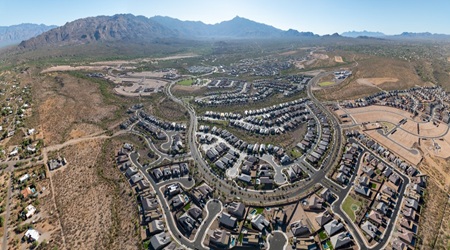
By: John Carroll of Land Advisors Organization
TUCSON, AZ (July 3, 2026) — The mid-year residential land update looks very different from what it was in 2025. The 2026 land market has come back with conviction. After a 2025 that honestly felt like we were waiting on everyone to get things together, the first six months of this year have been a different story. Permits are up, sales rates are strong, and builders are buying lots — a lot of lots. The competitive environment for good, entitled, infrastructure-ready ground has gotten real. In 2025, the pause was just setting in, and in 2026, all signs point to things heating up around Tucson.
Increase after increase
Through the first five months of 2026, Tucson has recorded 1,538 single-family permits — a 10.65% increase over the same stretch in 2025. Annualized, we’re on track to issue approximately 3,691 permits by year-end. I want to highlight that this would represent a 20% + increase over last year. Selling season started off strong and paused midway through, but the numbers are up, and that is what most builders are looking at.
The monthly breakdown tells the story: January ripped out of the gate up nearly 33% year-over-year. February was up another 12.5%. March dipped slightly — more about lot delivery timing than anything demand-side. April came roaring back at +22.85%, and May came in slightly under last year’s pace. Nothing in that pattern worries me. What we see is a market that’s expanding in a disciplined way, not overheating, not stalling. The trend line points up and to the right. That’s what we want.
Sales Velocity Is Real — Builders Are Writing Contracts
This isn’t just a permit story: multiple builders have consistently contracted on more than 50 homes per month since January. Six straight months of 50-plus net contracts at a market the size of Tucson isn’t luck — that’s real demand, real buyers, and builders confident enough in their lot supply to open the throttle.
This pace justifies new community openings. It justifies active investment in the land and lot pipeline, and the transaction in the first half points to this. We do not see any signs of this slowing down in the most active areas.
Builders Are Actively Building Their Lot Pipeline
The most telling story of the first half? What have builders been doing on the land side vs. 2025?
Our tracking shows builders across the Tucson market have collectively acquired a pipeline of 1,738 lots through June — 1,600 of which represent new land deals (the rest are pre-set land bank takedowns). As shown in the chart, the number of lots acquired in the first half of 2026 vs. 2025 represents a 42.86% increase. That’s a forward-supply engine being assembled in real time to fuel community openings in 2027 and 2028. Also of note is that some of the largest land deals in some time have closed. Camino Verano is leading the way in March.
The depth of the buyer pool is what really stands out. Ashton Woods / Starlight has been leading things in Tucson over the past 15 months and leads 2026 with 480 lots purchased. DR Horton, Mattamy, Richmond American, KB Home, and Lennar are all active so far in 2026. Now, for the second half of the year, you’ve got national platforms and regional operators competing for the same supply simultaneously. That supply isn’t getting larger. That’s a healthy, competitive market — and it’s very good news for the region’s master-developers.
Equally strong news is that the past 45 days have brought a huge wave of new deals slated for the second half. We see this as our biggest metric in gauging 2026 and into 2027. If only a portion of deals close, it will make for a big story in this year’s acquisitions and be a far cry from the slowdown we saw in 2025.
Market Share Is Shifting and the Numbers Make It Obvious
One of the clearest signals I’m watching right now is the shift in builder market share. When you look at builders who are contracting 50-plus homes a month and need the largest pipeline of lots to sustain that pace, it tells you everything about where market share is moving in this market.
The builders driving the highest sales velocity need the deepest lot supply — and they’re proving it with their acquisition activity. The builders at the top of the pipeline chart aren’t there by accident. They’ve made strategic bets on Tucson, they’re operating at scale, and they’re crowding out competitors for the best land opportunities. If you’re tracking monthly sales and cross-referencing them with who’s buying the most lots, the market share story becomes crystal clear. The big are getting bigger, new builders are entering Tucson, and they’re doing it through disciplined lot acquisition — not just sales and marketing.
Where Growth Is Happening — and Where It Isn’t
Not all submarkets are equal right now, and understanding where deals are getting done matters.
The most active areas in Tucson are Southeast and Southwest Tucson. These are the markets where land, infrastructure, and builder demand are aligning, and deals are getting completed. SE and SW have become the workhorses of this 2026 cycle, and that’s where we’re seeing the most competitive activity when quality product comes to market.
NW Tucson remains a critically important long-term story, but the geography is dictating the pace. The growth corridor is essentially boxed in by infrastructure limitations. This isn’t a slowdown in builder interest; it’s physical constraints that are redirecting the search to the areas and projects that are established and can fill the pipeline the quickest.
This year, 75% of lots in the first half of 2026 were purchased in master-planned communities and in partnership with the region’s master developers. Builders have found success with this formula, and we see them continuing to prioritize these projects and relationships.
And then there’s the bigger picture that cuts across all of Pima County: infrastructure.
Infrastructure is still the Defining Variable challenge
If there’s one theme that has defined deal-making in Tucson’s land market this cycle, it’s this: If a project doesn’t have the core components to launch- roads and utilities- it means it is much harder to do a deal. Full stop.
Infrastructure challenges aren’t just a nuisance. They’re actively defining where growth happens and where it doesn’t. Builders today are underwriting with a much clearer eye on infrastructure risk than they were five years ago. When the cost and timeline of bringing roads, water, and sewer to a site becomes a major variable, the calculations on raw or suboptimally positioned land change fast.
In 2026, we will experience that sites with infrastructure in place, or at least clearly defined with a near-term delivery timeline, will be the ones getting the calls and LOIs. The sites where that story is murky? Those are the deals that are not getting the full attention. Builders have multiple options right now, and they’re being selective about which infrastructure risks they’ll take on.
This dynamic isn’t going away. If anything, it’s intensifying as the market heats up and builders feel even less pressure to take on complicated entitlement or infrastructure situations when cleaner opportunities are available.
Bottom line: The first half of 2026 has put Tucson land back on the map. Permits tracking toward a cycle high, sustained consumer demand, active builder acquisition, and a competitive environment for quality lots and projects. These are all the ingredients of a healthy, functioning land market. The second half of the year looks strong for the projects that have paved the way for Tucson’s homebuilders. Looks like the race is on for 2027 and 2028, and that’s good news!
 John Carroll is a Pima County specialist focused on the sales and marketing of residential land and investment properties throughout Southern Arizona. A fifth-generation Tucsonan, John uses his deep local knowledge to provide clients with nuanced market insight. He joined the Tucson office of Land Advisors Organization in 2012. His affiliations include SAHBA, the Southern Arizona Home Builders Association, and ULI, the Urban Land Institute. John continued his family’s long University of Arizona tradition by graduating from the Eller College of Management with a degree in marketing. John can be reached at (520) 514-7454.
 PHOENIX, ARIZONA (July 7, 2026) — The following Phoenix leases were reported to Real Estate Daily News for the week of June 29 – July 3, 2026. Reported activity included a 2,777-square-foot lease at Bell Mar Plaza in Surprise and a retail water kiosk lease in Mesa. Rein & Grossoehme Commercial Real Estate represented parties in both transactions.
 By Keith Pomonis