Backing Ranchers Should Not Mean Pushing Out Wild Horses
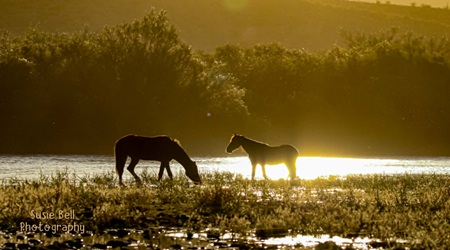
An outdoor recreation economy also puts food on tables.
(July 8, 2026) — The U.S. Small Business Administration’s recent promotion of ranchers as the people who “put food on our tables” may sound harmless at first. Ranchers are business owners. Many are family operators. Rural economies matter. But in Arizona, where the future of the Salt River wild horses is under direct threat, this kind of federal messaging lands very differently.
When government agencies elevate ranching interests while wild horses are being labeled as a problem, the public has reason to ask: whose interests are really being served?
The Salt River horses are not merely an inconvenience on public land. They are protected under Arizona law. They are part of the cultural identity of the Lower Salt River. They draw visitors, photographers, families, outfitters, conservationists, and tourists. They support an outdoor recreation economy that also puts food on tables, fills gas tanks, books hotel rooms, supports guides, and brings people to Arizona.
Yet the public is being told this herd should be reduced to a dangerously low number. AZDA is managing toward 125 horses within five years, despite scientific guidance showing that wild horse herds need larger numbers to remain genetically viable. Even the U.S. Senate, in passing the Theodore Roosevelt National Park Wild Horses Protection Act, recognized a minimum herd range of 150 to 200 horses for that park’s herd.
That is why SBA’s pro-ranching message feels like more than a business promotion. It comes in a broader political environment where ranchers and livestock interests are often given the benefit of the doubt, while wild horses are treated as competitors for land, forage, and water.
Arizona’s wild horses should not be managed out of the way for cattle. Public lands belong to the public, and the Salt River horses belong in the conversation as a protected herd, not as a nuisance blocking another industry’s expansion.
Supporting ranchers does not require sacrificing wild horses. Rural investment, food production, and small-business support can all exist without turning protected horses into scapegoats. But when federal agencies promote one side of the land-use debate while removals are being considered, transparency becomes essential.
Before a single Salt River horse is removed, Arizona officials should answer the most important question: Is the state managing this herd for long-term protection, or is it managing the horses down to make room for other interests?
The public deserves to know.