Congressman to help celebrate National Heritage Area designation at May 4 Canoa Ranch event
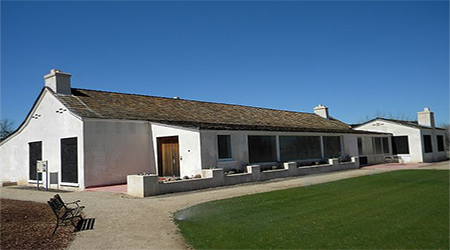
Canoa Ranch HQ

GREEN VALLEY, ARIZONA —Congressman Raúl Grijalva will speak at a May 4 event at Green Valley’s Historic Canoa Ranch celebrating the Congressional designation of the Santa Cruz Valley National Heritage Area focused on the Santa Cruz River from the Mexico border north to Pima County. The event begins at 9 a.m. and will include tours of the ranch, where Grijalva grew up.

The event recognizes the years of dedicated work by the Santa Cruz Valley Heritage Alliance, the enduring support from Congressman Raúl Grijalva, and the dozens of community partners who endorsed this legislation over the years. Also speaking at the event is Vanessa Bechtol, board president of the Santa Cruz Valley Heritage Alliance and senior director of community partnerships with Visit Tucson.

Anyone wishing to attend can RSVP here or via the Facebook event page.

Pima County has been an active partner along with Visit Tucson in the broad coalition of governments, conservations groups and others to establish the Santa Cruz Valley National Heritage Area. Specifically, the area encompasses the watershed of the Santa Cruz River, from Nogales and Patagonia, to Tucson, Marana and Oro Valley.

On March 12, President Trump signed into law a sweeping public lands package (S.47) that includes designation of the Santa Cruz Valley National Heritage Area and recognizes the Heritage Alliance as the Local Coordinating Entity.

“Our efforts to protect the unique cultural and natural resources of 3,300 square miles of the Santa Cruz River Valley are going to pay off in an economic return to everyone in the region,” said Pima County Board of Supervisors Chairman Richard Elías. “This heritage area should help to protect our way of life and improve our economic vitality into the future. Kudos to Congressman Grijalva, who doggedly has promoted this legislation since 2007.”

According to the Santa Cruz Valley Heritage Alliance, the designation will “include both economic and non-economic benefits. The proposed Santa Cruz Valley National Heritage Area will provide a framework for heritage-based economic development, including tourism-related increases in local jobs, business incomes, and tax revenues. There is a growing interest in the National Heritage Areas because of its proven success as a regional economic development strategy.”

Linda Mayro, director of the Pima County Office of Sustainability and Conservation, said the County has worked for more than a decade with the Alliance to make the designation a reality. 
”The designation of the Santa Cruz Valley National Heritage Area is a definite honor for the region and a wonderful outcome after 15 years of support by Pima County and every jurisdiction and tribal nation in the Santa Cruz Valley,” she said.

“With the rich diversity of cultural, historic, natural, and recreational resources available here in the Santa Cruz Valley, we have a tremendous opportunity to promote these resources and educate the community about our shared heritage,” Bechtol said. “In doing so, we can stimulate regional economic development by not only attracting tourists’ dollars to the region, but also by encouraging residents to visit these heritage destinations.”

Among the partners who came together to push for the designation were: Visit Tucson, the Arizona Office of Tourism, Tucson Regional Economic Opportunities, (now Sun Corridor, Inc.) various chambers of commerce, Southern Arizona Home Builders Association, every state and state park and land manager in the region, museums and historical societies, non-profits organizations, ranchers and farmers and many more.

Diane Frisch, director of Pima County’s Attractions and Tourism Office, said she plans to work with Visit Tucson to market the Heritage Area regionally and nationally.

“We want to leverage this national designation by promoting suggested itineraries that tell the story of the National Heritage Area, and collaborate with tour operators to continue to bring  additional national and international media and visitors to our region.”
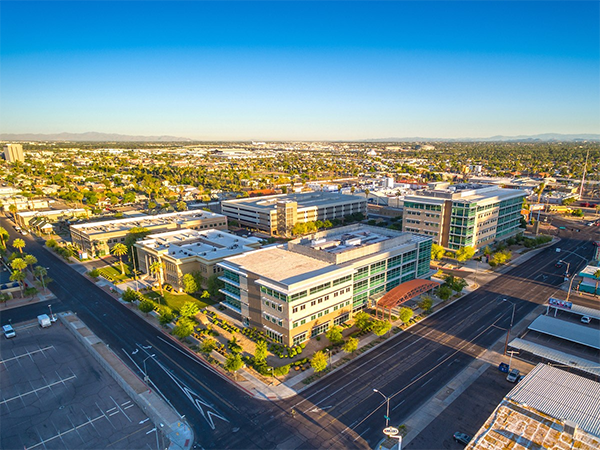


KBS/VERUS Taps Transwestern to lease madison square, a historic Boxing property in phoenix

PHOENIX, Arizona – Transwestern Commercial Services (TCS) today announces it has been selected to provide leasing services for Madison Square, a four-building office campus with a rich boxing and educational history near downtown Phoenix. TCS Managing Director Mark Stratz and Senior Vice President Scott Baumgarten are leasing the 310,000-square-foot property at Seventh Avenue and Van Buren Street. Executive Managing Partner Jim Fijan represented the seller in the trade to KBS/Verus, marking his third time to broker the sale of Madison Square.

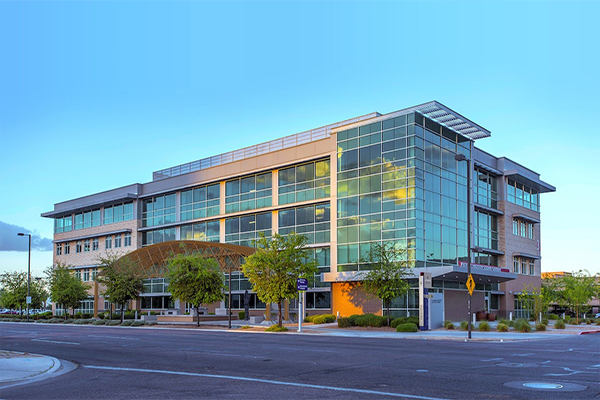
Madison Square overview

“Madison Square is an appealing space for businesses that want a flexible and creative environment steeped in Phoenix’s unique history,” Baumgarten said.

100 Seventh Ave.

Madison Square is located at the former site of the iconic Phoenix Madison Square Garden, which featured boxing and wrestling matches and music legends. Built in 1929 as the largest indoor arena in the city, Phoenix Madison Square Garden once hosted John Henry Lewis, Zora Folley, Johnny Cash, Wayne Newton, and Marty Robbins, among many others. The site is also home to the historic Grace Court School building, designed in 1911 and still standing. The campus has several pieces of art incorporated throughout the design, including steel trusses from the original Phoenix Madison Square Garden building.

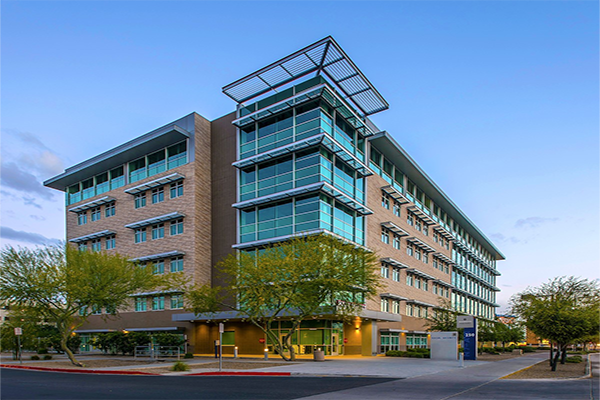
250 Seventh Ave.

“Madison Square offers businesses the rare chance to join a piece of Phoenix history,” Stratz said. “The property’s rich history will inspire creativity while the functional design and amenities meet the requirements of today’s tenants.”

The buildings offer efficient and functional floorplates, collaborative indoor/outdoor workspaces, and a five-level parking garage with an above-market parking ratio. The campus includes:

  • 100 Seventh Ave., a modern, Class A building with 94,245-square-feet
  • 250 Seventh Ave., a modern, Class A building with 136,852-square-feet
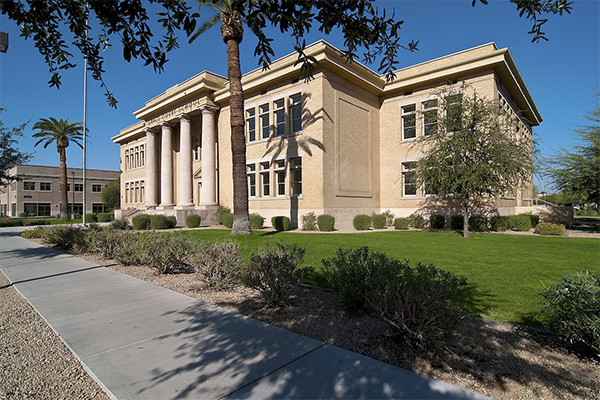
  • 800 W. Adams St., previously the Grace Court School, a neo-classical building with 31,842-square-feet
  • 850 W. Adams St., a fully leased building with 47,947-square-feet

800 West Adams

An adaptive reuse project, 800 W. Adams St. was completely remodeled in 2006 with an updated electrical and lighting system, roof, elevators and large handicap-accessible restrooms. All the double-hung windows were completely rebuilt and are fully functional.

The other three buildings were constructed in 2008. There are plans to renovate the lobby at 100 Seventh Ave. The buildings are flexible for a variety of users in technology, media, finance, healthcare and government that need 10,000- to 80,000-square-feet. The property has 174,000-square-feet of office space available for lease, including entire floors and a speculative suite.

Madison Square is near the Arizona State Capitol, municipal justice system, Phoenix City Hall, Comerica Theatre, Arizona State University Downtown Phoenix Campus and numerous other businesses and government agencies in the Central Business District. Current tenants include the Arizona Commerce Authority and Arizona Office of Tourism.

Stratz and Baumgarten have an extensive track record in downtown Phoenix. They have been involved with leasing Park Central Mall, the Heard Building at 112 N. Central Ave., Arizona Center, and Lincoln Union at Fifth and Lincoln streets.


Construction Increases in Greater Phoenix Industrial Market

Vacancy Declined Despite Lower Net Absorption During First Quarter

Phoenix, Arizona – The Greater Phoenix industrial market remained steady during first quarter, despite decreased net absorption relative to the end of 2018. Construction activity has increased, but vacancy declined during the first three months, according to a report released by Colliers International in Arizona.

According to the Bureau of Labor Statistics, Phoenix’ industrial employment increased approximately seven percent from February 2018 to February 2019. This has helped fuel usage of industrial space. Net absorption for the first three months was 550,000 square feet, far below the 2.3-million-square-feet absorbed in fourth quarter 2018.

New leases for the quarter included Z Modular’s commitment for 222,000-square-feet at 6205 S. Arizona Ave. in Chandler and States Logistics’ selection of 211,185-square-feet at Logistics 75 building in Tolleson.

The vacancy rate fell to a seven-year low of 7.2 percent. The industrial vacancy has hovered in this level since 2017, which is a noteworthy improvement from double-digit rates experienced as recently as 2015. Vacancy rates in the Southeast Valley and Southwest submarkets rose slightly during first quarter, reflecting the impact of new projects coming online. The Southwest ended the first quarter with 8.8 percent vacancy and Southeast Valley finished the three months with a 7.3 percent vacancy. The Airport Area and Northeast Valley posted the biggest declines in vacancy. The Airport Area now has a 6.2 percent vacancy and Northeast Valley boasts the lowest citywide vacancy with just 3.8 percent available.

Construction of new industrial space spiked to 7.3 million square feet underway. Approximately 1.4 million new square feet was delivered during the first three months of this year. The Greater Phoenix industrial market has added approximately seven million square feet to its inventory in the past 12 months. Construction activity in the industrial sector has averaged nearly 5.8 million square feet per year since 2013.

Rental rates increased approximately 1.8 percent during first quarter 2019. Average asking rents for industrial space reached $0.57 per square foot per month, which is 3.4 percent higher than a year ago. Rental rates are increasing the most in big-box distribution facilities, which have experienced a 4.1 percent rise in the past 12 months. Asking rents in the Southwest Valley increased to $0.40 per square foot during first quarter, which marks a 6.6 percent increase over the past 12 months.

Industrial property sales volume rose 44 percent over the first quarter to a total of $356 million. The median price for industrial assets was $104 per square foot and cap rates decreased 40 basis points to 6.72 percent. Investment sales volume is down from a year ago, but prices continue to rise.

Completion of new projects is expected to put pressure on the Valley’s industrial vacancy rate. Large blocks coming online will likely lead us to finish 2019 with a vacancy rate around eight percent. Net absorption is forecast to reach approximately 6.3 million square feet in 2019, but will lag behind the total of 7.5 million square feet of new construction being delivered. Completion of new space and strong demand will push rental rates higher. Colliers anticipates asking rental rates to rise approximately 3.0-3.5 percent during 2019.

See the full report her: 2019-1Q-Industrial_Arizona-Report-Colliers