Pima County to sell $25 million in bonds to fund roadway improvement projects

Improvements to three major corridors will be completed

PIMA COUNTY – The Pima County Board of Supervisors on Feb. 5, unanimously approved the sale of $25 million in Highway User Revenue (HURF) bonds to fund a selection of voter-approved roadway improvements.

The sale of the bonds, paid for through the County’s distribution of state gas taxes, provide the funding for roadway capacity improvements to three major regional corridors. The largest of the projects among these is the widening of Broadway from Country Club Road to Euclid Avenue, a City of Tucson managed project.

The Broadway widening plan includes reconstruction of the roadway to six traffic lanes, three in each direction, with bus pullouts. The City of Tucson has completed most of the needed property acquisitions to facilitate construction and utility relocation work is planned to start early this year. Construction is expected to begin in earnest this summer and last approximately two years.

The Broadway widening project is a city-led project that is also part of the 2006 Regional Transportation Authority (RTA) Plan, wherein voters approved a half-cent sales tax to fund transportation capacity improvement projects. As part of the RTA plan, several project budgets included a portion of the funding will come from the County’s voter-approved 1997 HURF Bond package, which included Broadway widening.

Other projects these County Bonds will fund include Houghton Road, Interstate 10 to Golf Links; 22nd Street, I-10 to Tucson Boulevard and pavement preservation work on County collector and arterial roadways.


Tucson Museum of Art Names Kristopher Driggers Assistant Curator, Schmidt Curator of Latin American Art

Kristopher Driggers,TMA’s Assistant Curator

TUCSON, ARIZONA – The Tucson Museum of Art (TMA) announces the appointment of Kristopher Driggers as TMA’s Assistant Curator, Bernard and Jeanette Schmidt Curator of Latin American Art. Currently a lecturer at University of Texas Rio Grande Valley, the nation’s second-largest Hispanic-serving Institution, Driggers will finish his semester of teaching and join TMA full time in early May to manage and develop TMA’s Latin American, Spanish Colonial, post-Colonial, and Latin American folk art collections, with emphasis on pre-Columbian art. Until then, he will be making visits to Tucson for collection research in preparation for the installation of the collection at TMA’s forthcoming Kasser Family Wing.

Driggers, who obtained his bachelor’s degree in History of Art from Yale University in 2011 and his master’s degree in Art History from the University of Chicago in 2014, expects to obtain his Ph.D. in Art History, Pre-Columbian and Colonial Latin American Art from the University of Chicago in May. He participated in the Center for Curatorial Leadership Mellon Seminar in Curatorial Practice in New York in 2017.

According to TMA CEO Jeremy Mikolajczak, “Kristopher’s range of study, international research and experience will provide the vision and practical skills to present, interpret and build TMA’s pre-Columbian collection, install the Kasser Family Wing, and produce insightful publications, public lectures, and symposia.”

While at Yale, Driggers held multiple fellowships, including the Josef Albers Traveling Fellowship which allowed him to travel and study pre-Columbian objects in Mexico,  Guatemala and Peru. He has worked as a development coordinator at the McNay Art Museum in San Antonio, Texas; a curatorial employee in African Art at the Yale University Art Gallery; and an intern in the curatorial departments of the Metropolitan Museum of Art and the Museo de Arte Latinoamericano de Buenos Aires.

Before beginning his teaching position in Texas last year, Driggers conducted fieldwork for three years in Mexico City and surrounding regions, as well as in Madrid and other European collections. His research has been supported by a Ford Foundation Predoctoral Fellowship, among other awards.

Driggers has written about his research for publication and has regularly presented his research at scholarly conferences. In 2017-18, he spoke at the Frick Collection in New York, the Newberry Library in Chicago, the Rare Book School at the University of Virginia, and in conferences in Mexico and Colombia, where he lectured in Spanish. He is organizing a panel on pre-Columbian art for the 2019 College Art Association conference on the topic of “Indigenous Languages of the Americas and the Language of Art History.”

Driggers’ knowledge and commitment to the highest standards of scholarship and interest in engaging diverse communities will advance TMA’s reputation as a leader in Latin American art and its service to our distinctive art and multicultural communities.


Phoenix-based Magnum Companies celebrates 40 years of crafting iconic metal masterpieces across Valley, U.S.

PHOENIX, ARIZ. – Magnum Companies, a Phoenix-based designer, fabricator, and installer of metal components, is celebrating 40 years of crafting iconic masterpieces in Arizona and across the U.S.

Magnum was formed in 1979 when its founder, Glenn Brockman, an engineer with General Electric, started building weight-lifting equipment. From that humble beginning, Magnum now has 65 full-time employees, a 32,000 SF manufacturing building at 2439 S. 49th Ave., in Phoenix, and a 16,000 post-production building within close proximity.

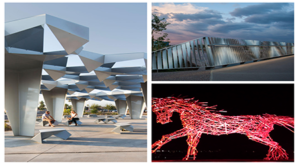
Drive around the Valley and Magnum installations stand out. They include Impulsion, the stainless-steel horse by Arizona artist Jeff Zischke that graces the entrance to WestWorld in Scottsdale; Shadow Play, a series of sculptures along Roosevelt Row in Downtown Phoenix; and a major renovation of the Royal Palms Resort & Spa in the 1990s.

“The footprint that Magnum has made in the Valley the past 40 years is a great sense of pride,” said CEO Greg Brockman, son of the founder. “As our employees drive around town and see the projects, or take place in the ribbon cuttings, it connects the dots that this is what we do and this is your work. It helps in retaining employees because it brings their family into the mix.

“The horse at WestWorld was an epic project, and we made sure that every employee at the time had a hand in building it,” Brockman recalls. “We handed a tube to the office staff and that person passed it on. That was truly being a part of the fabrication and installation. Everybody talks about it; people still send me pictures when they pass by it.”

Magnum won four Gold Awards at the 2018 Ernest Wiemann Top Job Competition for outstanding craftsmanship sponsored by the National Ornamental & Miscellaneous Metals Association (NOMMA). The awards were presented at NOMMA’s 60th-anniversary dinner in Phoenix.

Magnum’s Gold Awards were at the Grand Canal, Tempe; Alliance Bank, Gilbert; Moebius/Cloud, Culver City, California; and Shadow Play, Phoenix.

“Magnum has been a fabricator on many of our projects over the years and we really appreciate their passion and ability to help us realize our concepts,” said John Kane, FAIA LEED, Architect | Founding Partner at Architekton. “We really appreciate their willingness to collaborate with us, bringing their expertise and skillsets to the table and helping find solutions that not only meet the budget, but exceed our aspirations.”

Longevity is key to Magnum Companies. Its third employee, Rod Bruns, is still with the company. He is celebrating his 37th year. Greg Brockman has been with Magnum from Day 1. While in high school and college he worked as a laborer, machinist, and painter. He assumed the helm when his father, now 88, retired at 75.

“Greg has done an admirable job communicating Magnum’s vision to his team,” said Joe Hitzel, Owner of Southwest Architectural Builders, Inc. “We have had great experiences working with Magnum in the delivery of projects. Magnum enhances our project partners as a great subcontractor. It is awesome to both work with his team and also see Magnum’s artesian quality work enhance our projects.

“Greg has successfully grown Magnum to a place where its work is part of the design community’s vocabulary. I’ve seen firsthand where architects have described Magnum’s work as a proprietary product on the same level as a building’s sophisticated fire alarm or energy management system,” Hitzel said.

In 1995 Magnum Engineering Inc. added a construction division, Magnum Architecture, Inc. It became a subcontractor and handled manufacturing and installation for its clients.

“Where steel was previously only seen as a structural element of a building to be hidden and concealed by framing and stucco, Greg has brought structural steel and Magnum’s work to be the focal point of a structure’s exterior elevations. Steel is now celebrated and a key element in a structure’s design,” Hitzel said.

Magnum Companies is now a “go-to” firm for the installation of public art projects. It currently is working on 12 public art installations in Arizona; El Paso, Texas; Seattle, Washington; and Southern California.

“Our people have a passion for what they do,” Greg Brockman said. “This is true for the young welders we train and employ to those who have been around for years. Our employees are our greatest asset. They bring heart, passion and a great work ethic to the building every day. I can train other parts of the business, but not that. The strengths they possess come from within.”