G-20 Wants US Corporate Tax Reform a Priority

g20 summit logoWhile Syria dominated most of our news last week, the leaders of the G-20 economies were meeting last week in St. Petersburg, Russia to discuss re-shaping international regulations and practices that would stem corporate tax evasion, among other things.

Consider these two stories reported in a Canadian Business press over the weekend and you’ll see why this was such a big agenda item at the G-20 Summit:

Apple has paid little or no corporate tax on some $74 billion in income over the past four years. That’s because the tech giant oversees all of its business outside the Americas through a number of units in Ireland. These subsidiaries are virtually tax-free because America doesn’t tax companies incorporated outside the U.S. and Ireland exempts locally incorporated companies if they are managed abroad.

Under U.S. tax law, citizens and permanent residents must file and, if applicable, pay income taxes, even if they don’t live in the U.S. and have no U.S. sources of income. Some time ago, the IRS fined an American retired widow who’d been living in Canada for 30 years $75,000 for failing to file U.S. tax returns. The penalty was 25 per cent of the woman’s $300,000 in savings held in a U.S. bank account.

The tax treatment of Apple when compared to this widow seems unjust to say the least. But that’s not the only reason why international leaders are interested in corporate tax reform for the U.S.

The main reason is this: The IRS has no recourse against legal even if morally questionable corporate tax practices. It can, slam individual taxpayers who commit forgivable, and often unintentional, infractions. But there is nothing to be done for legal corporate tax dodgers..

According to the U.S. Congressional Research Service, estimates of how much corporate tax avoidance costs Uncle Sam range from $10 to $60 billion a year. For individual tax evasion, the range is $40 to $70 billion. Both are a hefty drain on government coffers, but cracking down on individuals, well it seems it’s just easier.

“Most provisions to address profit shifting by multinational firms would involve changing the tax law,” reads the CRS report. On individual tax evasion, on the other hand, the IRS has found ample margin to tighten the screw simply by stepping up enforcement, changing practices and increasing information sharing with other governments — in other words, without amending the law.

Of course, catching and punishing individual tax cheats is a good thing. But anecdotal evidence suggests the IRS’s tighter net is trapping lots of small fish, average-middle-class taxpayers who simply missed the fine print. And there are many of them among the hundreds of thousands of Americans living in Canada and Canada-U.S. double citizens.
In the G-20 Declaration on global corporate tax loopholes, the Organization for Economic Development and Cooperation noted: “When tax rules permit businesses to reduce their tax burden by shifting their income away from jurisdictions where income producing activities are conducted, other taxpayers in that jurisdiction bear a greater share of the burden.”

Eliminating loopholes and opportunities for legal arbitrage by international corporations might reduce the pressure on tax agencies to go after people who were obviously unaware

The published Tax Annex of the G-20 Leaders’ Declaration states: “Base erosion and profit shifting (BEPS) relates chiefly to instances where the interaction of different tax rules result in tax planning that may be used by multinational enterprises (MNEs) to artificially shift profits out of the countries where they are earned, resulting in very low taxes or even double non-taxation. These practices, if left unchecked, undermine the fairness and integrity of our tax systems. They fundamentally distort competition, because businesses that engage in cross-border BEPS strategies gain a competitive advantage compared with enterprises that operate mostly at the domestic level. Fair, transparent and efficient tax systems are not only key pillars for sound public finances, they also provide a sustainable framework for dynamic economies. For these reasons, G20 Leaders identified the need to address BEPS as a priority in their tax agenda at the Los Cabos Summit in June 2012. Additionally, we must achieve better international coordination on taxes. In this regard, we must move forward in fighting BEPS practices so that we ensure a fair contribution of all productive sectors to the financing of public spending in our countries.”

To read the full published G-20 Declaration click here: https://en.g20russia.ru/news/20130906/782776427.html

One final note: The IRS does wave or reduce penalties for individuals in some cases, and the woman from the anecdote here might have been spared — but horrendous IRS fines remain an ordeal for many average U.S. taxpayers and apparently the world is watching with interest to see what we are going to do about these injustices.
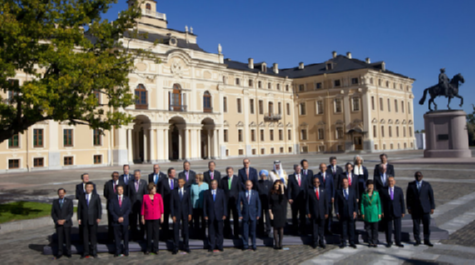


Quotes from Leadership in St. Petersburg, Russia

G-20 Official Photo
G-20 Official Photo

Following are key quotes reported from leaders at the close of a G-20 summit in St. Petersburg, courtesy of Reuters.

RUSSIAN PRESIDENT VLADIMIR PUTIN
“We achieved a consensus on the need to pursue policies that support economic growth while confirming medium-term national fiscal consolidation strategies.”

“The situation in the global economy looks better now than it did five years ago. Economic growth is recovering, but risks of course are still very, very great.”

“That’s why, since the start of our G20 presidency we have set our tasks as stimulating growth, creating new jobs – above all by encouraging investment, effective regulation and increasing confidence in markets.”

BRITISH PRIME MINISTER DAVID CAMERON
“I thought at the meeting last night, those people, including the Turks, the Saudi Arabians, the Americans, the British, the Canadians, the French, who made the arguments about the taboo of chemical weapons, about the importance of the world responding, I thought we had by far the better of the argument.”

“It’s better with a UN Security Council resolution but you cannot rule out taking action if you cannot get one. I think we should have learned from some of the genocides we have seen in our world that there is an imperative for a line to be drawn and that may well happen again in the future.”

Asked whether any military action against Syria would be illegal if it was not backed by the U.N. Security Council:
“If we’re saying there can only be a response if the U.N. Security Council votes positively, we are in fact contracting our foreign policy, our morality, to the potential of a Russian veto. I think that is a very misguided approach.”

GERMAN CHANCELLOR ANGELA MERKEL
“The general global economic situation is seen generally as fragile.”

“We have reached a success in fighting protectionism, so far, as the standstill-agreement was prolonged about two years. This is a good signal, I think. also a good signal is the agreement on regulation of shadow-banks.”

“We have agreed a roadmap about oversight and regulation.”

SPANISH PRIME MINISTER MARIANO RAJOY
“It’s important that the U.N. Security Council assumes its responsibility under international rules and beyond that what we want is a political and negotiated solution.
“Evidently something must be done and I hope something is done, that’s Spain’s position.”

ITALIAN PRIME MINISTER ENRICO LETTA
“We consider it is essential to maintain a system of alliances in which the transatlantic relationship remains one of the lynchpins.”

“Over the past few hours we’ve been working to ensure that the difference of opinion that exists over the instruments to be used in applying international law does not become a difference which wrecks the transtlantic relationship – a relationship which we consider fundamental, one which has always been one of the mainstays of our foreign policy and one which I want to reconfirm today.”

“We are working and we will continue to work to reinforce our relationship with the United States and we do not want to see the return of the situation of a few years ago with all the problems that caused.”

IMF MANAGING DIRECTOR CHRISTINE LAGARDE
“It is also right that monetary policy remain supportive where appropriate. I am pleased that the G-20 recognizes the need to ensure that exit from unconventional monetary policy, when it comes, should be orderly and clearly communicated.”

“Both advanced economies and emerging markets will have to address their domestic challenges in order for spillovers to be effectively managed. The IMF will continue to engage in these areas given their significant implications for the global economy.”

“There’s a readjustment and there is a repricing of assets, there is no question about it. There’s some currency valuation as well and it only goes to show two things: one is all the consequences of the unconventional monetary policy and tapering from such policies have to be considered and number 2: all countries have to do something about it in terms of anticipation and preventing the unfolding of potential crisis. We’re not at this sort of crisis, we certainly hope that it could be avoided and it should be avoidable if countries do what they have to do.”

FRENCH FINANCE MINISTER PIERRE MOSCOVICI
“On growth and economics it was a good meeting here in St Petersburg. We could consolidate that we decided before to give the priority to growth taking into account that we need to consolidate fiscally. But the priority is growth in order to create jobs … especially for the youth.”

“The second point we made a good progress here was to fight against tax evasion specially automatically exchange the information. The third one we decided that we would regulate so called shadow banking. The banking sector is regulated and we need to do the so with shadow banking. We found a good consensus we are satisfied with the final communique to which we contributed.”


TUCSON LEASE REPORT SEPTEMBER 2-6, 2013

RED NEWS COLOR LOGORETAIL GROUND LEASE – 5725 E BROADWAY, TUCSON

LongHorn Steakhouse through parent company Rare Hospitality Management, Inc., a subsidiary of Darden Restaurants, signed a long-term ground lease for approximately 62,796 square feet at 5725 East Broadway Boulevard. The existing strip center on the property is scheduled to be demolished to make way for a 6,200 square-foot LongHorn Steakhouse. Darden Restaurants, which owns several other restaurant concepts including Olive Garden and Red Lobster, is the world’s largest full-service restaurant company with over 2,100 restaurants through its subsidiaries. This is LongHorn’s first restaurant location in Tucson. Terry Dahlstrom of Volk Company in Tucson represented the Tenant in the transaction. Jim Egan of Prime Commercial Real Estate in Tucson represented the landlord, Heights Properties, LLP.

INDUSTRIAL SPACE – 4175 S. FREMONT AVE., TUCSON

Abrasives & Equipment of Arizona, Inc., a supplier of abrasives and blast equipment, as well as a developer and handler of specialty and environmental products for the abrasive blast industry, leased 6,230 sq. ft. at 4175 S. Fremont Ave, Suite 105 in Tucson from Doubletree Investments, Inc. Stephen D. Cohen, and Russell W. Hall, SIOR, GSCS, Principals and Industrial Specialists with Cushman & Wakefield / PICOR of Tucson handled the transaction.

OFFICE SPACE – 5151 E. BROADWAY BLVD., TUCSON

AXA Equitable Life Insurance renewed their lease for 5,075 sq. ft. at 5151 E. Broadway, Suite 1200 in Tucson from KCI Broadway, LLC.  Tom Nieman, Principal and Office Specialist, Paul Hooker and Jeff Zellet, Industrial Specialists with Cushman & Wakefield / PICOR in Tucson handled the transaction.

INDUSTRIAL SPACE – 3820 S. PALO VERDE RD, TUCSON

La Tauna Products, LLC. leased 3,807 sq. ft. at 3820 S. Palo Verde, Suite 102 in Tucson from Palo Verde Trust Partners, LLC.  Rob Glaser, SIOR, CCIM, Principal, Paul Hooker and Jeff Zellet, Industrial Specialists with Cushman & Wakefield / PICOR of Tucson handled the transaction.

INDUSTRIAL SPACE – 3455 S. PALO VERDE RD, TUCSON

Tucson Industrial Products and Sanitary Supply Co. leased 1,815 sq. ft. at 3455 S. Palo Verde Rd., Tucson from 3455 S. Palo Verde Road LLC. Robert Delaney and Tim Healy with CBRE represented the landlord, Gordon Wagner with Coldwell Banker – Commercial Group of Tucson represented the tenant.

INDUSTRIAL SPACE – 4500 E. SPEEDWAY, TUCSON

The following businesses renewed leases at the Midway Business Park: Express Interlock, LLC., 1,200 sq. ft. at 4500 E Speedway, Suite 46 in Tucson to the Southern Arizona Community Diaper Bank, and 1,860 sq. ft. in Suites 78 & 108 also at Midway. Rob Glaser, SIOR, CCIM, Principal and Paul Hooker, Industrial Specialists with Cushman & Wakefield / PICOR, represented the landlord in this transaction.

INDUSTRIAL SPACE – 3933 E. 29 STREET, TUCSON

Avtel Technologies, Inc. leased 745 sq. ft. in the Midpoint Business Plaza, 3933 E 29th St, Suite 503 in Tucson from Presson Midpoint LLC. Rob Glaser, SIOR, CCIM, Principal and Paul Hooker, Industrial Specialists with Cushman & Wakefield / PICOR handled the transaction.

OFFICE SPACE – 4525 E. SKYLINE DRIVE, TUCSON

Boskovich Insurance Sales & Service, PLLC, leased approximately 308 sq. ft. of office space located at 4525 E. Skyline Drive, suite 112 in Tucson from M. Francina Richardson and Suzanne Garvey. Doug Richardson and Terry Lavery of Tucson Realty & Trust represented the Landlord in this transaction.

Login for additional information. Please submit your sales and leases to [email protected]


[ismember]Avtel , 3933 E 29th St, Suite 503 in Tucson asking rate $0.63 sf/mo (modified gross)

Asking lease rate at 4500 E Speedway was $.41 -$.52 / SF/ month Industrial gross

[/ismember]