Improving Economic Momentum Supports Stronger Second-Half CRE Outlook
 (July 15 2026) — The U.S. economy is entering the second half of 2026 with improving economic momentum, supported by strengthening labor conditions, expanding business activity and resilient consumer spending. Together, these factors are creating a more favorable outlook for commercial real estate despite continued uncertainty surrounding tariffs, inflation and interest rates.
A July 2026 research brief from Marcus & Millichap reports that the economy has remained durable after navigating approximately 15 months of weak job creation, geopolitical disruptions and inflationary pressures. Recent employment gains now suggest that economic momentum may be strengthening.
Labor market conditions weakened between May 2025 and February 2026, resulting in the cumulative loss of nearly 50,000 jobs and reduced workforce mobility. That trend shifted beginning in March, however, with approximately 550,000 jobs added over the following four months.
Much of the employment growth has occurred in major metropolitan areas, including Phoenix, Dallas, New York, Orlando, Los Angeles, and Houston. The concentration of new jobs in large markets is expected to support demand across several commercial real estate sectors.
If hiring continues and unemployment remains in the low-4% range, Marcus & Millichap expects the labor market to provide additional support for apartment and office demand.
Manufacturing and Services Return to Expansion
Improving business activity is also contributing to the more optimistic outlook.
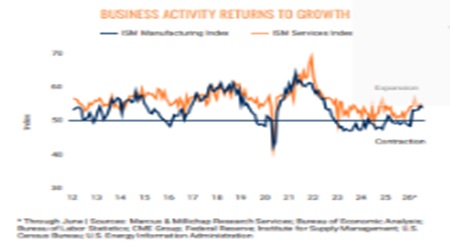
The Institute for Supply Management’s manufacturing and services indexes are signaling renewed expansion after a prolonged period of stagnation. The Manufacturing Index, which remained in contraction territory for much of the previous year, has registered above 50 since January, indicating renewed growth.
The Services Index has strengthened from near-break-even levels into the mid-50s, suggesting continued expansion across the more than 15 industries included in the survey.
The chart included in the research brief shows both manufacturing and services activity moving back above the threshold separating expansion from contraction. Continued improvement in those indicators would support demand for industrial, logistics and retail properties.
Industrial real estate could benefit from increased manufacturing output, inventory movement and business investment. Retail properties may also see stronger tenant demand as service-sector activity and consumer spending remain positive.
Consumer Spending Remains a Key Economic Driver
Consumer spending continues to be one of the strongest components of the economy.
Headline retail sales increased 6.9% year over year in May, while core retail sales rose 5.6%. After adjusting for inflation, core sales increased 2.2%, indicating that consumers were purchasing more goods rather than growth being driven entirely by higher prices.
Household debt remains a concern, but debt-service payments represented approximately 11.2% of disposable income, 60 basis points below the pre-pandemic average recorded between 2012 and 2019.
Continued retail sales growth could support demand for both shopping centers and the warehouses, distribution facilities and logistics networks that supply retailers and consumers.
Risks Remain for Investors
The improved outlook does not eliminate the risks facing the economy and commercial property markets.
Tariff pressures, geopolitical instability, and uncertainty surrounding the renegotiation of the United States-Mexico-Canada Agreement could affect business costs and investment decisions. Inflation also remains a concern, particularly if higher costs force the Federal Reserve to maintain restrictive monetary policy.
According to the report, financial markets were anticipating a potential 25- to 50-basis-point interest-rate adjustment by year-end. Easing inflation, however, could reduce pressure on the Federal Reserve and create a more supportive financing environment.
Stable or declining borrowing costs would help improve transaction activity by narrowing the pricing gap between buyers and sellers and making commercial real estate acquisitions and development projects easier to finance.
While economic risks remain, the combination of stronger hiring, expanding business activity and continued consumer spending is creating a more constructive environment for commercial real estate during the second half of 2026.
Read full source here: Marcus & Millichap Research Services, Economic Outlook, July 2026