Johnson Camp Mine Produces First Copper Using Rio Tinto’s Nuton Technology
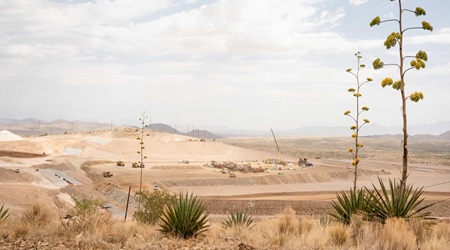
TUCSON, AZ (March 9, 2026) — A new copper recovery process being tested in Cochise County could help open a much larger share of the world’s copper resource to commercial production, as Rio Tinto’s Nuton venture reported its first copper output late last year at the Johnson Camp Mine south of Willcox. Rio Tinto released Dec. 4 that Nuton had produced its first copper at Johnson Camp using its proprietary leaching technology, marking what the company described as a key step toward scaling a process for hard-to-leach sulfide ores such as chalcopyrite.
The Johnson Camp deployment matters because chalcopyrite is the most abundant copper mineral in the world, but it has historically been more difficult and energy-intensive to process than oxide ores. In recent reporting by AZPM, Nuton Chief Technology Officer Harald Muller said chalcopyrite contains about 70% of the world’s copper and is likely to be a major target if supply is to keep pace with future demand.
Nuton, a Rio Tinto venture focused on bioleaching and related recovery technologies, uses naturally occurring microbes, an acidic solution, and heap leaching techniques to recover copper from low-grade chalcopyrite material that would often be considered too difficult or too marginal for conventional processing. Rio Tinto says the system is designed to recover copper from primary sulfides while lowering water use, energy intensity, and emissions compared with more traditional processing methods.
Rio Tinto is also promoting the Johnson Camp project as a lower-impact model for copper production. In its Dec. 4 release, the company said Nuton’s process could use up to 80% less water and generate up to 60% lower greenhouse-gas emissions than conventional copper processing routes, while also extending mine life by extracting value from material that might otherwise be treated as waste. The company has further said that Johnson Camp is targeting what it describes as the lowest-carbon-footprint copper in the United States, supported in part by renewable energy certificate purchases that match the site’s electricity use.
Johnson Camp, owned by Gunnison Copper, is in Cochise County, along Interstate 10 south of Willcox, and has become the first commercial-scale deployment site for the Nuton process. Gunnison described the project as part of the restart of mining operations at Johnson Camp, and both Gunnison and Rio Tinto said the Nuton phase at the site is expected to run for four years. During that period, Nuton expects Johnson Camp to produce about 30,000 tons of copper cathode.
Rio Tinto has also emphasized the carbon profile of the Arizona project. In its Dec. 4 announcement, the company estimated Johnson Camp’s mine-to-metal carbon footprint at 0.82 kilograms of CO2-equivalent per kilogram of copper.
The Cochise County test is not just a standalone mining story. It is also being positioned as part of a much broader push to secure domestic copper supply for power infrastructure, electrification, and data centers. On Jan. 15, Rio Tinto announced a two-year agreement with Amazon Web Services (AWS) to supply low-carbon Nuton copper produced in Arizona to AWS component manufacturers serving U.S. data centers. Rio Tinto said AWS will also provide cloud and analytics support intended to help optimize Nuton’s technology at Johnson Camp.
That agreement puts a Southern Arizona mining project directly into the conversation around AI infrastructure and domestic critical mineral supply chains. Reuters reported that Rio Tinto’s AWS deal reflects growing demand for copper tied to data centers and electrification, while industry forecasts continue to warn of future supply shortfalls.
Nuton’s Arizona work is also part of a wider strategy to form partnerships with copper projects in the western U.S. Rio Tinto’s prior disclosures tied Nuton to the Cactus project in Arizona Sonoran’s portfolio and to the Yerington project in Nevada. More recently, Nuton announced a $30.5 million payment to advance the Yerington Copper Project, while Arizona Sonoran disclosed in February that it and Nuton had terminated their option to form a joint venture on the Cactus Project. That leaves Johnson Camp as one of the clearest active demonstrations of the technology at commercial scale in Arizona.
For Arizona, the implications go beyond one mine. If Nuton’s process proves technically and economically viable at scale, it could reshape how miners think about lower-grade sulfide deposits across the state, especially in places where conventional processing has been too capital-intensive or environmentally challenging to justify. That does not eliminate the usual questions around mining economics, permitting, water, and long-term operations. But it does suggest that Cochise County is now hosting one of the mining industry’s most closely watched copper recovery experiments.