Little Known Facts About Arizona – Tucson’s Origin
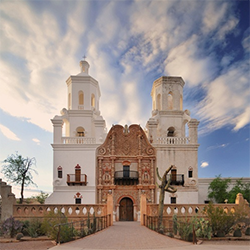 Jesuit missionary Eusebio Francisco Kino visited the Santa Cruz River Valley in 1692, and founded the Mission San Xavier del Bac about 7 miles upstream from the site of the settlement of Tucson in 1700. The Spanish established a fort on August 20, 1775 and the town came to be called “Tucson.” Tucson became a part of Mexico after Mexico gained independence from Spain in 1821. Following the Gadsden Purchase in 1853, Tucson became a part of the United States of America, although the American military did not formally take over control of the community until March 1856. From August 1861, until mid-1862, Tucson was the capital of the Confederate Arizona Territory. Until 1863, Tucson and all of Arizona was part of New Mexico Territory. From 1867 to 1879, Tucson was the capital of Arizona Territory.
By 1900, 7,531 people lived in the city. At about this time, the US Veterans Administration had begun construction on the present Veterans Hospital. Many veterans who had been gassed in World War I and were in need of respiratory therapy began coming to Tucson at this time, due to the clean dry air. The population increased gradually to 36,818 by 1940. In 2006 the population of Pima County, in which Tucson is located, passed one million.
During the territorial and early statehood periods, Tucson was Arizona’s largest city and commercial area, whereas Phoenix was the seat of state government and agriculture. The establishment of Tucson Municipal Airport in 1919, the first in the world, increased its prominence.
The name Tucson originates via Spanish from the O’odham, “Cuk” – meaning “Black Base,” a reference to the mostly volcanic mountains on the west side of the city. The most notable of these mountains is Sentinel Peak, better known as “A Mountain” because it sports a large letter A in honor of the nearby University of Arizona, situated in west central Tucson. Tucson is sometimes referred to as “The Old Pueblo.” It’s archeological and educational university makes Tucson one of the prominent communities in Arizona.
Today Tucson is a bustling powerhouse in Southern Arizona.