Tucson Creates New Office to Strengthen Regional Economic Coordination

TUCSON, AZ (June 15, 2026) — The City of Tucson’s new Office of Community and Economic Impact is intended to better coordinate the City’s economic-development, workforce, prosperity, cultural, and sustainability efforts with the outside organizations already working in those areas throughout the region to enhance Regional Economic Coordination.
The Tucson Mayor and Council approved the organizational change on June 9, placing the office directly under City Manager Tim Thomure. Lane Mandle, currently Thomure’s chief of staff, will lead the office as executive management professional.
During the council presentation, Thomure and Mandle emphasized that Tucson is not starting from scratch or creating an entirely new set of programs. The City already has initiatives, action plans, and partnerships addressing business attraction and retention, workforce development, generational poverty, cultural vitality, sustainability, and equity.
The purpose of the new office is to connect those efforts more deliberately, both within City government and with Tucson’s regional partners.
Thomure described economic opportunity, climate resilience, cultural vitality, and equity as interconnected contributors to Tucson’s long-term prosperity and quality of life. Bringing the programs together under one office is intended to reduce internal silos, improve communication, and provide a clearer structure for coordinating the City’s role in broader community efforts.
Mandle placed particular emphasis on the relationships that already exist throughout the region. Much of the work has been happening for years through cooperation among City departments, Pima County, educational institutions, workforce organizations, nonprofits, and business groups.
She also acknowledged that consistent coordination among the City and its outside partners has been lacking for some time. The new office is intended to rebuild those connections and establish a more deliberate and reliable way for the City to work with regional partners.
Economic development in Tucson does not happen through City Hall alone. It involves Pima County, the Chamber of Southern Arizona, Rio Nuevo, Pima Community College, the University of Arizona, Pima JTED, workforce-development organizations, nonprofit service providers, employers, and cultural organizations.
Many already work with the City, but often through different departments, initiatives, or individual relationships. The new office could give those partners a clearer point of contact inside the City government and a more consistent way to coordinate efforts that cross organizational boundaries.
The Prosperity Initiative is one example. The regional effort brings together the City, Pima County, and nonprofit partners working to reduce generational poverty and expand economic opportunity throughout the county. Under the new structure, the City’s participation in that initiative will be more closely connected to its economic development, workforce, cultural, and sustainability functions.
The objective is not for the City to take over the work of Pima County, educational institutions, economic-development organizations, or the private sector. It is to connect programs that often address different parts of the same economic or community challenge.
Business attraction, for example, involves more than identifying a site and announcing a new employer. A company considering Tucson may need assistance with permitting, infrastructure, utilities, workforce recruitment, job training, transportation, housing, and educational partnerships.
Those responsibilities are spread across numerous public agencies, educational institutions, and private organizations. No single City department or outside entity controls all of them.
Traditional economic-development functions will remain part of the new structure. The Office of Economic Initiatives, including its responsibilities for business attraction, business retention, and investment from Mexico, will be incorporated into the office. Cultural Affairs, sustainability efforts, the Office of Equity, and the Prosperity Initiative will also be aligned under the same leadership.
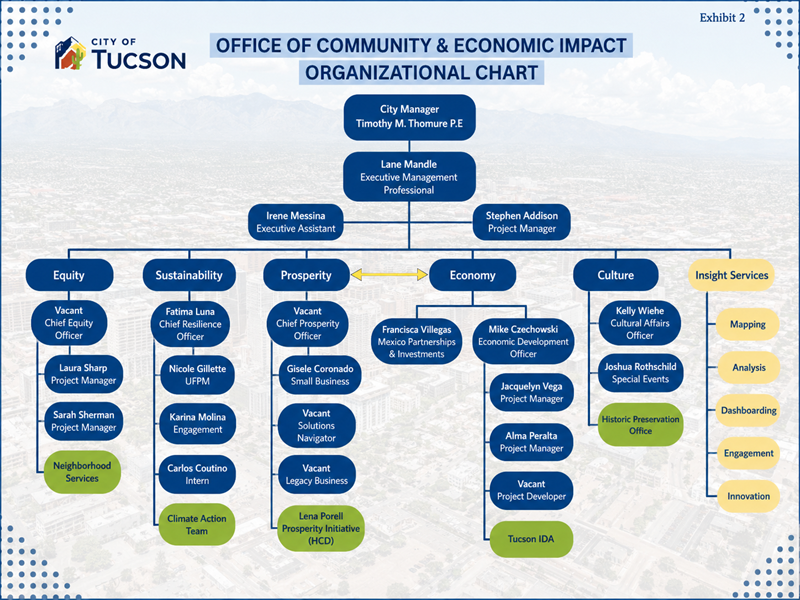
Bringing those functions together does not mean every program has the same mission. It recognizes that their work frequently overlaps and that the City may be more effective when departments and outside partners understand how their efforts fit together.
The reorganization does not add another layer to the City’s adopted budget, according to City officials. Instead, it realigns existing programs and personnel under a common management structure.
Its success will depend on whether the office can improve communication among City departments, strengthen coordination with Pima County and other regional partners, clarify responsibilities, and convert better alignment into measurable economic results.
For Tucson’s business community, the most significant promise may be the recognition that economic development cannot be achieved by a single department, government, or organization acting alone.
The goal is not simply to put several City programs under one administrative roof. It is to make the relationships among them—and with Tucson’s outside partners—work better.
Watch the Tucson Mayor and City Council Meeting June 09, 2026