Chandler Retail Building Sells in $1.3 Million Transaction
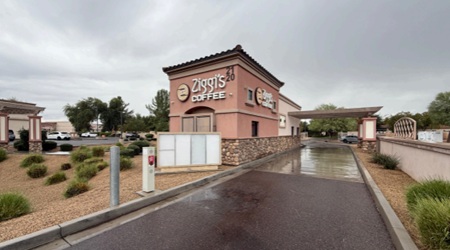
CHANDLER, Ariz. (November 26, 2025) — Nick Miner, CCIM, of ORION Investment Real Estate has announced the successful sale of a freestanding, drive-thru retail property in Chandler, Arizona. The 624-square-foot building, formerly occupied by Ziggi’s Coffee, sold for $1,300,000 ($2,083 PSF) and closed escrow under 75 days.
The property was built in 2018 by a local Ziggi’s franchisee. The seller decided to wind down operations to focus on other endeavors. Located on an ample ±0.78-acre parcel within one of Chandler’s busiest corridors, the property draws high visibility and benefits from neighboring traffic drivers such as CVS, Goodwill, Mesquite High School, and Legacy.
“This marks my third transaction with this Buyer”. Miner continued, “While in escrow, my client was able to secure a new tenant that could use the existing building with limited modifications.”
Future announcements regarding the new tenant will be released soon.
For more information about this sale or to inquire about other opportunities, please contact Nick Miner, CCIM, at ORION Investment Real Estate.
Seller, JRH&E Investments, Inc., was represented by Zach Stevens, Hudson DeJean, and Alex DeSoto of Matthews Real Estate Group.
The buyer, SNDC Landing Holdings, LLC, was represented by Nick Miner, CCIM of ORION Investment Real Estate.
Oro Valley Emphasizes Resilience, Fiscal Discipline, and Economic Development at 2025 State of the Town
ORO VALLEY, Ariz. (Nov. 26, 2025) — Mayor Joseph C. Winfield delivered the 24th 2025 State of the Town address with a clear message for business leaders and regional partners: Oro Valley’s continued success will rely on resilience, forward-looking governance, and disciplined financial stewardship.
Speaking to a full audience at the Oro Valley Chamber of Commerce’s annual event, Mayor Winfield credited the Town’s strength to collaboration—among businesses, community partners, Town staff, and engaged residents. He highlighted that “Oro Valley’s strength has never come from any one individual—it comes from all of us,” setting the tone for a presentation centered on long-term community sustainability.
Economic Conditions: Strong Fundamentals with a Shift Toward Maturity
While Oro Valley remains one of Arizona’s most desirable communities—including a recent ranking as The Most Livable Place to Retire in the West—the mayor acknowledged the realities of a maturing Town approaching build-out. Limited developable land and construction-sector delays have slowed growth-related revenues in 2025, though Winfield emphasized this year’s shortfall reflects timing, not trend.
To prepare for a future with slower construction activity, the Town is taking proactive steps: pursuing strategic annexations, diversifying its economic base, and tightening long-term budget planning.
A key concern is retail leakage. A recent analysis found Oro Valley residents spend $1.2 billion per year outside town limits—an estimated $30 million in lost sales-tax revenue. To counter this, the Town is targeting recruitment for missing business categories such as auto dealerships, larger retailers, and specialty restaurants. Partnerships with SaddleBrooke and the Chamber’s “Locals Eat Local” initiative are part of a renewed push to recapture local spending.
At the same time, the Town is sharpening its focus on high-wage employment sectors, prioritizing bioscience, aerospace, and emerging technologies. Optics and photonics were added this year as a new strategic target—supported by collaboration with the University of Arizona’s Wyant College of Optical Sciences and Optics Valley.
Small business growth remains strong, with more than 40 new businesses opening in the past year, including Ciao Down Pizza, Hooked Up Wellness Clinic, and The Picklr’s new 11-court pickleball facility.
Development & Redevelopment: Marketplaces, Tourism, and Strategic Annexation
One of the Town’s most visible redevelopment efforts—the revitalization of Oro Valley Marketplace—is now underway. The first phase includes new housing, improved intersections, safer pedestrian connections, and a public park, all aimed at repositioning the underutilized center into a modern mixed-use destination.
Tourism is expanding as a core economic driver. Since receiving Destination Marketing Organization status last year, Oro Valley has launched a new tourism commission, begun developing a dedicated tourism website, and engaged CSL International on a long-term strategy. Events like the Legendary Women’s Cup, Fine Art & Wine Festival, Pickle-icious Jingle Jam, and the Tucson Bicycle Classic continue to elevate the town’s profile as a regional outdoor venue.
A major economic milestone this year was the long-sought annexation of Westward Look Resort, bringing immediate sales and bed-tax revenue with minimal service demands. The deal also rezoned 17 acres for future high-density development, strengthening the Town’s tourism and hospitality base.
Fiscal Resilience: Strategic Savings and Infrastructure Investments
Despite rising costs and slower revenue growth, Oro Valley remains on strong financial footing. Over the past two years, the Town has reduced operating costs, postponed nonessential projects, and saved nearly $4 million, adding only one new full-time position—a police officer.
Major investments continue to shape long-term financial stability:
$33 million to fully fund the Public Safety Personnel Retirement System (saving taxpayers an estimated $20 million through 2038).
Acquisition and renovation of a new, cost-effective police station.
Major upgrades to Town Court and ongoing roadway preservation.
Significant parks improvements including shade, misting systems, and new event spaces.
A transformative $50 million water-resilience investment via the Northwest Recharge & Recovery Delivery System, securing 4,000 acre-feet of renewable water annually—enough for 12,000 homes.
The Town also secured $3 million in WIFA grants and additional state awards for Vistoso Trails Nature Preserve, Steam Pump Ranch, and Naranja Park improvements.
Winfield reaffirmed that new tax categories—such as telecommunications, commercial rental, or commercial use taxes—are not “short-term fixes” but part of a balanced, long-term strategy shared by neighboring jurisdictions.
Planning for the Future: General Plan Update & Regional Mobility
Oro Valley’s 10-year General Plan update, OV’s Path Forward, is nearing completion and reflects more than 9,000 community comments collected through a three-year award-winning engagement process. The 60% draft is now available for public review through October 31, with the final plan scheduled for the November 2026 ballot.
Winfield also highlighted his role as Chair of the RTA Board, emphasizing that the upcoming RTA Next vote in March 2026 will determine regional transportation priorities for the next 20 years.
Looking Ahead
The mayor closed by reiterating that Oro Valley’s next chapter will be defined by strategic governance, community engagement, and disciplined investment. “With resilience and forward-looking governance,” Winfield said, “Oro Valley stands today as one of Arizona’s most livable and sustainable towns.”
VIEW VIDEO OF THE SPEECH Click here to watch the 2025 address.
You may also copy and paste the link below into a web browser.
READ A TRANSCRIPT OF THE SPEECH Click here for the 2025 transcript or copy/paste the link below.
https://www.orovalleyaz.gov/files/assets/public/v/1/documents/mayor-and-council/state-of-the-town/2025-state-of-the-town-address-transcript.pdf
RealPage Lawsuit Reaches Settlement with U.S. Department of Justice in Rental Pricing Case
Arizona AG Mayes’ Lawsuit Against RealPage and Other Arizona Apartment Owners Still Pending
(November 26, 2025) — RealPage, Inc., the Richardson, Texas–based provider of revenue management and rental-pricing software for the multifamily housing industry, has reached a settlement with the U.S. Department of Justice (DOJ) resolving the federal antitrust action involving its pricing algorithms filed August 23, 2024. The agreement is memorialized in a proposed consent judgment and remains subject to court approval under the Tunney Act process.
This settlement does not resolve the separate lawsuit filed by Arizona Attorney General Kris Mayes against RealPage and several large landlord-defendants—including Tucson-based HSL Properties—which remains active.
Key Terms of the DOJ Settlement
According to the DOJ, the proposed consent judgment requires RealPage to:
Cooperate fully in the United States’ lawsuit against property management companies that used its revenue-management software.
Stop using competitors’ nonpublic, competitively sensitive information to set rental pricing in real time.
Limit model training to historic, backward-looking nonpublic data that is at least 12 months old.
Prohibit the use of models that evaluate geographic effects narrower than the state level, preventing metro-level or neighborhood-level coordination.
Remove or redesign features that discouraged price reductions or encouraged alignment of competitors’ pricing decisions.
Stop conducting market surveys to collect and redistribute competitively sensitive rental data.
Cease discussing nonpublic market data or pricing strategies in internal RealPage meetings about its revenue-management products.
Accept a court-appointed compliance monitor for a three-year oversight period.
Provide cooperation to federal enforcement efforts targeting property managers who allegedly used RealPage tools to coordinate rents.
The DOJ described the settlement as part of its broader national push to address algorithmic coordination, information-sharing practices, and other anticompetitive conduct in rental markets nationwide.
“Competing companies must make independent pricing decisions, and with the rise of algorithmic and artificial intelligence tools, we will remain at the forefront of vigorous antitrust enforcement,” said Assistant Attorney General Abigail Slater of the DOJ’s Antitrust Division.
RealPage President and CEO Dirk Wakeham called the settlement “an important milestone” for the company and the multifamily industry.
“Our teams remained focused on serving customers and advancing the technology the industry relies on every day,” Wakeham said. “We are convinced that RealPage is part of the solution to addressing the cost of housing, helping operators make informed, independent decisions in a complex housing market. We are pleased to have reached this agreement with the DOJ, which brings the clarity and stability we have long sought and allows us to move forward with a continued focus on innovation and the shared goal of better outcomes for both housing providers and renters.”
Status of the Arizona Lawsuit Against RealPage and Nine Arizona Apartment Owners
The DOJ settlement does not dismiss or resolve the February 2024 lawsuit filed by Arizona Attorney General Kris Mayes, which accuses RealPage and nine major apartment owners—including HSL Properties Inc.—of unlawfully using coordinated pricing algorithms to raise rents in Phoenix and Tucson.
As of today, there is no public record of a settlement, dismissal, or pause in the Arizona case (Superior Court Case No. CV2024-003889). The lawsuit remains active. Because RealPage must cooperate with ongoing state enforcement actions as part of the DOJ settlement, this may influence the progression of the Arizona case, but it does not resolve it.

 Arizona AG Mayes’ Lawsuit Against RealPage and Other Arizona Apartment Owners St