
Arizona Retail Leases – REIN & GROSSOEHME CRE (November 2025)

Arizona Retail Leases

PHOENIX METRO & SEDONA LEASES

(November 24, 2025) — Rein & Grossoehme CRE reported four Arizona retail leases totaling 7,591 square feet across Sedona, Surprise, Gilbert, and Mesa. The largest deal was a 3,223-square-foot lease to Imagine 3D Mini Golf at Hillside Sedona Shops along Sedona’s Highway 179 tourist corridor, reflecting continued demand for experiential and entertainment-focused retail. In the Phoenix metro, a 2,500-square-foot renewal for Signature Dental at Gilbert & Ray Shops underscored the stability of medical and dental users, complemented by new leases for Whole Plant Health Vitamins in Surprise and Plumbing Masters in Mesa.

The following leases were reported by Rein & Grossoehme CRE.

RETAIL – HILLSIDE SEDONA SHOPS, 671 HIGHWAY 179, SEDONA, AZ
Imagine 3D Mini Golf leased 3,223 square feet within Hillside Sedona Shops at 671 Highway 179 in Sedona, Arizona. The center’s owner is MCA Hillside, LLC. Jared Lively of Rein & Grossoehme CRE represented the tenant on this transaction.

RETAIL – BELL MAR PLAZA, NEC BELL ROAD & 114TH AVENUE, SURPRISE, AZ
Whole Plant Health Vitamins leased 1,118 square feet in Bell Mar Plaza, located at the northeast corner of Bell Road and 114th Avenue in Surprise, Arizona. The center’s owner is Rainbow Investments, LLC. Jared Lively of Rein & Grossoehme CRE represented both the landlord and the tenant in this transaction.

RETAIL – DOBSON–BASELINE PLAZA, 2051 S DOBSON ROAD, MESA, AZ
Plumbing Masters leased 750 square feet at Dobson–Baseline Plaza, 2051 South Dobson Road, Mesa, Arizona. Kevin Roessler of Rein & Grossoehme represented both the tenant and the landlord.

RENEWALS

RETAIL – GILBERT & RAY SHOPS, 1522 S GILBERT ROAD, GILBERT, AZ
Signature Dental renewed its 2,500-square-foot lease at Gilbert & Ray Shops, 1522 South Gilbert Road, Gilbert, Arizona. The owner of the center is Jabon Investments, LLC. Jared Lively of Rein & Grossoehme CRE represented both the landlord and the tenant in this transaction.

Submit sales and leases to [email protected]


Trend Report Editor’s Insights: Stability, Strategy, and the Road Ahead

Trend Report

TUCSON, AZ (November 24, 2025) –– The December Trend Report is out today!  As 2025 winds to a close, our special “Pivot to 2026” issue arrives at a defining moment for Southern Arizona’s commercial real estate community. It is rare to see an entire industry moving through a transition this broad in scope yet subtle in tempo. Unlike the sharp market swings of the last decade—driven by stimulus, supply shortages, and economic shocks—this past year has been marked by a more gradual reset. Pricing, underwriting, development plans, and tenant strategies have all adjusted to today’s realities. Across our coverage this month, a consistent message emerges: 2026 won’t bring a dramatic restart, but rather a more focused, more informed phase in which the market operates with clearer expectations.

These clearer expectations vary across property types, and Southern Arizona’s performance stands out in several key ways. One of the clearest takeaways from this issue is how grounded our region is compared to many major metros. The national reports we feature highlight cooling office demand, moderating industrial expansion, and a multifamily sector adjusting to a long-anticipated wave of deliveries. Yet in Southern Arizona, the story is more balanced. Office fundamentals remain steady, supported by the absence of overbuilding and the anchoring presence of healthcare, education, government, and professional services. Retail continues to benefit from tight vacancy and strong consumer activity—even as national trends lean toward more selective expansion. Industrial remains a tale of two markets: Phoenix surging ahead with mega-projects and power-intensive users. At the same time, Tucson absorbs a temporary vacancy increase from a single large move-out and still retains its long-term competitiveness. And in multifamily, Tucson’s shift from rapid expansion to measured stability reflects a maturing market finding its footing between new supply and population-driven demand.

Taken together, these sector trends point toward more profound shifts that will shape the region’s next cycle.

This issue also underscores how structurally different the next cycle will be. Our feature articles highlight the themes shaping investment decisions heading into 2026: recalibrated interest-rate expectations, renewed capital-markets optimism, and a growing recognition that energy availability has become one of the most important site-selection factors of the decade. That shift alone is poised to reshape industrial development across Arizona and the broader Southwest. Likewise, our examination of adaptive reuse in the office sector reveals a critical inflection point—one at which aging inventory will either slide into obsolescence or be repositioned as a strategic opportunity.

Our market data section tells a similarly nuanced story. October’s top commercial sales and leasing momentum offer a snapshot of a market where investors may be cautious, but they are not absent. Public-sector activity, population inflows, and diversified employment continue to provide a stable foundation for dealmaking. The inclusion of county-level data, residential trends, and economic indicators underscores the importance of viewing the region holistically—not merely property type by property type.

Together, these indicators reinforce a broader point about the region’s trajectory and what sets Southern Arizona apart. What I appreciated most in assembling this issue is how clearly Southern Arizona demonstrates the value of markets that understand their own identity. Tucson is not trying to be Phoenix; it is playing to its strengths—its measured growth, its specialization in essential services, its expanding innovation clusters, and its increasingly strategic approach to development. That authenticity is a competitive advantage, and it will matter even more in 2026.

I extend my heartfelt thanks to all who share research and perspective with Trend Report, and to our production team—Patti vanLeer, Michael Rossmann, and Jack Paddock—for bringing each issue to life.

Looking ahead, our January issue will name our “Best in Class Influencers” for 2025 and look back at the year’s best trends. As always, we welcome your feedback and contributions—visit trendreportaz.com and click “Connect” to get in touch.


Arizona Moves Forward With Major Water Infrastructure Project

Water Infrastructure

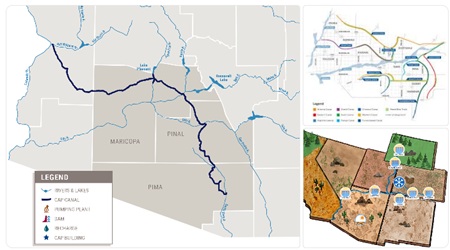
TUCSON, AZ (November 24, 2025) — Arizona is undertaking a landmark water infrastructure effort: the Central Arizona Project (CAP) and the Salt River Project (SRP),  two of the state’s largest water systems,  will be physically connected via a new interconnection facility, projected to cost around $250 million, with a target completion in  2028.

WHAT’S BEING BUILT AND WHY

  • CAP delivers Colorado River water over a long aqueduct system (300+ miles) to about 80% of Arizona’s population.
  • SRP draws from the Salt & Verde Rivers in the Phoenix region and serves the greater metro area.
  • The new facility — the “SRP–CAP Interconnection Facility” (SCIF) — will allow bidirectional flow between the two systems.
  • Connecting the systems enhances statewide flexibility and resilience amid long‑term drought and Colorado River shortages.

SIGNIFICANCE FOR ARIZONA’S WATER FUTURE

  • Improves resilience and redundancy if one system faces cuts or constraints.
  • Provides operational flexibility for managing flows, exchanges, and shortages.
  • Supports long‑term planning as climate pressures reshape water availability.
  • Estimated cost: $250M; anticipated completion around 2028.

KEY CAVEATS & NEXT STEPS

  • Depends partly on upcoming negotiations over the Colorado River operating guidelines.
  • Engineering, environmental review, and permitting will be complex.
  • Budgets and timelines may evolve.
  • Cities and utilities will evaluate cost, reliability, and operational impacts.

 IMPLICATIONS FOR TUCSON & PIMA COUNTY

  • Enhances statewide water‑system stability, indirectly supporting Tucson’s planning.
  • Reduces risk sensitivity for development and long‑term growth models.
  • Strengthens internal system flexibility that could ease regional stressors.

In brief, Arizona’s CAP–SRP interconnection represents a significant step toward a more integrated statewide water‑delivery network. As drought persists and river‑system pressures grow, this infrastructure investment is designed to increase flexibility, redundancy, and long‑term reliability. For the Tucson region’s real‑estate and planning sectors, it’s a significant development with wide‑ranging implications for future growth and water‑security strategy.

For more information, go to Central Arizona Project – CAP and Where your water comes from in the Phoenix metro area | SRP.