Canadian Company Establishes U.S. Operations Through University of Arizona Center for Innovation Soft Landings Program  

TUCSON, Ariz.– The University of Arizona Center for Innovation (UACI) welcomes Canadian-based Longan Vision to Tucson, Arizona.  The startup company, based in Hamilton, Ontario, Canada, is establishing a U.S. office at the UA Tech Park, moving resources and Andrew Leaman, the Manager of Commercial Operations to Tucson, Arizona, U.S. to launch their product.

Longan Vision designs and builds advanced Augmented Reality technology for First Responders to use in dangerous environments enabling them to help save lives faster. The Longan Vision product, Fusion Vision System (FVS), is an Augmented Reality Smart Visor attachment for firefighter’s helmets. The FVS provides enhanced vision and information sharing abilities that will allow firefighters to see through smoke, locate victims, and find fire sources. 

The startup participated in UACI through the Global Advantage Soft Landings Program in June of 2022. Longan Vision was part of a Canadian delegation that explored market potential by working with the UACI. Within two weeks, Andrew Leaman received mentorship and customized venture development support, connections with like-minded startups in the community and valuable discussions with local government officials and community leaders about the potential customers within the region. 

“UACI has provided us with an amazing opportunity to help build our U.S. operations, to help the Fire Service of Arizona, and of course, help save lives,” says Longan Vision Manager of Commercial Operations, Andrew Leaman, “The network UACI has provided far exceeded our wildest dreams about what could happen here. This area, especially centered around Tucson, is full of entrepreneurial, supportive, kind people who want to see you succeed. That kindness and support was evident within the first few weeks of being here, and it is a major driving factor for us staying here.” 

“Attracting foreign investment to diversify our economy is one of my priorities,” said Tucson Mayor Regina Romero. “Tucson is the place to be for Canadian entrepreneurs looking for innovation and quality of life. Our business incubator network and access to university talent, combined with our city’s unique culture and history are just some of the reasons why Canada is Tucson’s largest source of origin for Foreign-Owned Enterprises.” 

Longan Vision is the fourth international company that moved to the U.S. after working with UACI. UACI has worked with 20 international companies and hundreds of international entrepreneurs through the Soft Landings program. UACI helped a total of nine business from outside Tucson establish their Southern Arizona business operations. 

UACI has a long-established reputation as a proven entrepreneurship center that has demonstrated the capabilities necessary to provide resources and programming to international companies seeking new market entry in the US.

“We invite companies from all over the globe to explore the market. International startups are often amazed by our community’s support and our incubator’s offerings,” says Eric Smith, Executive Director of UACI, “The Soft Landings Program provides all the necessary accommodations so international companies can smoothly enter the United States.”  

UACI was recently honored by the International Business Innovation Association as Soft Landings Designee of the Year for the dedication exhibited in helping international startups with market expansion. UACI is quickly establishing itself as an innovative powerhouse in the entrepreneurial ecosystem, currently assisting 81 startups programmatically with four incubator outposts across Southern Arizona. UACI guides startup founders along a 27-point program roadmap providing individualized coaching at all stages of development.  

The Soft Landings program is part of UACI’s established international program that supports early-stage companies, called Global Advantage. This program utilizes its strategic location in Tucson, Arizona paired with relatively low business startup costs and highly accessible major market connections to the west and east coast. Global Advantage is comprised of partners that foster international business opportunities and include:  

  • CAID Industries which specializes in diversification and being a vertically integrated solutions for engineering, custom fabrication, pressure vessels, large scale manufacturing, factory automation, precision machining, extensive mine technologies and services. 
  • Farhang & Medcoff Attorneys a prominent minority-owned, full-service law firm with locations in Tucson and Phoenix, Arizona. 
  • Cushman & Wakefield |PICOR an employee owned and founded commercial real estate business with properties in Southern Arizona and Sonora, Mexico. 
  • Tech Parks Arizona which creates the place, environment, and interactive ground that generates, attracts and retains technology companies in alignment with the research, mission, and goals of the University of Arizona.   
  • Tetakawi which provides manufacturing and technology companies with turnkey solutions to establishing world-class manufacturing environments in Mexico. 
  • Tucson Electric Power which provides safe and reliable power to Tucson residents. 

The University of Arizona Center for Innovation (UACI) is a startup incubator network with outposts across the Southern Arizona region. For nearly two decades, the program has directly served over 200 companies and impacted thousands of entrepreneurs. This is done by providing access to people, programming, and places that help entrepreneurs take their companies from idea to market. Startups go through a structured program that takes them through a continuum of education provided by mentors, advisors, and community collaborators. UACI also provides access to service providers, industry cluster groups, interns, and connections to potential customers and strategic partners. Entrepreneurs utilize various physical spaces that include offices, wet and dry labs, meeting rooms, a prototyping center, collaboration areas, and the infrastructure to support these spaces. Tech Parks Arizona directs the UA Tech Park, the UA Tech Park at The Bridges and the University of Arizona Center for Innovation. 
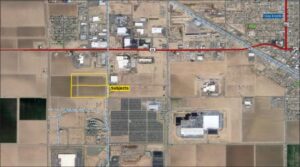


TSMC chemical supplier KANTO-PPC closes on pair of deals totaling 50 acres for $3.7M in Casa Grande, AZ

KPPC Advance Chemicals is the sixth semiconductor supplier to land in Casa Grande and the fifth that Land Advisors Organization has helped to locate.

Casa Grande, Arizona – Land Advisors Organization is pleased to announce it recently closed on two deals totaling 50 acres, representing two separate sellers at the SEC of Highway 84 and Burris Road in Casa Grande, Arizona. The buyer of both parcels, KPPC Advanced Chemicals Inc. (KANTO-PPC), is a chemical supplier to the Taiwan Semiconductor Manufacturing Company (TSMC), which has a multi-billion-dollar project under construction near Interstate 17 and Loop 303 north of the Valley.

Land Advisors Organization’s advisors Kirk P. McCarville, CCIM, and Pinal County Specialist Trey Davis represented the seller, San Carlos 198 LLC (Charles Lawrence Principal) in the $1.783 million sale of 26.22 acres. McCarville and Davis also represented The Kendler Family Trust (Edward Kendler Principal) in the $1.912 million sale of 24 acres of agricultural raw land.

The 26-acre sale fetched $68,000 per acre; the 24-acre deal fetched $79,700 per acre.

“KANTO chose Casa Grande because of the competitive land price, efficient rail infrastructure, housing affordability for employees, and the high-quality schools in the area,” said McCarville, who added KANTO-PPC is the sixth semiconductor supplier to land in Casa Grande and the fifth that he and McCarville have helped to locate.

KANTO-PPC provides high purity electronic chemicals required in the processes of semiconductor and optoelectronics industries. It collaborates with KANTO Chemical Japan to build manufacturing plants with state-of-the-art clean rooms as well as research and development equipment in Taiwan. As the precision requirement of semiconductor processes has become more vigorous, KANTO upgrades the product quality and also develops the products of next generation to enhance the international competitiveness of the semiconductor and optoelectronics industries.

The two parcels are located near the Pinal County Tech Park, a two-phase, ±1,064-acre, rail-served industrial park. With its proximity to the TSMC semiconductor factory and Intel expansion plus Lucid Motors and Nikola, the Pinal County Tech Park has received tremendous interest from companies in the semiconductor supply chain and the Tier 1 and Tier 2 electric vehicle manufacturer suppliers.

McCarville and Davis have represented the Pinal County Tech Park, Central Arizona Commerce Park and the Barnes Farm Industrial Area recently in four other major industrial transactions. These deals include Kohler’s 206-acre greenfield plumbing products manufacturing facility, ancillary warehouse and office space site; the 84-acre CCCP manufacturing and distribution facility site; the 27-acre site for LCY Electronic Materials 80,000 square-foot manufacturing facility; and the 20-acre Jing He Sciences manufacturing facility parcel. Michele Pino, an advisor with Land Advisors Organization, represented the buyers in the CCCP, LCY Electronic Materials and Jing He Sciences transactions.


A quick analysis of important economic data released over the last week

By: Elliott Pollack Company, The Monday Morning Quarterback

There are lots of opinions on where the housing market is headed over the next couple of years. Prices across the country are up 42% over the past two years, even higher in Phoenix and other fast-growing cities across the Sunbelt. Mortgage rates are up to 5.5%, historically a very reasonable rate, but not compared to the rates quoted just six months ago. In response, the red-hot housing market has begun to cool dramatically in just the last month or so. The dreaded “R” word is still on everyone’s mind.

The most frequent way we enter a recession is the Fed raises rates to fight inflation. The leading indicator for this type of recession is the housing market. Housing is not particularly the target, but it ends up being the sacrificial lamb.

So where will the housing market end up? Bill McBride of Calculated Risk thinks U.S. home prices will be flat over the next year. Alternatively, Freddie Mac believes prices will rise another 4.4%. However, real estate is known as a market of markets. In other words, there is a big difference in price movements between homes in Evansville, Indiana and Greater Phoenix.

CoreLogic, a real estate data analytics firm, conducted an assessment of the likelihood of regional home price declines. Their analysis, based on various factors such as population and employment growth, unemployment rates, and the like, concludes that Maricopa and Pima counties have very low odds of home prices dropping over the next year. However, Yavapai and Mohave counties are found to have a very high probability of price declines along with Boise, Philadelphia, and San Francisco. For the next year, CoreLogic predicts U.S. home prices to rise 5%, but regional differences will vary from that forecast.

By comparison, Moody’s Analytics puts Phoenix, Boise, Austin, Las Vegas, Nashville, and several other Sunbelt cities in the “significantly overvalued” housing category which could mean price declines.

So, all we can do is watch the data as it comes in each month. The Snapshots below start to tell the story for the last month or so and the market in Greater Phoenix is clearly slowing. In the end, we are probably not heading towards a housing bust like we saw in the early part of the last decade. Homeowners are in better financial shape and financial institutions have been very careful in their lending practices. And even with a price drop of 10% or 20% in Greater Phoenix, if you are a homeowner, you have still gained equity. If you are not a homeowner, prices may be trending downward creating opportunities for purchase if you can withstand rising interest rates.

U.S. Snapshot:

  • The Conference Board’s Leading Economic Index dropped for the fourth consecutive months in June. The continuous decline suggests even slower growth and the probability of a recession is increasing.
  • Mortgage rates rose again to 5.54% last week, up from 5.51% last week and 5.30% from the beginning of the month. Concerns about inflation, recession fears and higher rates will cause price appreciation to slow.
  • Home builders’ confidence fell again in July and dropped to the lowest level since May 2020. Builders are dealing with shortages of supplies and labor, inflation and higher borrowing costs causing them to halt or slow construction.
  • The housing market has slowed as housing costs increases and consumer confidence drops, according to the U.S. Census Bureau. Total starts and permits were pulled down by the single family sector. Single family starts fell 8.1% to 982,000 seasonally adjusted annual rate (SAAR) in June. Permits had a similar drop of 8.0%. Multifamily was the lone bright spot, with starts and permits increasing by 15.6% and 26.0%, respectively.
  • Existing home sales fell again, but home prices increased in June. The National Association of Realtors latest release shows all sales dropping 5.4% and single family decline 4.8%. Median sale price increased 1.9% and existing home sales reached $416,000 and single family $423,300.
Arizona Snapshot:
  •  Let’s look at Arizona’s seasonally adjusted June employment figures. The state added 15,000 more jobs. Greater Phoenix led the way by adding 16,300 jobs and Greater Tucson added 1,000 jobs. The balance of the state lost a combined 2,300 jobs in June.
  • Through the first six months of the year, Arizona has added 112,900 jobs. Leisure & Hospitality, Trade, Transportation, & Utilities and Educational & Health Services added 78,000 of those jobs. The state’s growth rate (3.9%) ranks 18th out of the 50 states. The Phoenix metro area added 85,700 jobs, while Tucson grew by 13,800. The major metros grew at 3.9% for Phoenix and 3.7% for Tucson.
  • Housing slows in both of Arizona’s major metros in June, according to RLBrownReports.com.
  • Greater Phoenix permit activity dropped 27.5% with resales falling by 22.5% and new home closings declining 1.7%. Year-to-date, permits (-10.3%), resales (-7.3%) and new homes (-4.0%) are all down compared to 2021. The median sales prices for existing and new homes have continued to slow as well. Resales saw no growth from May and remained 20.5% above last year’s level. New home prices increased 0.5% for the month and were up 23.4% for the year.
  • Despite new home sales outpacing last year’s June level, Greater Tucson was not immune to the uncertainty surrounding the economy. New home sales were up 9.7% from a year ago, but down 12.4% from last month. Permits were down 46% and resales were down 19.3% from last year. Median prices remained nearly at May’s level, with new home prices dropping 0.3% for the month and the price of existing homes increasing 0.9%.
  • Home builders, sellers, potential buyers and lending institutions will adjust their decisions as mortgage rates change as the Fed’s effort to tame inflation continues. Expect mixed headlines to continue as uncertainty surrounding the economy remains top of mind for consumers.