Northmarq: Market Insights Greater Tucson Multifamily 1Q 2022
 Northmarq is reporting Q1 market insight for Tucson Multifamily.
Highlights include:
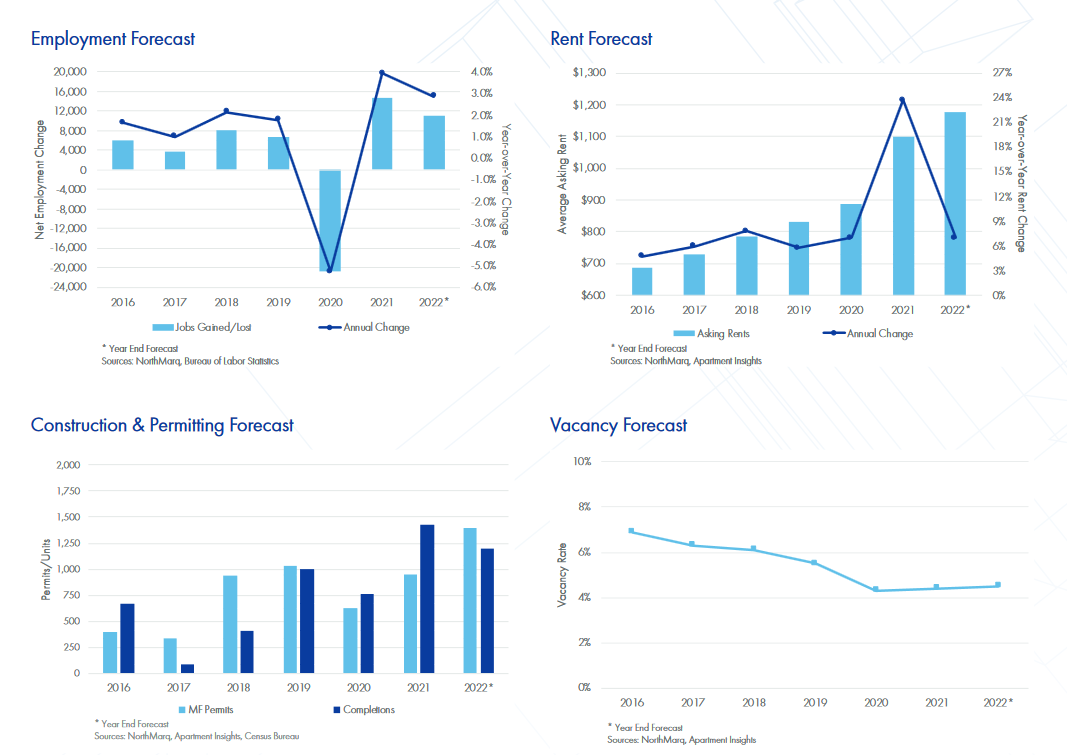
- Demand for multifamily units in Tucson leveled off during the first quarter, following a year of rapid growth. Vacancy rose, generally in older units, while rents continued to push higher. A healthy labor market is forecast to support operating conditions through the remainder of this year.
- Apartment vacancy rose 40 basis points in the first quarter to 4.8 percent. This marked the second consecutive quarter where the rate ticked higher, following several years of gradual declines. During the past 12 months, the rate has risen 50 basis points.
- Asking rents finished the first quarter at $1,126 per month, 23.2 percent higher than one year ago. Rents increased 2.3 percent during the first quarter.
- Fewer apartment properties sold at the start of this year, following a rapid pace of deal flow at the end of 2021. In deals that closed in the first quarter, the median price was approximately $125,000 per unit, while cap rates averaged around 4.2 percent.
Tucson Multifamily Market Overview
Activity in the Tucson multifamily market leveled off during the first three months of 2022, following a year of unprecedented growth. In the first quarter, net absorption in Tucson was essentially flat, while the delivery of new units continued at the steady pace that has been established in recent years.
The result was an uptick in vacancy, although the current rate remains about 100 basis points lower than the market’s long-term trend. These tight conditions, coupled with ongoing gains in the local labor market, are supporting rent increases, a trend that should continue throughout the remainder of 2022. While vacancy rose to start the year, the increase was not recorded in newer, Class A units. Instead, vacancies trended higher in 1970s- and 1980s-vintage units, which may reflect a flight to
quality as personal balance sheets have improved.
Investment trends were mixed in the first quarter. Sales activity slowed from heightened levels recorded in each of the past two years and reflected a more normalized pace of velocity.
Cap rates began to push higher, which likely contributed a bit to the more modest pace of transactions. Despite these factors, prices continued to trend higher, with the median reaching $125,000 per unit, 10 percent higher than the median price in 2021. This reflects the impact of rapid rent growth in the market in recent years and supports a favorable outlook for owners. As recently as the end of 2020, average rents in the market were below $900 per month. Current rents are up more
than $225 per month with additional gains likely in the coming quarters.
Development and Permitting
- Developers delivered 312 apartment units during the first quarter, down about 20 percent from the number of units that came onlineduring the first few months of last year. Quarterly deliveries are up about 70 percent from the market’s five-year trend.
- Projects totaling more than 1,300 units are currently under construction in the Tucson market, nearly identical to the number of units that were in development one year ago.
- Multifamily permitting has picked up to this point in 2022, with developers pulling permits for approximately 420 units in the first quarter. Activity is up more than double from levels recorded one year ago.
- Forecast: Deliveries are expected to total approximately 1,200 units this year, after more than 1,400 units were completed in 2021. The pace of construction activity is
expected to be fairly consistent throughout most of the year.
Vacancy
- Vacancy rose 40 basis points during the first quarter, reaching 4.8 percent. Vacancy dipped below 5 percent in the third quarter of 2020, and the rate has remained between 4 percent and 5 percent in each of the past seven quarters.
- After increasing for the second consecutive quarter, the vacancy rate in Tucson is up 50 basis points from the same period one year ago.
- Demand has remained healthy in the Class A segment. The rate ended the first quarter at 3.8 percent, down 110 basis points year over year. Class A vacancy tightened 40 basis points in the first quarter.
- Forecast: Vacancy is forecast to end 2022 at 4.5 percent, up 10 basis points from the end of last year. The rate has remained in a tight range after falling each year from 2013 to 2020
Rents
- The Tucson multifamily market recorded some of the most rapid rent increases in the country last year, with rents spiking by more than 23 percent. During the first quarter of this year, rents gained an additional 2.3 percent, reaching $1,126 per month.
- Local asking rents are up 23.2 percent from one year ago, although the bulk of the increase was recorded in the second half of 2021. Tucson rents have increased by more than $200 per month since the first quarter of 2021.
- The strongest rent growth in the Tucson market occurred among Class B properties. Asking rents in Class B buildings have increased by 29 percent compared to the first quarter of last year. With demand elevated, many operators are pushing rents higher, particularly in 1980s- and 1990s-vintage units.
- Forecast: Rent growth is expected to continue in the coming quarters, although the pace will be moderate compared to last year. Tucson asking rents are forecast to increase approximately 7 percent this year, ending 2022 at $1,177 per month.
Multifamily Sales
- After surging at the end of 2021, the pace of local apartment sales cooled off at the start of the year. Sales velocity is down roughly 27 percent from the same period at the beginning of last year.
- While fewer properties changed hands during the first quarter, prices continued to trend higher. The median price in deals that closed at the start of 2022 reached $125,000 per unit, an increase of 10 percent compared to the median price in 2021.
- After compressing throughout 2021, cap rates trended higher at the start of this year. The average cap rate in closed transactions in the first quarter was 4.2 percent, 70 basis points higher than the average rate in the previous quarter.
Looking Ahead
Economic growth in Tucson is forecast to continue to provide fuel for the local multifamily market. Employers are expected to continue to add back workers to payrolls, supporting renter demand for apartment units. The pace of new development in Tucson began to gain momentum in 2019, and in recent years, the market has repeatedly proven that there is sufficient demand to absorb new units delivered to the inventory.
The local vacancy rate is forecast to remain near recent ranges throughout the remainder of this year. The persistent renter demand and low vacancy rates should continue to support rent increases. Operators are forecast to implement additional rent increases this year, following an average spike of more than 23 percent in the previous year.
In recent years, momentum has been building in the Tucson multifamily market with a greater number of transactions closing to a more diverse set of buyers. The pace of activity slowed at the outset of this year, and there could be another quarter or two of modest sales velocity as buyers and sellers assess the impact of rising interest rates on pricing and cap rates. To this point, cap rates have shown some signs of inching higher after compressing for the past several years. Traditionally, the bulk of the activity in the Tucson investment market has occurred below $10 million, but in recent periods there has been a significant su ge in transactions ranging from $20 million to $50 million
 CASA GRANDE, Ariz. –
  TUCSON, ARIZONA – The University of Arizona Center for Innovation (UACI) has teamed up with Startup Tucson to sponsor one promising startup team with resources, facilities, services, and expert guidance to grow their business. The year-long program will also foster networking opportunities for its participants.