U.S. GDP Grows by 6.9% in Q4 2021

CBRE is reporting the U.S. economy grew at an annualized rate of 6.9% in Q4, bringing full-year 2021 growth to 5.7% (in line with CBRE’s forecast of 5.6%). Growth was propelled by strong consumer and business spending. Disrupted supply chains have exacerbated price pressures in certain areas and remain a drag on growth. This was seen particularly in motor vehicles and durable goods during Q4.

  • Consumer and business spending were very strong in Q4 despite continued supply chain disruptions and the emergence of the COVID-19 omicron variant.
  • Replenishing inventories added 4.9 percentage points to GDP growth in Q4, likely reflecting businesses maintaining higher levels of stock to meet increased demand and counter supply chain disruptions.
  • This better-than-expected growth underscores the strength of the U.S. economy and will bolster the Fed’s case for rate hikes this year, beginning in March.
  • Commercial real estate fundamentals will continue to improve in 2022 as CBRE expects annual GDP growth of at least 4.5%.

Commercial Real Estate Highlights:

Office
Office-using industries such as financial services and tech saw notable growth in Q4 2021. This bodes well for office demand, particularly as pandemic-related uncertainty eases.

Retail
Consumer spending accelerated and was up by 3.3% in Q4 2021, although supply-chain disruptions continued to hamper growth in certain sectors. We expect those disruptions to further moderate in 2022. With the consumer in good shape and as public health concerns recede, the stage will be set for retail fundamentals to further strengthen during the year.

Industrial
Replenishing inventories added 4.9 percentage points to U.S. GDP growth in Q4, likely due to businesses countering supply-chain difficulties by maintaining more stock. Such dynamics greatly support already strong industrial & logistics fundamentals.

Multifamily
A strong economy and labor market will continue to support household formation, while housing shortages and high house prices will continue to bolster multifamily demand. Nevertheless, there may be some near-term headwinds for new supply related to labor and materials availability and cost.

Hotels
Accommodation & food services contributed to GDP growth in Q4, underpinned by low unemployment and healthy consumer balance sheets. CBRE expects leisure travel to remain strong, with international and business travel continuing to experience some volatility.

The Bottom Line
The U.S. economy grew at an annualized rate of 6.9% in Q4, bringing full-year 2021 growth to 5.7% (in line with CBRE’s forecast of 5.6%). Growth was propelled by strong consumer and business spending. Disrupted supply chains have exacerbated price pressures in certain areas and remain a drag on growth. This was seen particularly in motor vehicles and durable goods during Q4.   We expect GDP growth to slow sharply in Q1 2022 due to the COVID-19 omicron surge.  This will put the Fed in a more difficult position, given its preference to raise interest rates and withdraw monetary stimulus. However, we still expect at least three increases in the federal funds rate this year, beginning in March. Economic growth should rebound in Q2 2022, driven by strong private-sector demand, and reach between 4% and 5% for the full year. This will in turn help drive an increase in demand for commercial real estate.   Several quarter-point interest rate increases are not expected to significantly disrupt commercial real estate investment in light of the continued strong economy. Additionally, CBRE expects the 10-year Treasury yield to rise by only 2.3% in 2022. As a result, real estate should be comparatively more attractive to investors as a hedge against inflation and as historically low-cost debt remains broadly available.



Fed Rate Hike Coming in March

At the conclusion of its January policy meeting, the Federal Open Market Committee strongly signaled that it will undertake its first, post-covid increase of the federal funds rate in March. The Fed is tightening monetary policy in response to the highest inflation readings in nearly 40 years. These inflationary pressures have increased both consumer costs and businesses input costs, including those faced by the residential construction sector. Today’s policy announcement noted clearly:

With inflation well above 2 percent and a strong labor market, the Committee expects it will soon be appropriate to raise the target range for the federal funds rate.

Housing market stakeholders should be prepared for four 25 basis point federal funds rate increases over the course of 2022. It is possible that the first rate hike could be larger than 25 basis points, given the current overshoot of inflation. However, while possible, this seems less likely than not given the more preferred, orderly approach the Fed has been telegraphing for moving from accommodative monetary policy to tighter, anti-inflationary policy.
Additionally, the Fed will reverse course from quantitative easing to balance sheet reduction. The Fed’s announcement today indicates that bond purchases, including mortgage-backed securities, will end in March. Balance sheet reduction should begin after the first rate hike, perhaps late Summer or early Fall. How large this balance sheet reduction will be is uncertain. The Fed currently holds approximately $9 trillion in financial assets, the previous purchase of which has held long-term interest rates lower than they otherwise would have been.

It is important to note that there is not a direct connection between federal fund rate hikes and changes in long-term interest rates. Indeed, during the last tightening cycle, the federal funds target rate increased from November 2015 (with a top rate of just 0.25%) to November 2018 (2.5%), a 225 basis point expansion. However, during this time mortgage interest rates increased by a proportionately smaller amount, rising from approximately 3.9% to just under 4.9%.

Nonetheless, the ongoing policy pivot will yield successively higher interest rates in 2022 due to tighter monetary policy. This change will reduce housing affordability and again emphasizes the need for policymakers to enact solutions to fix the nation’s supply-chains. With respect to this item, a contrarian take on monetary policy would point out that higher interest rates will not solve ongoing production and logistical challenges for supply-chains. In fact, higher rates could make them worse and continue to yield higher costs for the economy. Thus, monetary policy is not the only way to fight inflation.


Tucson Rents Increasing for 20 Straight Months -January up 1.0% over Decemeber

Tucson rents increased over the past month. In this report from Apartment List trends in the Tucson rental market, including comparisons to cities throughout the state and nation are compared.
Tucson rents increase sharply over the past month

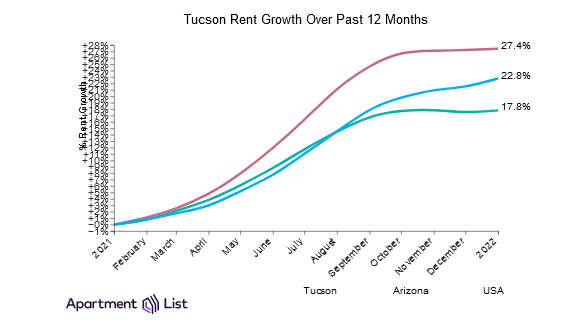
Tucson rents have increased 1.0% over the past month, and have increased sharply by 22.8% in comparison to the same time last year. Currently, median rents in Tucson stand at $1,021 for a one-bedroom apartment and $1,365 for a two-bedroom. The city’s rents have been increasing for 20 straight months – the last time rents declined was in May 2020. Tucson’s year-over-year rent growth lags the state average of 27.4%, but exceeds the national average of 17.8%.

Rents rising across cities in Arizona

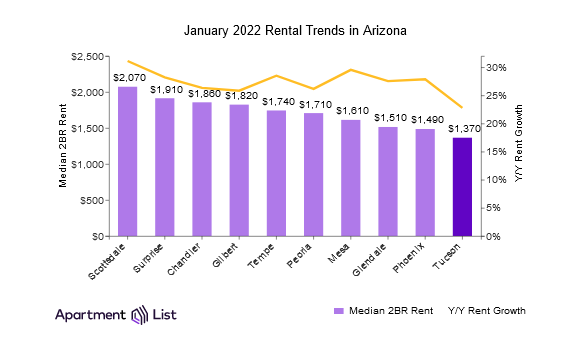
Throughout the past year, rent increases have been occurring not just in the city of Tucson, but across the entire state. Of the largest 10 cities that we have data for in Arizona, all of them have seen prices rise. The state as a whole logged rent growth of 27.4% over the past year. Here’s a look at how rents compare across some of the largest cities in the state.

  • Looking throughout the state, Scottsdale is the most expensive of all Arizona’s major cities, with a median two-bedroom rent of $2,073; of the 10 largest Arizona cities that we have data for, all have seen rents rise year-over-year, with Scottsdale experiencing the fastest growth (+31.1%).
  • Mesa, Tempe, and Surprise have all experienced year-over-year growth above the state average (29.5%, 28.5%, and 28.2%, respectively).

Tucson rents more affordable than many similar cities nationwide

As rents have increased sharply in Tucson, a few other large cities nationwide have seen rents grow more modestly. Tucson is still more affordable than most comparable cities across the country.

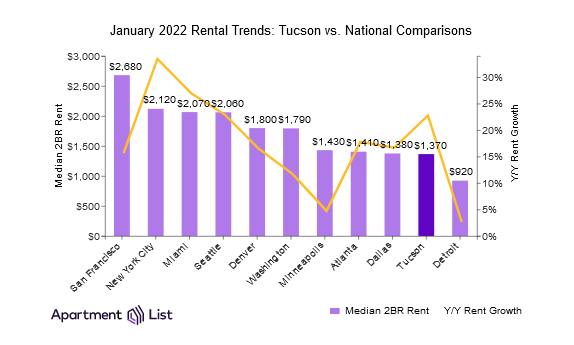
  • Tucson’s median two-bedroom rent of $1,365 is above the national average of $1,285. Nationwide, rents have grown by 17.8% over the past year compared to the 22.8% increase in Tucson.
  • While Tucson’s rents rose sharply over the past year, many cities nationwide also saw increases, including New York City (+33.5%), Miami (+27.0%), and Seattle (+22.9%).
  • Renters will find more reasonable prices in Tucson than most similar cities. For example, San Francisco has a median 2BR rent of $2,681, which is nearly twice the price in Tucson.

For more information check out our national report. You can also access our full data for cities and counties across the U.S.

Methodology – Recent Updates:

Data from private listing sites, including our own, tends to skew toward luxury apartments, which introduces sample bias when estimates are calculated directly from these listings. To address these limitations, we’ve recently made major updates to our methodology, which we believe have greatly improved the accuracy and reliability of our estimates.

Read more about our new methodology below, or see a more detailed post about the methodology on our blog.

Methodology:

Apartment List is committed to making our rent estimates the best and most accurate available. To do this, we start with reliable median rent statistics from the Census Bureau, then extrapolate them forward to the current month using a growth rate calculated from our listing data. In doing so, we use a same-unit analysis similar to Case-Shiller’s approach, comparing only units that are available across both time periods to provide an accurate picture of rent growth in cities across the country.

Our approach corrects for the sample bias inherent in other private sources, producing results that are much closer to statistics published by the Census Bureau and HUD. Our methodology also allows us to construct a picture of rent growth over an extended period of time, with estimates that are updated each month.

Read more about our methodology.