Top deals of 2021 by LevRose CRE professionals show a diverse mix of assets, total almost $70M
SCOTTSDALE, ARIZONA – The Metro Phoenix commercial real estate market remained vibrant in 2021 for LevRose CRE professionals, whose top 5 sales deals alone fetched more than $69 million.

“We were not only excited to see a diverse mix of our top sales and leases (office, retail, industrial and land), but we were thrilled to have so many different teams at LevRose with such a strong 2021,” said LevRose Managing Director Mike Baumgardner.

“This mirrors the incredible transaction volume last year in the Valley’s commercial real estate market,” added Jon Rosenberg, Co-Founder/Managing Partner at LevRose. “It is further proof that investors are active, local businesses are growing and new companies are planting their flag in Metro Phoenix.”

A look at top LevRose deals of 2021

Industrial

Landon McKernan and Marty Maier facilitated the $24 million sale of a multi-building portfolio at 6111, 6121, 6131, and 6215 W. Van Buren St., in Phoenix. The buyer was Nicola Wealth Real Estate Acquisitions Ltd.

The project totals 161,800 SF and features clean distribution facilities with ample parking and proximity to the Valley’s major freeways.

Office

Keri Davies, Jason Reddington, and Jon Rosenberg represented the buyer in the $15.9 million purchase of 14301 N. 87th St., in Scottsdale. The highly-visible, 76,565 SF, multi-tenant office building is located on the SW corner of Raintree and Loop 101 in North Scottsdale. The buyer was SPB Property, LLC; the seller was Double Anchor Investments, LLC.

Industrial

Michael Waxman, Aaron Norwood, and Foster Bundy represented the tenant, Bay Logistics, in the long-term lease for 76,189 SF at 291 E. Buckeye Road, in Phoenix. The tenant, a distribution and logistics company, was in need of high-quality commercial refrigeration space.

The property was recently renovated to include an Alta Refrigeration System, which allows for multiple temperature ranges. The building is part of a larger industrial park including 4 other buildings.

Land

Anna Sepic and Gunnar Sinnett represented the out-of-state buyer in the $11.7 million off-market acquisition of 701 N. Central Ave., in Downtown Phoenix, currently a parking lot. The property totals .93 acres (40,508 SF) of DTC-GTWY zoned land. The buyer was 701 N. Central Owner, LLC; the seller was Central Fillmore Dev 1, LLC.

Office

Michael Waxman and Foster Bundy represented the seller, WYAZ Investments, LLC in the $8.86 million sale of Cooper Crossing, 1800-1850 E. Ray Road in Chandler, Arizona. The buyer was 1800 E. Ray Expansive LLC.

Built in 2006, Cooper Crossing is a two-story office property totaling 54,639 SF. Amenities include a conferencing facility, fitness center, and outdoor seating in a courtyard. The asset is located in the much sought-after Southeast Valley submarket.

Flex/hangar building and land

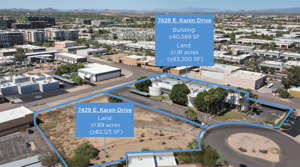
The Kottler/Cosgrove team (Zak Kottler, Joe Cosgrove, Hunter Chasse, and Aaron Cook) represented the seller, Chaplin Family Enterprises, in the $8.775 million disposition of a Scottsdale Airpark portfolio comprised of a ±40,589 SF flex/hangar building plus an adjacent ±1.89 acres (±82,123 SF) of vacant land.

The property at 7428 and 7429 E. Karen Drive in Scottsdale is situated in the heart of the amenity-rich Scottsdale Airpark and is one the largest sites sitting on the Scottsdale Airport Taxiway.

The existing building at 7428 E. Karen Drive previously served for many years as the corporate headquarters for Hi-Health, which has since fully vacated the property. The new owner intends to renovate and occupy the existing building while developing the vacant land at a later time.

PHOTO: 7428 & 7429 E Karen Drive, Scottsdale


HelloFresh subsidiary Factor signs full-building lease in Phoenix market expansion – Brings 800 Jobs

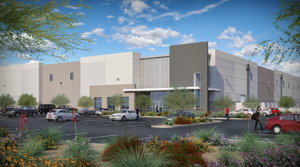
Commits to 300,100 s.f. at Baker Development and capital partner GTIS’s Yuma|143 industrial project in Goodyear, Arizona to fuel brand’s future growth plans

GOODYEAR, Arizona – The Phoenix office of JLL has completed a 300,100-square-foot lease to HelloFresh’s subsidiary Factor, America’s leading fully prepared meal delivery service. The lease is at Yuma|143, a still-under-construction, Class A, two-building industrial project being co-developed in Goodyear, Arizona by Chicago-based Baker Development Corporation (BDC) and New York’s Foundation Capital Partners (FCP), along with capital partner GTIS Partners.

The lease marks the second recent metro Phoenix industrial commitment by HelloFresh, the world’s largest meal-kit company, which operates in 16 markets across the globe. Factor will use the building as a regional packaging and production center, and expects to begin operation in Q4 2022. This new facility will fuel the next phase of Factor’s growth to serve new and existing customers in the West and Midwest regions.The new production center is expected to generate approximately 800 or more new local jobs once fully operational.

“The City of Goodyear is very pleased to welcome Factor. We are glad they have chosen to locate their new facility in our growing community,” said Goodyear Mayor Joe Pizzillo. “Factor’s fully prepared healthy meals contribute to the health and wellness of their customers across the U.S. and this great addition to Goodyear provides new employment opportunities and continues to grow our economy, offering an enhanced quality of life for our residents.”

“We’re excited to be increasing our production capabilities in Arizona as we continue to grow Factor,” said Mike Apostal, CEO of Factor. “The new Goodyear facility accommodates the increasing demand for Factor, providing new and existing customers with fresh, healthy and convenient ready-to-eat meal solutions.”

The new Factor building will sit at 14170 W. Yuma Rd., between Litchfield and Bullard roads. It is being developed in tandem with an adjacent, fully speculative, 190,000-square-foot Class A industrial building. Both buildings are slated for completion by BDC in early Q1 2022. They sit immediately north of Phoenix Goodyear Airport and within two miles of Interstate 10, placing them within a 30-minute drive of 1.7 million residents and approximately 5 to 6 hours from the ports of Southern California.

“Goodyear has proven itself as a logistics frontrunner and is quickly becoming a light manufacturing hub, ranking as the ninth fastest growing city in the U.S. and the number two-ranked U.S. workforce market,” said Baker Development Corporation’s Principal Daniel Slack. “The city’s geographic, regulatory and demographic advantages are what encouraged us to build two best-in-class projects here, totaling approximately 1 million square feet. These attributes, when coupled with market forces such as re-shoring and supply chain disruptions, will continue to attract leading tenants like Factor. We welcome HelloFresh and Factor to Yuma|143.”

“GTIS is delighted to partner with Baker, the City of Goodyear and Factor on this exciting project,” said Stephen Tanenbaum, Managing Director at GTIS Partners. “Phoenix is a key target market for GTIS right now due to its impressive demographic growth and business-friendly climate. Yuma|143 also marks our second investment in an Opportunity Zone in the Phoenix metropolitan area and our fifteenth investment overall since inception of the firm.”

Yuma|143 is BDC’s fourth major Phoenix-area industrial development. It is preceded by VB|143, a $46 million, 325,000-square-foot Class A industrial project also located in Goodyear and also co-developed with FCP. In May, BDC purchased 28 acres just northeast of Sky Harbor Airport in Phoenix for Park 52, a $100 million+ industrial park featuring 350,000 square feet targeting the last-mile/e-commerce user. In June, it purchased 81 acres in Surprise, Arizona for Cactus 303, a $150 million industrial park slated for 1 million square feet and six Class A buildings fronting the Loop 303, and complimented by approximately 16 acres of retail along the Cactus Road frontage.

HelloFresh was represented in its lease negotiations by JLL Managing Directors Marc Hertzberg and Anthony Lydon, Executive Managing Director Adam Citron and Associate Kelly Royle. JLL’s Hertzberg, Lydon and Senior Executive Vice President Riley Gilbert represented the building owner, a joint venture controlled by BDC and FCP.

“This was the perfect scenario – a Class A building under construction that allows Factor to complete process-specific modifications and a cold storage retrofit to meet their exact food-grade needs,” said Hertzberg. “It is a prime logistics location with an abundance of labor that will solidify their regional supply chain platform.”

Yuma|143 is located within the Goodyear Gateway South master-planned industrial park, surrounded by corporate neighbors such as FedEx, Quetico, Chewy and UPS. It offers Foreign Trade Zone / Magnet status, allowing up to a 72 percent reduction in real and personal property tax.

Factor is slated for move-in at Yuma|143 during Spring 2022.


BIG Lots Plans to add 500 New Stores

Detailing its long term ambitions, discounter Big Lots said that it could open 500 net stores, or more, in the coming years. The retailer plans to add more than 50 net new stores in 2022 and more than 80 per year after that, according to an investor presentation. The openings, together with initiatives to boost merchandise sales productivity and grow e-commerce, are aimed at bringing the retailer’s sales to $8 billion to $10 billion in the long term.

Discounters have by and large missed the memo on brick-and-mortar retrenchment. Through years of bankruptcies, store closures, mall struggles and talk of a “retail apocalypse” sparked by e-commerce, off-pricers, dollar stores and others have steadily expanded their presence in the U.S.

Similar to off-price retailers like TJX Cos., Ross Stores and Burlington, Big Lots relies on the “treasure hunt” approach to retail to drive consumers to its stores and keep them coming back, looking for deals and surprise finds.

Unlike those players, Big Lots has a wide category assortment that includes food and consumables — which make up about a quarter of its sales — along with furniture, home goods, apparel, electronics and seasonal products.

Also unlike off-pricers, Big Lots emphasizes digital and omnichannel growth in its ambitions. Its e-commerce penetration stands at more than 5%, according to its recent presentation. That is a much smaller share than some retailers, but outpaces off-pricers such as Burlington, which about two years ago shut down its e-commerce operations.

That relative indifference to the e-commerce revolution can be explained by economics, as well as a simple lack of necessity. Given the consistent and significant sales growth at off-price stores over recent years — disrupted, notably, by the pandemic — it’s clear that their shoppers still go to their physical stores, for the prices and for the treasure hunt.

Going forward, Big Lots wants to turn its e-commerce arm into a $1 billion sales channel and aims for digital penetration of 10% to 15%. But its plans to add hundreds of new stores — after a decade of flat store count — shows that the physical store is just as relevant as ever for the retailer. The company estimates that the store growth could add up to $2 billion in sales.

For all its long-term ambition, Big Lots has several near-term challenges to contend with. Since the beginning of the month, Big Lots has experienced “softening of traffic and sales trends which it believes, in addition to adverse weather conditions, has been significantly driven by the rapid spread of the Omicron strain of Covid-19 and its impact on consumer behavior,” the company said in a press release. As a result, it expects comps to come in below expectations and to take a hit on earnings.

Aside from the recent surge in COVID-19, Telsey Advisory Group analysts led by Joe Feldman said in a research note that “Big Lots’ performance remains clouded by significantly higher supply chain and freight pressures, which are likely to continue well into 2022, and the consumer spending environment uncertainty as we lap the US government stimulus in 1H22.”

The retailer posted operating and net losses of more than $4 million in the third quarter. On a December call with analysts, Big Lots CEO Bruce Thorn cited fading stimulus, supply chain disruption, inflation and labor constraints as all playing a role in the company’s performance.

Full article HERE.