Growth & Reductions for some National Retailers
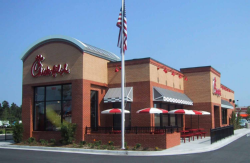
Chick-fil-A-exterior-lgRestaurant chain Chick-fil-A  plans to open 102 new locations across the country in 2013, including 78 stand-alone, one drive thru, four in-line and two mall restaurants to go along with 17 licensed locations. The company continued to grow in 2012, increasing the number of new restaurants initially planned for the year and reporting a record-setting annual sales of more then $4.6 billion in 2012.

Whole Foods says it plans to take “a good hard look” at parts of the Fresh & Easy chain that British retailer Tesco is divesting in California. Bolstered by healthy cash flow and no debt, the organic grocer plans to introduce 32 new stores during fiscal 2013 and an additional 33 to 38 units the following year. Tesco has announced that it intends to leave the US market and abandon the Fresh & Easy Neighborhood concept that has been losing money. The future of these 200 grocery stores remains in limbo, with lots of interest from potential buyers.

As the housing market begins to take hold, home improvement chains are again experiencing positive store sales growth and returning to expansion.  During the recession, comparable store sales from Home Depot and Lowe’s posted declines that peaked in 2008 and spurred the closing of a combined 105 locations between 2009 and 2012. Since then store sales have steadily improved and regained positive territory during 2010, a 2.9% sales increase for Home Depot and  1.3% growth for Lowe’s. In fiscal year 2012 growth improved to 4.6% for Home Depot and 1.4% for Lowe’s. Although Lowe’s has added more stores over the past two years, Home Depot remains the growth leader.

Lowe’s will continue to add new stores at a more measured pace in the near-term, remaining cautiously optimistic about the recent housing recovery. The home improvement chain introduced 10 new locations in 2012 and projects a similar number for the current year. Lowe’s expansion strategy is focused on under-penetrated urban markets where it believes it can take advantage of favorable site costs , reasonable municipal requirements, and attractive returns on investment.

Office supply chain Staples announced it will more aggressively trim its North American store base than previously projected. The company reported that it is on target for a reduction of 40 stores in 2013, compared to its earlier expectation of 30 stores.

Electronics retailer Best Buy has highlighted several priorities in its turnaround efforts, including accelerating online growth and optimizing its US real estate portfolio. The company closed 47 stores, while opening 105 Best Buy Mobile standalone units during 2012. Occupancy cost reductions continue to be a key focus for the company and it says it has made significant progress renegotiating leases. Additionally Best Buy will reduce space allocated to the negative growth and low margin CD and DVD categories while replacing it with higher grossing products like mobile, appliances, and accessories. The retailer plans to close an additional five to ten US Best Buy locations and open a small number of mobile units in 2013.


Sponsored by Stewart Title and Trust – The only title company named one of

 “AMERICA‘S MOST TRUSTWORTHY COMPANIES” in 2012 by Forbes®.

Contact Stewart Title & Trust of Tucson at (520) 327-7373 for your next closing.


Homeowners: FHA Changed The Rules on June 3rd

FHAstampFor the seventh time in 5 years, the Federal Housing Administration (FHA) raised its mortgage insurance premium (MIP) schedule for FHA-insured borrowers on April 1, 2013. As of June 3, HUD revised the FHA minimum time a borrower must hold mortgage insurance and rescinded the automatic cancellation of annual MIP.

FHA was a critical player during the housing bust, increasing eligible loan amounts to take the slack left by private mortgage insurance providers (PMI) that tightened guidelines so much they became unreliable for borrowers with less than 20% down. But lending during the bust, while helpful in preventing an even worse economic outcome, left the FHA short on reserves.

By 2010, the FHA’s Mutual Mortgage Insurance (MMI) account had dropped below $2 for every $100 insured, which was a violation of the agency’s congressional mandate. Through 2011, the losses continued and in 2012 the FHA showed a negative $1.44 for every $100 insured.

For this reason they are increased mortgage insurance fees April 1st and the length of time a borrower must pay them on June 3rd.

While this up-trend has been going on since 2010, when the annual premium was .55% to.6% of the loan amount, paid monthly. Compare that to the latest change with rate ranges up to 1.3% to 1.55%. In other words, on a 10% down scenario for a $500,000 loan today, the monthly mortgage insurance has increased to $542.

Going forward, on and after June 3, 2013, the FHA removed the exemption from annual MIP for loans with terms of 15 years or less and LTVs of less than or equal to 78% at origination. For everyone else with a LTV greater than 90%, including those making a 3.5% down payment, the FHA will assess MIP for the duration of the loan’s term, or the first 30 years of the term, whichever comes first.

For streamline refinances without appraisals, FHA uses the original appraised value of the property to calculate the LTV.

These new rules give the FHA more padding, but they remove the option and incentive for a borrower to pay extra to eliminate the mortgage insurance sooner.

Prior to this, if a borrower paid their normal mortgage payment (without making any extra principal payments), they would be able to eliminate their mortgage insurance in about 6 years—and if they wanted to do it more aggressively they could pay a bit extra to knock it out in 5 years.

With these new rates and terms, we may see the pendulum swing away from FHA and back toward private mortgage insurance (PMI) providers. The PMI companies have eased approval guidelines a bit as the recovery trudges on, and their fees are definitely less, with rates ranging from .64% to 1.02% depending on credit score (or $267/mo compared to $425 on that same $500,000 loan example used above). But their approval guidelines are more stringent than FHA.

So from here out borrowers will need to look at both options.


Retail M&As in the News

M&AFoot Locker announced that it will buy Runners Point Warenhandelsges, a German athletic store chain with more than 200 stores for approximately $94 million as it expands in Europe.

Sears Holdings has formed a new unit to market space from Sears and Kmart stores for data centers, disaster recovery space and wireless towers. Ubiquity Critical Environments was created in and attempt to reposition its assets. The retailer operates about 3,200 properties totaling 25 million-square-feet, that includes dozens of Sears and Kmart locations that have been closed over the past few years. Although mall based locations are not viable for data center usage, the company believes they are ideal for disaster recovery centers. The company believes that wireless towers present the most promising opportunity with 70% of the US population living within 10 miles of a Sears or a Kmart store.

TowerBrook Capital Partners has agreed to purchase True Religion Apparel in a deal valued at approximately $835 million. The upscale jeans and sportswear products are sold in department stores and specialty stores around the globe and also operates more than 120 stores in the US and more than 30 international locations. In 1Q 2013, total net sale increased 13.1% to $120.8 million.

Apax Partners and private equity firm, also based in London, has offered $1.1 billion for the PA-based retailer, rue21, a teen clothing retailer.  The retailer plans to open its 1,000th  location this year with sales in excess of $1 billion. The company also plans to launch an e-commerce platform in early 2014. Apax has been an investor in rue21 since 1998 and was majority owner then the retailer went public in 2009.

Upscale department store operator Saks has reportedly hired Goldman Sachs Group to explore alternative including a possible sale of the company and possibly a merger with Neiman Marcus, which also has been exploring a sale or public offering. The two companies have explored a merger in the past in the hopes of gaining more leverage with vendors. Nieman Marcus is stronger in Texas and parts of California, while Saks has its stronghold in New   York and Palm Beach. However, the two retailers do overlap in many locations prompting the risk of cannibalization.


Sponsored by Stewart Title and Trust – The only title company named one of

 “AMERICA‘S MOST TRUSTWORTHY COMPANIES” in 2012 by Forbes®.

Contact Stewart Title & Trust of Tucson at (520) 327-7373  for your next closing.